General Information:
Height/Length: Large
Weight: 7-20 lbs.
Life Span: 12-17 years
Coloring: White with markings on head and tail.
Area of Origin: Turkey
Similar Breeds: Turkish Angora, Persians, Maine Coons, Cornish Rex
Breed History and Origins:
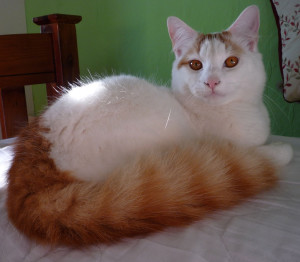 The Turkish Van is a rare and ancient natural breed that developed in the region of central and southwest Asia, which now comprises of Iran, Iraq, southwest Soviet Union and eastern Turkey. Actually, the term “Van” is common for the whole region and has been added to several towns, villages, and even a lake, which resulted in the naming of the cat native to the region as “Van cat” by the locals. This breed most likely existed in its homeland for centuries. It is thought that the Turkish Van cat originated more specifically in the Lake Van area of Turkey.
It is said that the mountainous and rough, rugged landscape along with the cold temperatures of the region contributed in the development of the Turkish Van breed. Turkish people narrate the legend that this cat swam ashore from Noah’s ark, which tradition says landed on Mount Ararat in Turkey, not far from Lake Van.
In regards to their coat color, both Jewish and Islamic religions tell that the cats received a divine touch that gave color to their formerly white coat. On the ark, a door closed on the cat’s tail, making it red. And finally, that God reached out and touched this cat’s head, leaving a spot where his hand rested. The Islamic version says that Allah touched the cat on its back and the spot that is sometimes seen there on a Turkish Van is called the thumbprint of Allah.
Their rich history made the Turkish Van cats very popular and many of Turkey’s invaders and visitors would keep these cats as souvenirs in the past millennium. The breed was first brought into Europe from the Middle East by returning crusaders, and has been known by a variety of names over time, such as the white ring-tail and the Russian longhair.
When they were brought to England in 1955, they were known as the Turkish cats, but was later changed to Turkish Van to avoid confusion with the Turkish Angora. Although the breed has an ancient descent, the Turkish Van is a relatively new to the United States and very rare. Some historians claim that they arrived in the 70’s, but other state that it was in 1982. The International Cat Association (TICA) recognized the breed for championship status in 1985, and the American Cat Fanciers Association (ACFA) began registering it in 1988.
In their homeland, these cats are considered regional treasures and are not easily available for export to other countries. Their preservation is overseen by the Turkish College of Agriculture and the Ankara Zoo. Even in their homeland, where they have been known for centuries, these cats are still rare.
Size and Physical Characteristics:
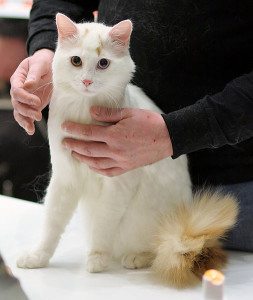 The Turkish Van is a large and powerful cat. It is a natural breed, which means that there was no human intervention in their development. Males will weigh between 9-20 pounds and females between 7-12 pounds. It takes Turkish Van cats 3 to 5 years to fully mature.
This breed is incredibly strong and active. They have well-muscled and heavy hindquarters, a moderately long body and tail, and broad shoulders with a short neck. Turkish Van cats have a wedge-shaped head and a rounded muzzle. Many people consider these cats as the jocks of the cat world. They are built like athletes and will be active cats throughout their lifespan. They even enjoy swimming!
Turkish Van cats have large ears when they are kittens. Their facial features display a straight and Asian-like nose with high cheekbones and really bright eyes. Often, Van cats will show odd eye colors, one blue and one amber. This feature is expected in their home country, and individuals with odd eyes are highly sought after. Their eyes can also be amber or blue, although blue individuals will tend to be deaf.
Their coat is semi-long and lies flat on the body without the presence of an undercoat. Its texture is cashmere-like which helps prevent matting and makes it water repellent as well. As the cat matures, their coat grows more and more lush. They have a longer and a shorter coat depending on the season. Their tail is elegantly plumed and doesn’t shed like the rest of the body does with the seasons. Their ears are always feathered with fur as well.
The coat and coloring is what distinguishes the Turkish Van cats from others. It is said that this breed is the original one to carry the piebald gene, which results in a white, semi-longhaired cat with colored markings specifically on the head and tail. Thanks to this breed, their pattern has been dubbed “Van pattern” to describe other breeds that display it. Their coloring is specifically a chalk white color all over with patches of color. Scientifically though, the cat is actually colored with large patches of white, thanks to the piebald spotting gene. They may display some random spots of color on the back and legs awe well.
Turkish Van color now include red, cream, black, blue; tabby in red, cream, brown and blue, and varying shades of tortoiseshell.
Personality and Temperament:
The powerful and intelligent Turkish Van is a popular cat in its home country, and is highly regarded in many other countries as well for being very social and affectionate. This cat becomes strongly attached to his family member and will tend to choose one or two as its favorites. Turkish Van cats are very athletic and will remain active and playful into their senior years. Despite their athleticism, they might not always be graceful since they’re so large and bulky, and might not always land on their feet.
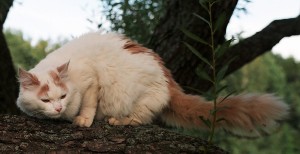
Turkish Van
These cats are highly intelligent and love learning tricks and playing fetch. All Turkish Vans will fetch instinctively. They especially love interactive toys that allow them to mimic pouncing on prey. You must be careful not to set decorative items in high places because this cat likes to perch up high and tends to either be clumsy or mischievous at times, pushing stuff just to see what happens.
Turkish Van cats love water and especially love playing in it or with it, so be sure to keep toilet seats down, faucets well closed and swimming pools closed. It’s not unusual to find them lying in water or swimming. They are also easy to train and will easily learn how to walk on a leash.
This is not much of a lap cat, and they do not like being held or restrained. They’re very independent and enjoy their freedom of movement. If these cats ever get upset, their pink nose will turn red. Despite this, these cats will be happy to sleep in your bed and cuddle next to you, but on his own terms. He will also show people how they like to be petted.
A Turkish Van that is well socialized will be comfortable with kids, making him a great choice for families. Make sure that the children are educated in respectful ways to handle a cat. They are also happy to live with cat-friendly dogs, as long as they remain in charge. They tend to accept other cats but prefer ones from his same kind.
Nutritional and Exercise needs:
Diet is very important for cats for it will determine overall health. A healthy coat, teeth, body weight and energy level will depend almost completely on what they are fed. Cats generally are carnivores, so a protein based diet is always the best option. One of its primary food sources is fish, so be sure to provide it now and then. The amount fed depends on weight, activity and age. The type of food depends on the owner but make sure to provide quality and enough water if dry kibble is your choice. If their food is canned verify that only a few fillers are added.
When cats are indoors most of the time, they might not get enough exercise. Despite this, Turkish Van cats are active. Make sure they have plenty to space to pounce, run and play. Cat trees and scratching posts can be used for this purpose. Cat jungle gyms can be bought at a local pet store or you could build one yourself!
Grooming and Upkeep:
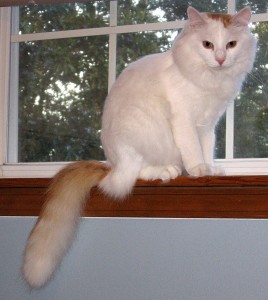 The Turkish Van breed has a unique single coat that does not lend itself to matting, so they require little grooming. It’s easy to groom with weekly combing or brushing with a slicker brush. It sheds very little except during spring and fall when old coat is falling out or new coat is coming in. The Turkish Van‘s coat is water-resistant, so baths are rarely necessary. They’ll probably take a dive by themselves!
Nail trimming and ear cleaning is required regularly. Teeth brushing at home with an appropriate pet toothpaste, and scheduling veterinary dental cleanings is sometimes necessary. The earlier you began to brush, trim its nails and brush its teeth, the better your kitten will start to accept these activities. Also keep in mind to provide a clean litter box.
Characteristics unique to the breed:
This fun and loving breed is ideal for cat aficionados. Along with their rich history, these cats are perfect companions that love to play but aren’t too needy. They’re always amusing with their clumsiness and antics with water. They also love pouncing and fetching, so children will never be bored with these cats!
| Advantages | Challenges |
| Require little maintenance | Moderate shedding |
| Generally very healthy | Not hypoallergenic |
| Very intelligent | Sometimes clumsy and mischievous |
| Affectionate | |
| Very playful |
Health and Wellness:
Turkish Van cats evolved naturally, with no human intervention, therefore they are a very healthy breed. One exception is the all-white Van (Turkish Vankedisi) with no color at all, which is prone to deafness or a degree of hearing loss. This is a common defect with many all-white animals. In Britain, most Turkish Vankedisi are crossed with a Turkish Van so as to minimize any hearing disorders. Some cats have been reported to develop a form of heart disease called hypertrophic cardiomyopathy, but it has not been determined if it is hereditary or not.
The Van may or may not be a good traveler. Trips to the veterinarian often involve the cat vomiting, or bathroom accidents in the car. It’s important to ask the breeder if cats in that line are prone to carsickness.
Annual exams, vaccinations, heartworm prevention and flea and tick preventions are recommended. Initially make sure to deworm your cat and run basic blood tests as early diagnosis is always the best. Keep in mind that a good diet and regular exercise is always the best prevention.
Being a pet, it is somewhat common for them to suffer some types of eye problems, diarrhea and fleas. These cats are not hypoallergenic and may affect people with cat allergies that come in contact with this breed. Be sure to consult a veterinarian of your choice for routine care and medical advice for your furry friend.
Interesting Facts about the breed:
- Turkish Van cats love water and in their native region they have been named “the Swimming Cats.”
- They are highly cherished in Turkey and there are strict exporting laws to protect them.
- This breed actually has an Islamic and Jewish legend to explain its origin and colored pattern.
- Some individuals have odd-eye coloration, one blue and one amber, which makes them very prized and sought after.