Welcome to our Turkish Angora Cats page! Here you will find everything you could ever want to know about Turkish Angora cats and a complete list of all the Turkish Angora catteries we have located in the USA.
Turkish Angoras are one of the most affectionate and outgoing breeds. This beautiful and rare cat has an amazing history and is considered a national treasure in Turkey. This is a naturally developed breed that has existed in Turkey for hundreds of years. Turkish Angoras are thought of as white cats with green or blue eyes, but they actually come in different colors and color combinations, including calico, tortoiseshell, and tabby.
Turkish Angora Cat Breeders Near You

Turkish Angora
- Are you a cat breeder who isn’t listed? Add your information here.
We also highly recommend reading checking out our latest news articles at our blog. Find information on cat health, nutrition, holistic healing, basic care, toys, and much more!
Turkish Angora Cat Breed Information
 The Turkish Angora breed should not be confused with the Oriental Longhair breed, which was previously known as Angora. Neither should these cats be confused with the Turkish Vankedisi and Turkish Van, which are two totally different breeds.
Today, Turkish Angoras thrive in homes around the world, admired for their regal appearance and vivacious, playful personality.
The lovely personality of this breed makes these cats perfect companions for every family. They are playful, patient, and extremely adaptable, so they are a great choice for seniors and families with young children. Finely-boned and elegant, the Turkish Angora often acts as the energetic and graceful host, welcoming every visitor into the home.
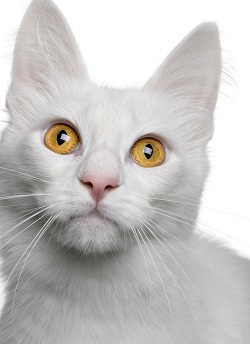
Regal, refined, and poised, Turkish Angoras, with their long, fine, silky coat, elegant body, large eyes, and pointed ears, are one of the most beautiful breeds. They have a medium-sized body with firm musculature and fine boning. Though strong, they are very graceful and elegant.
General Information:
Height/Length: medium
Weight: 5-10 pounds
Lifespan: 13 -20 years
Coloring: many colors
Area of Origin: Turkey
Similar Breeds: Persian, Turkish Van, Somali, Oriental Longhair
Breed History and Origins:
 There are several theories regarding the origins of this breed. One theory says that the longhaired Pallas, an Asian wildcat, is the ancestor of the Angora, but this theory is unlikely to be valid because Pallas cats are aggressive and wild, while Angoras are affectionate and loveable. Another theory suggests that this breed originated from the African wildcat.
Turkish Angora comes from Ankara, Turkey (formerly known as Angora). Many cat breeds with long, silky coats originate from there, and it is believed that the Angoras acquired their longhaired characteristics from mutations that happened centuries ago. There are also many legends associated with this breed, including one story of Mohammed, the founder of the Islamic faith, cutting off his sleeve because he did not want to disturb his Angora cat sleeping in his arms.
In the late 1500s, Turkish Angoras were sent to France and Britain from Turkey, Russia, Persia, and Afghanistan. In the late 1700s, Angoras were introduced to America and gathered fanfare in no time. Unfortunately, the Persian cat’s arrival decreased the popularity of the Angoras. These two breeds were crossed so that the Angora’s coat could be longer and silkier. The offspring from this crossing more closely resembled the Persian cat, causing the Angora breed to lose its breed purity. In the 1900s, the Turkish people and government began a breeding program in order to protect and preserve this wonderful breed.
To this very day, it is almost impossible to acquire a white Turkish Angora from Turkey, as they can only be found in the homes of breeders or at the zoo. Even in Turkey, the number of people who own Angora is small. In 1962, Liesa F. Grant first imported two Turkish Angoras from Turkey to America, along with their ancestry certificates. Other Americans imported several Angoras to the U.S. Although the number of imported cats was small, with diligent and smart work of the Angora cat fanciers, the breed grew and granted a registration status with the CFA in 1968.
Size and Physical Characteristics:
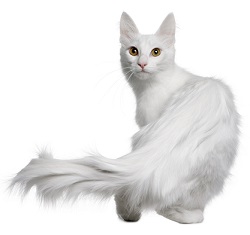
The Turkish Angora is a finely-boned, muscular cat of a medium size. All Angoras are graceful and elegant, yet athletic-looking. Long is the adjective that best describes these cats: they have a long body, long legs, long coat, long tail, wide eyes and large ears.
Their coat shimmers when they move. It is single-layered, which makes them easy to groom. The length of their coat depends on the season: in the warm months, it has a shorthair appearance, while in the cold months, their coat is longer and thicker and the mane, britches, and tail fluff up fully. Their coat never mats, unlike the Persian’s; both are longhaired cats, but Persians have a top coat and woolly undercoat prone to matting.
White Angoras have been the norm for this breed, but other colors are becoming increasingly popular. All colors are accepted, except those that show hybridization: chocolate, lavender, pointed pattern, or the combination of each with white.
| The Turkish Angora | |
| Head: | Medium long head in a smooth wedge shape |
| Coat: | Semi-longhaired soft, silky coat that rarely mats |
| Adult Weight: | 5-10 pounds: females weigh 5-8 pounds; males weigh 7-10 pounds |
| Size/Shape: | Medium in size with a svelte, well-balanced, long body |
| Legs: | Long legs ending in small, round paws |
| Tail: | Long tail tapering from a wide base to narrow end with a full brush |
| Voice: | Talkative |
The head is wedge-shaped, small to medium in size and is always in balance with the body. The nose has no break, while the ears are vertical, large and wide at the base, always erect and pointed. The eyes are large and almond-shaped. The color of the eyes is unrelated to the color of the coat. As the cat matures, the color of the eyes changes. Acceptable eyes colors include green, blue, green-gold, amber, and odd eyes (one eye one color, one eye another).
The length of the fur varies, but the tail’s hair is full, long with a silk-like sheen.
Personality and Temperament:
 Turkish Angoras are playful, athletic, and intelligent, and like to be involved in everything that happens around the house. They usually bond with every family member, but tend to pick a particular member of the family to be their favorite. They are protective of their person, which is a unique feature in this breed.
Not only are they intelligent, but they are also extremely adaptable to new surroundings. They easily accept dogs and other pets, but their assertive temperament makes them the “alpha” of the household.
Although they look delicate and slender, they have a body of solid muscle, so they stay in shape by exercising their hunting instincts, and thus often “chase” their toys around. They are very agile and can be found in high places from which they can observe every activity in the household. These high places usually include bookshelves, tops of doors, and other furniture. They may even ride on their favorite person’s shoulders.
They do not like to be ignored and will do anything to make their owner pay attention to them. They are not happy unless they are in the middle of whatever their owners are doing. Although they are good-natured, they can be very stubborn.
When in movement, which is quite often, they will flow with the elegance and grace of ballerinas. They do not like to be held for more than just a few minutes at a time. Highly intelligent, they will tolerate being held for a short period of time before jumping down to chase feathers or bat at sunbeams. However, they do prefer to stay close to their owner.
Angoras love to talk. Owners are advised to listen what their Angora has to say; the fluffy ballerina might be asking for a dance.
Nutritional and Exercise Needs:
Turkish Angoras and Nutrition
Angoras are lively cats and that is why they require rich diet. The average suggested daily food intake for females is 300 kcal/day, while for males is 400 kcal/day. Needless to say, this varies based on the Angora’s lifestyle and weight.
Turkish Angoras must follow a well-balanced and healthy diet in order to maintain their silky fur and their high energy levels, as well as to be protected against obesity. There are many cat meal products on the market that provide the needed vitamins and minerals that nourish their coat and skin and promote the hair shaft renewal. Most of the foods include a mix of different types of fibers that help the cat facilitate the elimination of swallowed hair. Furthermore, these foods fortify the immune system of the Angoras, while protecting them against obesity and boosting their levels of energy. One meal of canned and one meal of dry food each day and limiting the temptation treats to two or three a day is what vets recommend.
 Turkish Angoras and exercising
Turkish Angoras are super playful. They can jump up to four feet in the air. They also love playing fetch, scaling the tallest of furniture with no problem, and constantly “hunting” their humans, hiding behind furniture or under drapes and jumping out to scare them when they walk by.
They are pretty adventurous. They love water and will sometimes roll around in the sink if the faucet is on. They love when their humans are driving in the car, so they often get mad if their owner runs to the store by themselves.
Angoras turn every task into a fun game. They do not need expensive and luxurious cat toys. All they need is a scratching post and maybe a climbing tree and that is all!
Many people believe that Turkish Angoras are indoor-only pets, but vets advise owners to allow their cat to go outside and have an out-of-the-house exercise a few times a week. All cats like to roam around and play because that lifestyle has been their habit.
Grooming and Upkeep:
Longhaired cats usually require regular grooming, but that is not the case with the Turkish Angora. The silky texture of this breed’s coat makes the grooming procedure significantly easier. However, they do need a timely and proper grooming.
In order to check for rashes, skin problems and loss of hair, owners should massage their cat’s coat from head to tail. The grooming sessions can be done by hand, but they should be groomed by brush twice a week. Brushing should be done very gently and slowly because otherwise it might hurt the cat if there are tangled hairs.
Bathing is another important part of the entire grooming process, but the question here is: how often do Angoras need bathing? Usually, they need a bath once a month. Using a high quality shampoo is highly recommended. Owners should be very careful when washing the nose, eyes and ears. Most Turkish Angoras love water, so the bathing part is easy; owners merely need to wait for the coat to be completely dry to brush it.
Turkish Angoras, as any other breed, are not fans of the cleaning teeth part of grooming. However, cleaning your cat’s teeth is necessary to prevent mouth infection. It should be done every day for a solid three to four minutes with a medicated toothpaste and toothbrush specially designed for cats.
The ears of Angora should be checked regularly because there is danger of mites’ occurrence. If the cat is scratching the ears, she might have mites. Rolling a cotton bud gently inside the outer ear carries all the dirt with it. Consulting a vet is recommended because only a professional can thoroughly clean the ears.
Owners should be extra careful when cutting the Angora’s nails because it might result in bleeding if not done carefully. Owners must make sure they are cutting the nail at a proper distance from the nail’s root.
Characteristics Unique to the Breed:
| Advantages | Challenges |
| Stunning and beautiful cats that come in lovely colors | Can be very stubborn |
| Smart, athletic, playful | Demand a lot of attention |
| Well suited for apartment living | Prone to deafness |
| Affectionate, loves everybody | |
| Easy to groom |
Turkish Angoras are active, athletic cats that want to have something to do all the time. They are perfect for active households. They love to perch in high places where they can see everything. They are easy to train and extremely intelligent. They can be trained to do small tasks, like fetch and other tricks that are common for dogs.
The pure white Turkish Angora with blue eyes can be born deaf, which is not a defect of the breed, but a defect in the dominant W gene that is responsible for producing blue eyes and white coat color in felines. Luckily, deaf cats can still lead a happy life.
Not every Turkish Angora loves water, but many of them will plunge in for a swim.
Health and Wellness:
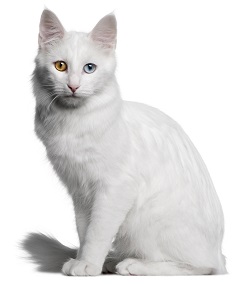 The W gene responsible for blue eyes and white coat is related to the hearing ability, so these Angoras are prone to deafness. Luckily, many white coated, blue-eyed Angoras have normal hearing.
Some Turkish Angoras suffer from hereditary ataxia, which is a condition inherited as an autosomal recessive. Kittens that suffer from this condition have shaking movements. It begins with tremors that can progress rapidly to a total lack of voluntary muscular control.
Hypertrophic cardiomyopathy is another genetic illness that can be found in Angoras. This cardiac condition has not been thoroughly studied in Angoras due to its rarity. The symptoms of this disease can be very subtle. A number of veterinary schools are working to find ways to treat and cure the disease.
Interesting Facts about the Turkish Angora:
- Louis XV, Louis XVI and Marie Antoinette were Turkish Angora lovers.
- Turkish Angoras with blue eyes are prone to deafness.
- Angoras that have one amber eye and one blue eye are usually deaf on the side of the blue eye.
- Turkish Angoras are great swimmers.