Welcome to our Thai Cats page! Here you will find everything you could ever want to know about Thai cats and a complete list of all the Thai catteries we have located in the USA.
Thailand has a long history of producing some of the most popular, ancient, and widely-known breeds. The cats here are revered as lucky symbols and as the pets of choice for royalty. Thailand is home to beautiful breeds of cats with fantastic personalities and distinctive looks. One of these breeds is the Thai breed – a short-coated, medium-sized cat that is originally bred in Thailand.
Thai Cat Breeders Near You

Thai
- Are you a cat breeder who isn’t listed? Add your information here.
We also highly recommend reading checking out our latest news articles at our blog. Find information on cat health, nutrition, holistic healing, basic care, toys, and much more!
Thai Cat Breed Information

When people think of Thailand-native cats, they tend to think of the Siamese. However, there are eight breeds native to Thailand. The most ancient of them is the Thai cat – the cat that formed the foundations of the Siamese breed.
People often refer to this breed as traditional Siamese or old-style Siamese. Nevertheless, regardless of the name, these cats have won over the hearts of many people worldwide. This is because Thai cats are beautiful, affectionate, and very intelligent, and moreover, they are said to live up to 16 years, so owners can expect to spend many years with them.
Although newly classified, the Thai breed is an old one, related to but different from the modern Siamese cat. Cats that were imported from Thailand to Western countries in the late 19th and early 20th centuries had different features than modern Siamese cats.
Thai cats are often vocal, so they always let their humans know when they need something. They are bold, brassy, and big. They come in several colors, and tend to get darker as the years go by, but the color of their eyes never changes; their eyes will always be blue.
General Information:
Height/Length: medium
Weight: 8-15 pounds
Lifespan: 10 -16 years
Coloring: they can be found in any Siamese cat colors
Area of Origin: Thailand
Similar Breeds: Siamese
Breed History and Origins:
The Thai cats are descendant of the Thailand landrace cats, which secure their position in the group of the most ancient native cats. The term “landrace” refers to many things, but in this case, it refers to domesticated, regional ecotype (all life forms) that has adapted locally to form a traditional species that is domesticated, but it has also evolved naturally along with its home region.
The Thai cat is related to the original landrace cat known as the “Moon Diamond” cat or Wichien-maat. These cats were mentioned in ancient books of cat poems. Cat fanciers were impressed with these marten-faced, graceful cats. Unlike some landrace cats, the Wichien-maat can still be found in Thailand, and despite the crossings and diversity of the type that actually led to the advent of the Thai cat that is popular today, the landrace cat has continued to thrive.
In the 1800s, the Wichien-maat was brought to England and was selectively bred and crossed, becoming the breed known today by the name Siamese. Further selective breeding resulted in an angular appearance Siamese – the modern day Siamese that has a distinctive look. This actually explains the relation between the Siamese and the Thai; they are closely related, but have different appearances.
In 1990s, a woman from Germany introduced the Siamese cat that had the classic look of the Old-style Siamese to Europe, and she called the cat “Thai”. She was very dedicated to revitalizing the old look and she was using Siamese bloodlines.
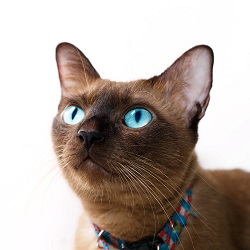 Thai cats today
Today, the Thai breed is widely documented and is still one of the most ancient breeds. However, these cats are only now being registered and classified with the main cat registries, even though some people still think they are not a separate breed. In 2010, the Thai breed was accepted for Championship status by TICA (The International Cat Association).
Thai cats are often outcrossed with the Siamese in order to add genetic diversity to the gene pool of the Siamese breed. This moderate-looking pointed cat has the potential to produce genetically diversified and healthy cats.
Size and Physical Characteristics:
The Thai cat and the modern Siamese share a commonality of distant relatives, the gene for point coloration, and the people-loving, vocal, and outgoing personality. Although very similar, they are distinctive in their appearances. The Thai cat is pointed, has a wedge-shaped head, and when viewed in profile, the forehead is long and flat with no sharp nose break. They do not have a longhair gene, but their coat is short and lies flat.
The Thai is a medium-sized cat with a well-shaped, sturdy body. The breeding of the Thai pedigree has led to a cat with a coat commonly described as sleek, soft, and thin. The extremities are dark-colored – they are known as the “points.”
How to make a difference between the Thai and other shorthaired, pointed breeds? The key to distinguishing these breeds is in the details of their body and head shape.
The Thai is a pointed, shorthaired cat of foreign type with a moderately long body that is subtle, lithe, and substantial, but in no way extreme. The coat is flat and short, loose enough to feel silky and soft. It is not slick and tight, nor does it feel plush.
As for the coat, there are Thai cats of several varieties, but the most popular is the seal point. Other common pointed patterns include chocolate point, red point, lilac point, and blue point.
The trademark, however, is in the unique shape of the head. The round-cheeked head is projecting a wedge-shaped muzzle. The ears are set high on the head and are broad-based.
All in all, the whole appearance of this breed has no extreme features; the body is substantial and long, the boning is medium, the eyes have a deep blue color, and the tail and legs are proportionate to the body.
Personality and Temperament:
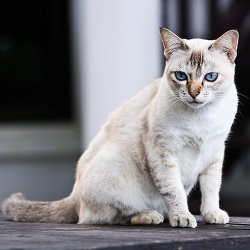 Thai cats do not need much time to get used to a new environment and new people. They start acting normal within just a few days. They love to make new friends and show affection to everyone they meet. Thai cats are very active, people-oriented, and highly intelligent. They are great chatters and talk to their humans in yips and yowls. They are not necessarily loud, but they do like to talk a lot. Living with a cat from this breed is like living with a small kid: they follow their humans around trying to assist and help in everything they do. They even jump on a wall-mounted clock to test their balance.
They are intelligent, inquisitive, fun-loving, and trainable, all of which are typical traits of a dog’s personality. They do great in learning new tricks, especially self-taught tricks like opening doors. Owners have even trained their cats to walk with a harness and leash.
They will greet each family member at the door and start chatting away. They sometimes communicate with paw taps or by jumping to their human’s shoulders. They will need daily attention from their humans. They are easy to maintain when it comes to grooming, but emotionally, Thai cats are high maintenance. They are friendly and cuddly, and they easily win everyone’s affection and love through their irresistible elegance, devotion, and grace.
People who find delicate and thin modern Siamese cats a bit too genteel will definitely love the traditional Siamese cat – the Thai cat. It seems like Thai cats have an endless amount of energy. Not many cats are as active and smart as this breed. Those who want a close companion should look no further – the Thai cat offers a friendship that will deepen as years go by.
Nutritional and Exercise Needs:
Thai cats and nutrition
Of all the carnivores, cats are the most specialized meat eaters. As an active and energetic breed, Thai cats require a well-balanced and good-quality diet in order to stay energized, healthy and fit. Eating either wet or dry food, they rarely tend to overeat. However, owners must monitor their weight to make sure that their kitty will retain its elegant, fine-boned appearance.
Convenience and economy have made dry cat food the most popular product for feeding cats. There is nothing easier than plunking down a bowl of kitty kibble. But is dry food the healthier option?
A cat’s natural diet contains about 70% water. In the wild, cats would be hunting and eating prey, meaning they will eat meat-based food high in moisture and protein with low carbohydrate levels. Dry food contains 35 to 50 percent carbohydrates, while canned food contains 3 to 5 percent carbs and a much higher water content.
Water is the most important nutrient for sustaining normal function of every living creature. Cats do not drink water very often, so the amount of water required for Thai cats is affected by the water content of their food. To prevent dehydration, then, they should be on a diet of canned, wet food. Furthermore, vets recommend owners to place at least two bowls with water around the house, so that the Thai can have access to fresh water at any time.
| The Thai Cat | |
| Head: | Wedge-shaped head; long, flat forehead; and blue eyes |
| Coat: | Short, close-lying, glossy coat in pointed colors |
| Adult Weight: | 8-15 pounds: females and males weigh the same |
| Size/Shape: | Medium size, athletic and muscular |
| Legs: | Long, slim legs |
| Tail: | Long tail, proportionate to the length of the body |
| Voice: | Talkative and vocal |
Thai cats and exercising
These little critters love to play with their humans. Oftentimes, cats are chasing invisible mice, bouncing off the walls, knocking things off tables, carrying around unusual objects, and getting into other kinds of mischief. This behavior is quite normal for a bored, lonely cat that has high levels of energy. This behavior can be prevented by providing interactive games.
The amount of physical activity that an indoor Thai cat requires depends on its age and physical condition. Thai cats require more active play, but do not require luxurious toys. Rope, yarn, ping pong balls, pens, and empty spools are some of the makeshift toys that can be found in every household. For example, Thai cats love when their owners create a hockey rink by putting a ball in a large box for their cat to play with.
With the right equipment and the proper training, owners can entice their cat to walk with a harness outside. Thai kitties are easy to train, but in all cases, it takes perseverance and patience.
Grooming and Upkeep:
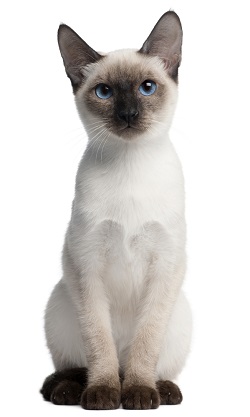 Grooming a Thai cat is not complicated at all. Owners should spend a little time once a week brushing and trimming. Even though they shed a little fur, they do require regular grooming. Thai cats keep themselves clean, so bathing is needed only when they have decided to help their human paint the house.
Thai cats are shorthaired and elegant, so grooming should be very gentle because it needs to enhance the cat’s characteristics, rather than camouflage them.
This breed requires subtle combing rather than intense effort. A comb must be used carefully because otherwise it might remove too much fur. Breeders also recommend using a variety of products in order to improve the coat’s look. These range from bay rum and witch hazel to professional coat conditioners for Thai cats.
Trimming the cat’s nails is another crucial part of the entire Thai grooming procedure. The first sign that the nails have become too long is that the cat will start to get caught in soft furnishings and carpets. When this happens, owners must trim their nails.
Brushing their teeth is another important grooming procedure. Human toothpaste can be harmful for cats, so owners should buy specialized cat toothpaste, often flavored like meat. Daily brushing is recommended.
Characteristics Unique to the Breed:
Thai cats are a lot more than just an unusual looking breed. They are cats with unique behavior. Most people think that cats are distant and aloof. Dogs, for example, seek out human love and companionship, while cats lurk in the shadows. But not the Thai cats. Not only do they demand human attention, but they will go to great lengths to get it. They are among the most people-dependent cats. Thai cats demand love from their owners, and offer even more back.
Thai cats can be trained not to sneak food from the table. They can even learn other tricks like saying their prayers, sitting up, and chasing a ball, and they enjoy traveling in automobiles.
Health and Wellness:
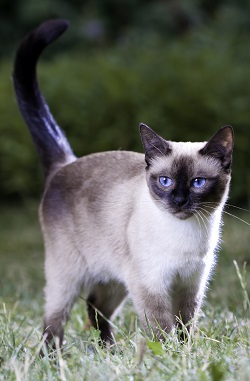 The Thai breed is naturally healthy, but they can suffer from the same diseases common to their cousins – the Siamese.
Thai cats might suffer from dental problems, which is why extra dental care must be taken. Dealing with dental problems on time is of great importance because if left untreated, dental problems might become very serious. Reflux and kidney problems have also been reported. Thai kittens are prone to respiratory infections, so they often have a discharge from the eyes or nose and sneeze more than usual. Just like the Siamese, the Thai cats are more sensitive to anesthesia than any other cat breed.
Thai cats with eye problems are common; many of this breed have a condition that causes the eyes to shake back and forth. Cats with this condition should not be bred. And last but not least, cardiomyopathy is a common disease found in Thai cats that causes enlarging of the heart muscle and reducing the heart’s ability to pump blood.