Welcome to our Snowshoe Cats page! Here you will find everything you could ever want to know about Snowshoe cats and a complete list of all the Snowshoe catteries we have located in the USA.
The Snowshoe is a beautiful, rare breed with a lot of charisma. The most popular Snowshoe is Internet sensation Grumpy Cat, but the cranky scowling face of the world’s grumpiest cat is far from the personality, temperament and appearance of this breed. The permanently grumpy face of this cat is due to the combination of an underbite and feline dwarfism.
Snowshoe Cat Breeders Near You

Snowshoe
- Are you a cat breeder who isn’t listed? Add your information here.
We also highly recommend checking out our latest news articles at our blog. Find information on cat health, nutrition, holistic healing, basic care, toys, and much more!
Snowshoe Cat Breed Information
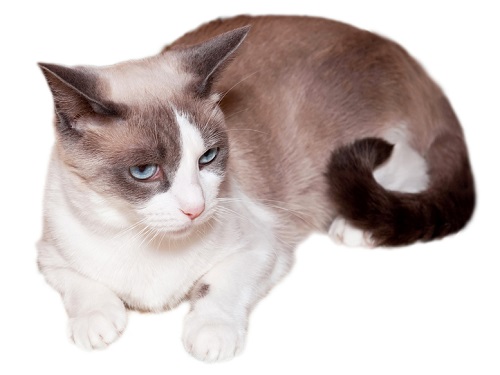
Lovely and affectionate, the Snowshoe is the perfect cat for those looking for a purring machine. While not as vocal or loud as the Siamese, they are never at a loss for words. Snowshoes, named for their white paws, are a blend of the American Shorthair and the Siamese, combining the American Shorthair’s solidity with the Siamese elegance. They come in a wide range of personalities; they may be demanding or reserved, but they are always affectionate and sweet, with the inquisitive and curious nature of every cat breed.
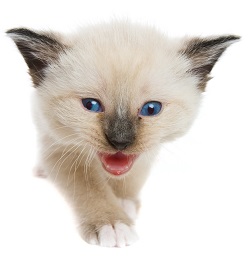
They are born totally white, and the point coloring develops in a few weeks. The head, ears, legs, and tail darken as the kitty ages. They have a very striking coloration that is very difficult to reproduce. The unusual, genetically recessive white markings making this breed unique.
Snowshoes like to be around people, although some cats are shy with strangers. They are very intelligent and trainable, and get along well with other pets. However, this is not a breed that does well when left alone for a longer period of time, so people who are busy most of the day should opt for another breed or get two Snowshoes. They ooze friendliness and love to be petted because they thrive on social contact. They get along well with everyone in the house, but tend to bond with one person.
General Information:
Height/Length: medium
Weight: 7-12 pounds
Lifespan: 14 -19 years
Coloring: a wide variety of colors
Area of Origin: United States
Similar Breeds: Birman, Ragdoll
Breed History and Origins:
 In the 1960s, Dorothy Hinds-Daugherty, a Siamese cat breeder, had a cat that produced a litter of Siamese kittens with unique markings. Three of the kittens had white feet. Dorothy was intrigued by the kittens’ looks, so she started working on breeding cats like them. She was using bicolor American Shorthairs and seal point Siamese cats. At first, the results were kittens lacking the Siamese points, but she then bred them to Siamese cats in order to achieve the desired appearance.
Their white feet were the most unique feature of these kittens, so she decided to name the breed Snowshoe. She was trying hard to promote the breed at local cat shows, but the Snowshoe was not a recognized breed at the time. Dorothy eventually abandoned the breeding program of the Snowshoe, and passed the torch to Vikky Olander.
Vikky, in charge of everything related to the Snowshoe, was the one who wrote the first Snowshoe breed standard, and succeeded in obtaining “experimental breed” status for the Snowshoe in 1974 from the American Cat Association (ACA) and Cat Fanciers Federation (CFF).
In 1977, Olander was contacted by Georgia Kuhnell and Jim Hoffman, who were also interested in this breed. Several other breeders joined Olander as well, and in 1983, they successfully obtained the champion status from CFF. In 1989, Vikky left the breeding program, but nevertheless, by then, Snowshoes had a strong following, and in 1990 they attained champion status with The American Cat Fanciers Association, and in 1993 became recognized by The International Cat Association.
Even though the Snowshoe had a low start when it comes to gaining popularity and gaining recognition, in the last several years, this breed has become quite popular. In the future, breeders are planning to work on larger size, deeper eye color, and more uniform body type.
While the Snowshoe is a distinct cat breed, they are still bred back to Shorthairs or Siamese every now and then in order to maintain their traits. Producing kittens with the desired markings is not easy at all, so the breed is uncommon.
Size and Physical Characteristics:
The Snowshoe is a cat of a medium size that is an ideal mix of the Siamese and American Shorthair when it comes to combining elegance and heftiness. They are well-balanced cats; neither too large nor too small. They have a firm and muscular body without being bulky or powerful.
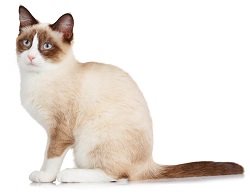
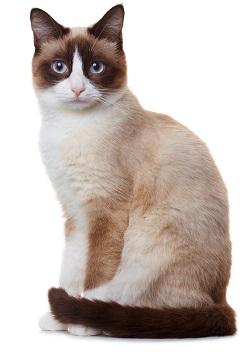
They are born with blue eyes, and the pattern of their coat appears within two to three weeks after birth. In their soft, thick coat, Snowshoes have a white, solid pattern along their stomach and chest, and their most unique feature – the white V pattern on their face. The shading on their shoulders, back and hips is darker.
Just like their Siamese ancestors, they have point coloration, meaning their body is lighter than their face, ears, legs and tail. Paw pads might be white, flesh tone, mottled, or point color. They usually have one of the following colorations: blue, black, seal, chocolate, cream, cinnamon, red, tortoiseshell, tabby, or fawn. As they age, their coloration darkens.
| The Snowshoe | |
| Head: | Triangular or apple-shaped, medium-to-large ears with slightly rounded tips, blue eyes |
| Coat: | Shorthaired coat with solid and white patterns |
| Adult Weight: | females weigh 7-10 pounds; males weigh 9-12 pounds |
| Size: | Medium size |
| Legs: | Long legs ending in oval, neat white paws |
| Tail: | Medium in length, tapering to a rounded tip |
| Voice: | Talkative; soft melodic voice |
The “snow” pattern is striking, but difficult to achieve.Every Snowshoe kitten has its own unique pattern and characteristics.
The coat is glossy and short, and seal and blue are the most popular coat varieties as they give beautiful contrast with the white coat markings. In general, the pattern of the Snowshoe cat can be divided into two categories:
- Bi-color Snowshoe – two-thirds of the cat is white; the paws are always white;
- Mitted Snowshoe – their feet are white, but the white usually extends from the toes to halfway up the leg.
Personality and Temperament:
 The personality of the Snowshoe is as unique as its physical appearance. Its temperament is actually a combination of a mystical aloofness and elegance along with a slight dash of normal, ordinary cat.
In general, Snowshoes are sweet-tempered, mellow, and affectionate. They enjoy being petted and love their humans, and moreover, are compatible with little children and other pets, even dogs. They are very docile and social, and are always showing love and devotion towards their humans. Consequently, they do not like being left alone for a longer period of time. That is why owners who work eight hour shifts are advised to get another cat.
Snowshoes are very vocal and always tell their owners how they feel. Their meows are quieter than those of the Siamese. Anyone looking for a standoffish and aloof cat should definitely apply for Snowshoe ownership. According to the people who already own a Snowshoe, these cats do not seem to realize they are cats; they like to think they are people. Very intelligent, they can easily be taught many tricks.
Everyone who has heard of this breed is familiar with their fascination with water. They will even climb into the tub, as long as it is their idea.
No two Snowshoes have the same coloring and temperament. Some are shy, some are caregivers, taking care of their person, and some are kind of bossy. Almost every cat of this breed is active and inquisitive, so owners will have hours of entertainment and a cat’s lifetime of companionship.
Usually, Snowshoes bond with one person but maintains a strong friendship with the rest of the family. They always like to be near their human, but unlike dogs that follow their owners, Snowshoes prefer to lead them. All in all, they are unique individuals that are interesting to live with. They might be the mistress of the home, the bossy master, the feline “parent” always checking on everyone in the house, the needy best friend, or the clown of the family. In whatever personality they have, though, they are smart, affectionate, and active.
Nutritional and Exercise Needs:
Snowshoes and Nutrition
Snowshoes do not require a special diet. However, they are active cats so their diet needs to be well thought-out.
When it comes to the debate of canned vs. dry vs. semi-moist food, the choice is up to the individual. When canned or dry food is fed in the right amounts based on the Snowshoe’s size and age, it will meet the nutritional needs, helping the cat stay fit and healthy. Some medical conditions, like dental disease, might benefit from dry food. Other conditions, like urinary disorder, for which increased water intake is recommended, encourages a canned food diet. That is why owners are advised to consult a vet. Simply put, Snowshoes should eat a combination of a canned food and dry food.
In most cases, people leave dry food out for the Snowshoe to eat whenever it wants, and offer canned food twice a day. Snowshoes maintain their own weight, i.e. they are rarely underweight or overweight, so this is the most recommended method. This way, the Snowshoe can nibble all day while the owner can observe the cat’s behavior. If the cat does not come running for the normal meal of canned food, it might be an early sign that something is wrong.
Snowshoes and exercising
Owners are advised to keep their Snowshoe at home. Needless to say, keeping a cat indoor has plenty of benefits: it minimizes the risk of being hit by a vehicle, attacks by dogs or bite wounds from other cats, exposure to toxins, infectious disease, and more.
However, there is a risk in keeping a cat indoors – the cat might become bored and as a result, she might have problems like inappropriate urination, aggression, scratching, lethargy, depression, decreased appetite, etc.
Snowshoes like stimulating environments because they are active cats. They need to live in an environment with windows to look out of, places to climb, toys to play with, and things to chase. Simply put, they do not want something fancy; they will be happy in a house with scratching posts, climbing posts, and window beds or perches with a view of squirrels and birds to watch.
As for toys, Snowshoes become bored if playing with the same toys for a longer period of time. Instead of buying new ones, owners are advised to rotate the toys – to hide the toys for a while and then reintroduce.
Of course, the best thing owners can do for their cat is to have some quality time playing together. Petting, grooming, playing, or just hanging out – it’s all good! Snowshoes love their humans and love spending time with them.
Grooming and Upkeep:
 Snowshoes need daily play sessions in order to stimulate their natural desire to explore and hunt. They are meticulously clean, so their litter box must always be clean.
As for grooming, they have a short coat, so they are low maintenance. Brushing must be done as needed: at least once a week for a healthy shine. Snowshoes shed more in spring months, which means they require additional grooming in that time of the year. Most Snowshoes enjoy their brushing sessions. Owners are advised to brush them after eating or exercising because that is when they are really relaxed.
Snowshoes do not require bathing, but if their coat becomes oily or greasy, or if they have gotten into something smelly or sticky, they will need a bath.
Snowshoes are not fans of nail clipping. This feeling is foreign for them and it might make them upset. Because of that, owners should get their Snowshoe used to having its paws touched before they attempt a nail trim. All cats are different, but chances are that in a few weeks of a daily massage of their feet, any cat will accept nail clipping.
Snowshoes are not prone to ear problems. However, your cat might have some ear problems if it shows some of the following signs: persistent scratching, head tilt, hearing loss, sensitivity to touch in the ear area, disorientation, and loss of balance, to name a few.
Characteristics Unique to the Breed:
| Advantages | Challenges |
| Intelligent, sweet-natured, friendly | Can be very vocal |
| A sweet heart and more cuddly than most cats | Demand a lot of attention |
| Elegant and beautiful | |
| Extremely affectionate and social | |
| Easy to groom |
Snowshoes are extraordinary cats. Their genetics influence their appearance, health, and behavior. Understanding their unique features will help owners keep their cats healthy and create a stronger bond with them.
Creating the perfect Snowshoe is not easy at all. Four traits make it difficult:
- The inverted V facial pattern;
- The white boots;
- Achieving the ideal Siamese pattern and shading;
- Achieving the standard for a type of body that combines the length of the Siamese with the heftiness of the American Shorthair.
Their two principal defining features are their nose – the white upside-down V extending down between their eyes and out over their nose and muzzle – and their white boots. Their nose and feet actually give them an appearance of being covered in snow, hence the name Snowshoe.
Health and Wellness:
 Needless to say, learning about the genetically linked diseases of the Snowshoe is of great importance. Of course, not every cat from this breed will have the same health problems, but research shows they are more at risk than other cat breeds. Exploring the health concerns related to the Snowshoe is a must for every pet parent because this way, they will become more confident and knowledgeable.
The most common health issues a Snowshoe could encounter are:
Heart disease – this disease usually affects the structure of the dividing wall of the heart. It might cause problems with the electrical signals controlling the heartbeat.
FLUTD – a term used to describe different conditions that affect the urinary bladder and the lower urinary tract. In general, middle-aged cats, neutered cats, lazy and overweight cats are more prone to this disease.
Renal failure – the kidneys of a snowshoe begin to fail with age. If left untreated, renal failure can lead to more serious problems; when it is chronic, there is no known cure. However, an early diagnosis can boost the length and quality of the cat’s life.
Hyperthyroidism – the cause for this disease is increasing the production of thyroid hormones situated in the neck.
Diabetes mellitus – otherwise known as sugar diabetes, this is a disease in which the cat does not produce insulin.
3 Interesting Facts about the Snowshoe:
- Probably the best-known cat on the Internet is a Snowshoe cat known as Grumpy Cat.
- Snowshoes are one of a few cat breeds that enjoy water.
- Their average litter is 3-5, but the record litter is 19.
Why Choose a Snowshoe?
The social and active Snowshoe is the ideal choice for families with cat-friendly dogs. These cats play fetch, learn tricks easily, are both playful and cuddly, and appreciate the attention they receive from children and humans who treat them with respect.
Snowshoes are avid bed companions and lap sitters. They are intelligent and know many different words.