Welcome to our Singapura Cats page! Here you will find everything you could ever want to know about Singapura cats and a complete list of all the Singapura catteries we have located in the USA.
One of the smallest domestic breeds, Singapuras have beautiful brown ticked fur and large eyes. Their gentleness and street smarts have won human hearts all over the world. Singapura cats make active, loving companions, although it is often said that you don’t own a Singapura – the Singapura owns you. These lively little lions can adapt to any home environment. They are generally easy to care for, although the breed has a couple of associated health problems and doesn’t like loud noise.
Singapura Cat Breeders Near You

Singapura
- Are you a cat breeder who isn’t listed? Add your information here.
We also highly recommend checking out our latest news articles at our blog. Find information on cat health, nutrition, holistic healing, basic care, toys, and much more!
Singapura Cat Breed Information

Singapura History and Origins:
Singapura is the Malaysian word for Singapore – literally “lion city” – on the southern tip of the Malay Peninsula. Some tabby cats in that city have brown fur in a ticked pattern of alternating bands of light and dark color. Singapura cats are known as “drain cats” in Singapore, but they have Abyssinian and Burmese breeds in their background.
From Singapore streets to the cat fancy
In 1971, two Americans who were visiting Singapore adopted some of the ticked street cats and brought them back to the US. Three years later, the Americans moved back to Singapore with all their pets, which included three grandkittens of the adopted street tabbies. After staying in Singapore for a year, they returned to the US for good in 1975, now accompanied by five brown ticked cats.
These five, plus another brown ticked cat, who was adopted from the Singapore pound and imported to the US, became the foundation of the Singapura breed. The International Cat Association (TICA) recognized Singapura cats as champions in 1979, and the Cat Fanciers Association (CFA) recognized them in 1988.
Singapore designated the Singapura breed a living national treasure in 1991 and put statues of the cats along the banks of the Singapore River.
Two problems to overcome
In the early days, people who loved and wanted to develop Singapuras faced two major problems. The first was coat pattern. The ticked tabby pattern gives a Singapura cat its attractive iridescent appearance. This is why breeders were concerned when solid brown kittens began to appear. Breeders identified which Singapura cats carried the gene for solid color and took them out of the breeding program.
That solved the coat problem but it made the second problem – inbreeding – worse by removing breeding individuals. The Singapura breed was established with only a few cats anyway, and some of those were closely related. The SPCA Singapura – widened the gene pool a little bit. In 1987, a breeder spent three months in Singapore, finding more foundation cats with the help of the local cat club.
The Singapura breed is now well established, but inbreeding is still a concern. Some cat fanciers avoid it by going outside their cat association – a TICA breeder, for example, will add in a CFA breeder’s Singapura.
There is a lot of resistance to going outside the breed to get a healthier gene pool. However, the UK’s Governing Council of the Cat Fancy has decided to allow limited outcrossing with shorthair ticked tabbies from Singapore; some Abyssinians, Burmese, and Korats; and black or brown ticked tabby domestic shorthairs that meet the Singapura standard appearance.
Size and Physical Characteristics:
| The Singapura Cat | |
| Head: | Round, with a strong whisker break and short, broad muzzle. Big almond eyes. |
| Fur: | Very short and fine. Dark brown ticking on an ivory background. |
| Adult Weight: | Males: 6-8 pounds. Females: 5-6 pounds. |
| Size/Shape: | Small. Stocky and muscular. Body, legs, and floor form a rectangle. |
| Legs: | Medium long. Upper legs muscular, taper to fine lower legs, small paws. |
| Tail: | Almost as long as body. Slender, but not whippy. |
| Voice: | Vocal; generally soft voice. |
The Singapura cat is a cute little shorthair with an athletic build, big ears, and brilliant eyes. Besides size, this kitty’s trademark is its shimmering brown and ivory fur.
Head and body
Singapura cats have bright hazel, green, or yellow eyes that are set in a sweet little round face with high cheekbones. The muzzle is short, and the nose is broad and blunt. Singapuras have a rather short, thick neck. Their body is compact, not rounded, and the back is kept straight to the floor. A Singapura cat has a lot of muscle, but its body should be trim rather than bulky.
This cat is small, only 6-8 inches high at the shoulder, but it has powerful upper legs that taper down into finely boned lower legs and small paws with prominent knuckles. The Singapura is very dexterous and likes to use its paws a lot. The cat’s slender tail should reach to its shoulders.
A ticked tabby coat
Singapuras have very short fur that is fine and silky. Each hair has ticking – at least two alternating bands of dark brown and light ivory color, starting next to the skin with a light color and ending with a dark tip. This gives the Singapura cat an iridescent look when it moves (and these frisky little cats are often in motion). The longest fur and most intense ticking is usually along the spine. The muzzle, chin, chest, and tummy have unticked, lightly colored fur.
On its face, a Singapura has the tabby “M” on its forehead, as well as dark fur outlining its eyes, lips, whiskers, and nose. There are also usually dark lines that set off the beautiful eyes of this cat, as well as curved “puma” or “cheetah” shadows of slightly darker fur that extend from the inner corner of the Singapura’s eyes out onto its cheeks.
Singapura Personality and Temperament:
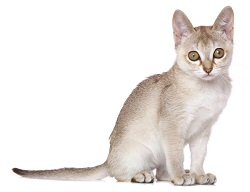 Lively Singapura cats may be small in size, but they’re street-savvy and have lots of self-assurance. They need lots of affection and like to get involved with anything you are doing. Singapuras have energy to burn and remain kittenish well into adulthood.
Like a boss
Your Singapura cat may be a little reserved at first. However, it doesn’t take this kitty long to figure out how to get the most from its home and all the people and other pets that live there. Gradually this beautiful feline starts making its moves, and soon enough, it’s running the show.
Singapura cat owners say that after interacting with a Singapura they just can’t imagine life without one. The Singapura is bossy. It’s pretty. And it needs you. Singapuras are too active to be called lap cats, but they sleep with you, work alongside you, and may even jump up on your shoulder and ride around. This very intelligent cat can be trained, or perhaps it will train you. Either way, you will both have a lot of fun.
Sociable and playful
A Singapura cat is a lot stronger than it looks. This pint-sized feline can easily jump or climb up onto your shoulder and then race after you when you go into another room. It likes to mingle and will run over to greet visitors. Singapuras do very well in busy families where there is a lot to entertain them.
They get along well with children, too. Some Singapuras are upset by loud noises that can be associated with younger kids, but it depends on the cat and the family. Children of any age love this frolicking feline, and in return, Kitty enjoys all the attention. When playtime is over, a Singapura will happily climb up in somebody’s lap and settle down for some petting and snoozing.
Grooming and Upkeep:
 Singapura cats shed a little, but they do their own grooming and are low-maintenance pets. You will need to keep their claws trimmed and clean their teeth.
Grooming tips
Like other shorthairs, the Singapura cat does its own grooming. At most, this kitty needs a weekly brushing to remove dead hair and distribute oil through that beautiful ticked coat. Its large ears tend to pick up dirt and other irritants, so check them for redness or an odd odor when the cat is in your lap. You can use a cotton ball dipped in a cat-safe cleaner to gently wipe them out. Never use a cotton-tipped applicator, which can damage a cat’s delicate internal ear structures.
Singapuras don’t need a bath unless you plan to show them. After the bath, Kitty should be air-dried. Blow drying will fluff out itssilky coat too much for the judging bench.
Nails and dental care
A Singapura grooms its nails by scratching, but that doesn’t shorten them or get rid of all the old layers. You will need to clip the claws every ten days or so. If you have never done this before, don’t worry. Clipping goes very quickly with the right tools and some advice from your veterinarian on how to do it safely.
Don’t forget the teeth. Cats are prone to gingivitis. They don’t need tooth cleaning after every meal, but try to do it frequently. You can use cat-safe toothpaste and a feline toothbrush from the vet or just a gauze-wrapped finger. The vet can do a dental treatment, of course, but it requires general anesthesia, which is always risky.
Most cats learn to accept having their mouths and nails handled when you begin training them for it at an early age. Don’t let your playful Singapura bluff you out of doing nail and dental care. Just be gentle and firm. Singapuras love their human friends and always want to please them.
Singapura Nutritional and Exercise Needs:
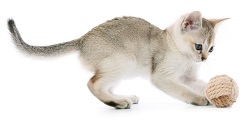 A Singapura cat needs plenty of protein, but this little beauty can eat regular cat food. Singapuras are small, but they are lively and curious and can sometimes be a handful.
A strict carnivore
Singapura cats, like all cats, are carnivores. They must have meat. This is because cats get most of their energy from protein. They also need just the right balance of fat, carbohydrates, and other nutrients in their diets. Fortunately, it’s not hard to give your Singapura the nutrition it needs.
A serving of any commercial food that meets guidelines set by the Association of American Feed Control Officials (AAFCO) has the correct amount of protein and other nutrients. Look for the words “complete and balanced” on the label. Pet food manufacturers in Europe also follow AAFCO standards.
If your Singapura eats canned food, then it will probably get enough water from its food to stay healthy. If it eats kibbles, however, then Kitty might get a little dehydrated. Cats don’t always drink enough water on their own, even when they need to. However, if you offer lots of fresh, clean water, the cat will eventually drink enough to stay healthy and active.
Exercise needs
Singapuras aren’t quite as lively as Abyssinians, but they will keep you entertained and busy. They do well in apartments as long as there is enough space to rollick around.
Your Singapura is a constant presence in your life, especially when you’re busy. Allow extra counter space near the stove when you are cooking (and good luck trying to keep Kitty off the counter!). You might even want to keep a few extra pens or other small objects near your keyboard to distract your little supervisor.
In the unlikely event that you can’t find your feline companion, look up. The Singapura may be known as a “drain cat” on the streets of Singapore, but it loves heights. As tiny as this kitty is, it can still spring up to the top of a cabinet or refrigerator in a single bound. A ceiling-high cat tree will keep your Singapura happy and off the drapes and cabinets.
One of the most endearing qualities of the Singapura is that it remains curious and energetic most of its long life. Another quality is that Singapuras do settle down in your lap eventually, happily purring and enjoying an extended cuddle session.
Characteristics Unique to Singapura Cats:
Singapura cats only come in brown ticked tabby. Unlike many other breeds, these tiny cats love people and need to be around them.
An agouti coat with a Burmese color
Tabby cats have something called an agouti gene that gives their coats a dark pattern on a light background. The hairs in the background have alternating bands of color. Since the agouti gene causes this, it’s known as agouti coloring.
All tabbies have agouti coloring. The gene also gives them that famous “M” mark on their foreheads, as well as dark mascara lines around their eyes, thin dark lines on their faces, and banding on their bodies, legs, and tails. In some tabbies the bands look like spots, blotchy patterns, or stripes.
In ticked tabbies like the Singapura, the agouti gene is slightly different. It masks some of the tabby features like stripes or spots. All you can see is the ticking, with the darkest color at the tip of the hair and then alternating light and dark bands down to the skin. From a distance, this gives a ticked Singapura cat a pretty shimmer as it moves.
Why does this cat’s coat only come in brown? Because the Singapura has inherited another gene, this time from its Burmese ancestors, that makes the agouti coloring a warm brown alternating with a warm yellowish ivory.
People-centered
Your Singapura cat will try to boss you around. It will ignore you when it wants to and try to manipulate you into doing what it wants. But when all is said and done, you are the center of your cat’s world.
That’s a little odd, when you think about it. Street cats are generally more independent than ordinary domestic cats. Perhaps it is the Singapura’s small size that makes the difference. This breed couldn’t have survived the rigors of street life in crowded Singapore without human help.
Health and Wellness:
 Singapura cats are generally healthy except for a risk of anemia and problems giving birth. They do need core vaccinations and may need other immunizations, depending on their lifestyle.
Uterine inertia and PK deficiency
Some of the original Singapura cats developed a condition known as uterine inertia. This makes the mother cat unable to deliver her kittens, requiring her to have a cesarean section. Most Singapuras have absolutely no problem breeding, but this condition does happen occasionally.
The Singapura cat has inherited from its Abyssinian ancestor the tendency to develop PK deficiency. Pyruvate kinase (PK) is an important enzyme in red blood cells. When it’s absent, red blood cells don’t last very long and the cat becomes anemic. This anemia can be a long-term, low-grade problem, or it can happen suddenly as a life-threatening illness.
Again, most Singapura cats don’t get PK deficiency, but it’s very difficult to eliminate this hereditary problem from the breed. Today genetic screening is available, so be sure to get a health certificate from the breeder when you buy your Singapura kitten.
Interesting Facts About Singapura Cats:
- The Singapura cat has been listed in the Guinness Book of World Records as the smallest domestic cat breed.
- Singapuras take about two years to fully mature. Because they are such a small breed, this slow development sometimes misleads veterinarians into thinking there is something wrong with the young cat.
- This breed’s nickname is Pura.