Welcome to our serval cats page! Here you will find everything you could ever want to know about serval cats and a complete list of all the serval catteries we have located in the USA.
Maybe you’ve seen an internet video of someone playing with a large, exotic cat called a serval in their home. Maybe you’ve seen one in a zoo and thought that they’re about the size of a housecat. Either way, anyone who has thought of owning a serval should not mistake this wild cat for their domestic cat.
Serval Cat Breeders Near You

Serval
- Are you a cat breeder who isn’t listed? Add your information here.
We also highly recommend reading checking out our latest news articles at our blog. Find information on cat health, nutrition, holistic healing, basic care, toys, and much more!
Serval Cat Breed Information

General Information:
Height/Length: 22 in.
Weight: 40 lbs.
Lifespan: 20 years
Coloring: tawny with black markings
Area of Origin: Sub-Saharan Africa
What is a Serval?
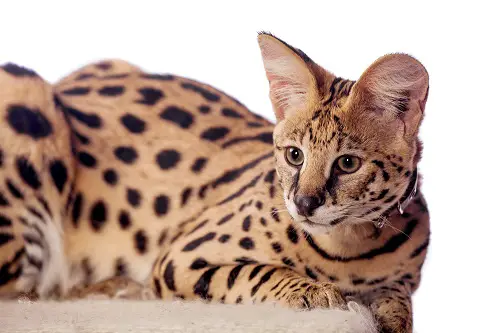
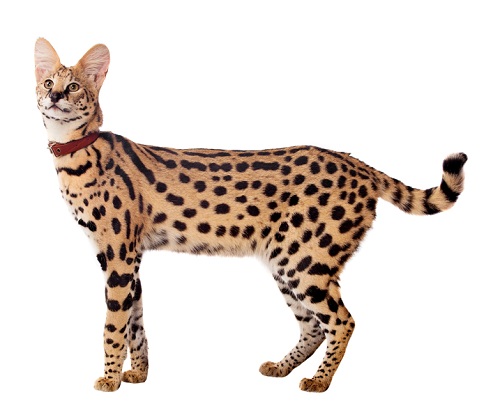
Servals are small for wild cats, but are still much larger than your average housecat—if anything, they are more comparable to a medium-sized dog in stature. They are usually almost two feet (about half a meter) tall at the shoulders and weigh between 30 and 45 pounds (13.6 -20.4 kg). They have a long body, but a tail that is only about a foot long.
Their general appearance is at once elegant and eclectic—indeed, the name “serval” is derived from a Portuguese word meaning “wolf-deer,” and they have been called a “cat of spare parts.” These impressions are the result of the cat’s large, satellite-dish ears mounted on a delicately small head, which in turn extends from a long neck. Servals have long, straight, and very slender legs, with the hind legs longer than the front.
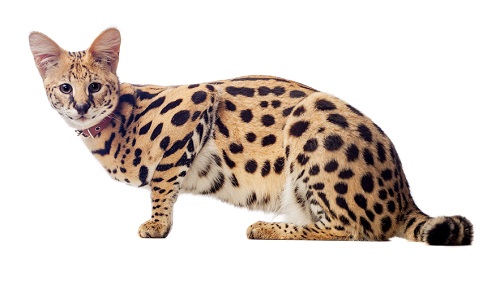
These cats have a distinctive and exotic coat—golden-brown in color, with markings that range from dark brown to black. Their markings are either spots, speckles, or stripes that run longwise down their backs. The backs of a serval’s pointed ears are distinctly black with a white spot. These coats have helped the serval survive in the wild by camouflaging them in tall grasses.
Servals roam wild in the savannahs and forests across sub-Saharan Africa. They live near waterways like rivers and lakes. Their numbers have been dwindling in the wild due to poachers hunting them for their fur and, in some areas, meat. Their natural predators, like leopards and hyenas, are also still dangers to them.
They almost exclusively hunt rodents, but will also leap into the air to catch birds or wade into water for a tasty frog. They use their huge ears to track and pinpoint their prey in the tall savannah grasses, then wait, stock-still, until the moment is right to pounce. Their long, muscular back legs allow them to jump up and dive onto their prey, or leap up to ten feet high to grab a bird before slamming it into the ground. Once they have a good hold on their prey, they will bite the neck to finish it off. Servals are excellent hunters, with a 50% kill rate—compare that to a domesticated cat’s 10% kill rate, and you have a mouse exterminator that can’t be beat.
In the wild, servals are solitary creatures, with each individual having its own territory of up to four square miles. Males and females only enter one another’s territory to mate. The mother will usually raise a litter of two kittens, but may have as many as five. The kittens are independent at 6-8 months of age, and reach sexual maturity between 18 and 24 months old, when they will be driven out of their mother’s territory.
Owning Servals as Pets:
In recent years, servals’ gracefulness and energy have attracted many exotic pet owners to the species. However, since these are wild animals, the legality of owning a serval differs on national, state, and local levels. In some places, they are completely illegal to own, while others require a permit or license to own a wild animal. If you are considering getting a serval, your local, state, and national laws concerning wild animal ownership should be the first information you gather.
Servals’ owners find these cats to be playful and affectionate. Tamed servals do still have all the hunting prowess of their wild cousins, which means that, even though they are not trying to be aggressive, they have the potential to cause serious harm. They play hard, using their sharp teeth and claws. For this reason, it may not be not wise to keep a serval in the same house with small children. Older children who are instructed on how to play safely with the serval may be better playmates. In general, use your best judgment as to a child’s maturity level when introducing him or her to a serval. When it comes to other cats or dogs, the serval is an eager companion. When introducing a small pet to a full-grown serval, however, you should exercise caution. Its strong rodent-hunting instincts may make small pets seem like a tasty snack, and they will use their smarts to quickly open a hamster or guinea pig cage.
Undesirable behavior can be trained out of servals. They are very smart, but they can be just as stubborn, so it may take several corrections for the lesson to sink in. When the cat begins playing too rough or marking the couch, you can reprimand it with a firm “No,” which may be backed up with a squirt bottle filled with water.
As territorial creatures, servals become quickly attached to their families, often bonding for the rest of their lives to either one person or the whole family. They usually shy away from strangers, preferring to hide in their kennel rather than answering the door. Serval owners should never try to drag their cat out to greet a stranger, since this will cause a lot of anxiety for the serval.
Caring For a Serval:
 Servals require more in-depth care than domesticated cats. This includes a special diet, training, and living space. Following is a more in-depth look at how to best care for a serval.
Nutrition
Servals cannot just eat regular kitty kibble and thrive. They need more nutrients than housecats, and their digestive systems are designed to digest raw meat. Their food usually comes in the form of raw, bone-in meats, poultry and fish, complemented by vitamin supplements designed for wild cats. Kittens can be fed a combination of ground meat and high-protein wet cat food, gradually shifting to the occasional chicken leg, and finally eating meat and bone. Eating bone is important for a serval, since it provides the important calcium needed to build its strong bones. A serval kitten needs to consume 54 mg of calcium, which can diminish to between 45-49 mg per pound as an adult.
Vitamin supplements are useful for providing both the right amount of calcium and other nutrients that are not available in their diet. By the time the serval has grown to full size, they should be eating about one to three pounds of meat per day, with a weekly addition of grass to their meals. The grass helps the serval’s digestion.
Living area
Servals should have both an indoor and an outdoor living area. These are not apartment-dwellers, since they need plenty of room to run around and play in. Their inside kennels should act like a den would in the wild—it should be a place the serval can go for safety and rest. It is best to set aside an entire room for the serval if you can, since they can become stressed quickly if cooped up in a small space, and stress usually leads to aggressive and destructive behavior.
The cat can have some free roam of the house, but many owners find it useful to have a place that the serval can go to when they are out of the house or when it is not convenient to have a 40-pound cat jumping around the house. The serval’s room should be free of any dangers to an inquisitive serval—pin up any hanging cords that it can tangle itself in, hide electrical cords and harmful chemicals, and keep away anything fragile and sharp. Cupboards should be locked tightly away from curious paws. The indoor living area should be well-stocked with a bed, plenty of toys, and two large litter boxes: one for urination and one for defecation.
The outdoor living space should be large, with a very high fence and roof. It is extremely important to ensure that all fences and gates are secure at all times, since a serval is unlikely to return on its own once it has escaped. Once out of their home territory, servals are likely to become confused and scared, often becoming more lost than ever as they bolt from one place to another. Even once you find your lost serval, it may be difficult to calm the cat down enough to safely transport it home. Therefore, a serval’s pen should be both jump- and dig-proof. These cats can jump 10 feet high, and have been known to dig in the ground to catch rodent prey.
Plenty of exercise room is another important element of the outdoor pen. There should be a catwalk that links the outdoor pen to the interior of your house (preferably into their own room). Plenty of toys and room for the cats to run and jump in will make the space fun. Servals also appreciate a couple of litter boxes in the outdoor pen, since they hardly enjoy playing where they poop. Particularly if you live in an area with extreme weather—blistering hot summers or frigid winters—the outdoor area should have a place that the cat can take refuge from the elements. Since they love swimming, a great addition to this area is a small pool or pond to cool off in.
| Advantages | Challenges |
| Playful and affectionate | Can be destructive if not trained properly |
| Enjoys the company of other pets | Need a great deal of space |
| Often forms strong bonds with owners | Require much more care than domestic cats |
| Very intelligent |
Training a serval
As previously mentioned, serval cats are both smart and stubborn. No matter what age you got the cat, it is still a wild animal and will never be fully domesticated. Litter box-training a serval can be a little difficult. This is not so much that they do not want to use the box as it is because they instinctually want to mark everything in the house—including their owners. They will also mark over any areas that domestic cats have urinated on, so it is best to thoroughly clean any carpets or couches that your cats have previously confused with the litter box.
When cleaning, avoid ammonia-based products—they smell too much like urine to your cat, and will only encourage more urination there. If you find your serval relieving himself in an undesirable place, simply move the cat back to his litter box without scolding or shouting at him. Litter boxes should be kept immaculately clean, or the serval will not use them. Clean the litter out every day, and change the litter weekly.
If you plan on taking a serval anywhere—like the vet’s office—it will need to be harness-trained. Clever contortionists, servals will make quick work of slipping a collar, but a harness is much harder for them to get out of. Still, make sure that the harness lies close to the cat’s body, adjusting straps as needed. It is best to start harness training by first letting the cat walk around with the harness on to get used to its weight and fit. This can then progress to letting it walk around (under supervision) with the leash attached to the harness, and then on to you leading it gently around the house with the leash. Eventually, you should be able to take the cat out for short walks, and then walks a little further from your home.
Playing with a serval
Playing with a serval is an essential part of the bonding process and a way for the cat to exert its high amounts of energy. When the serval is still a kitten, it is best to get on the floor with it to appear less intimidating as you play with it. Younger cats can play with regular cat toys, but they will swiftly outgrow them. Their tendency to chew on their toys with their sharp teeth means that hard plastic dog toys are a good choice for a growing serval.
Serval Health:
Servals are generally hardy—they do not have any genetic defects that are common for many cat breeds. However, they will need vaccinations like any cat. Veterinarians should only use killed vaccines on a wild cat like a serval, rather than a live virus. This is because wild animals have less natural resistance to these diseases than domesticated animals, and may become ill with a deadly virus if they are given live vaccines.
Serval owners need to make a decision about declawing. Since servals can be very destructive with their large, sharp claws, this is an attractive option for many. Some breeders will declaw a kitten before selling it, and others will strongly recommend that the new owner does so. However, declawing is not always a great option—it is often painful for the serval, and it carries risk of infection. Declawing also removes the cat’s ability to defend itself in the event that it needs to. Anyone considering declawing their serval should discuss all possible options with their veterinarian.
Rehoming Servals:
Sometimes, it becomes necessary to find a new home for a serval, which is often a very difficult endeavor. Finding a new home for a serval would require contacting the breeder, finding someone in the serval community to care for it, or taking the cat to a big cat or exotic animal shelter. Anyone who takes in a serval from another home must be willing to invest the same amount of effort and time as the previous owners into creating a proper living space. This is often complicated by the fact that servals will usually bond with only one family for their entire lives, regarding any other owners as strangers, and nobody wants to take on an expensive pet who won’t even cuddle up to them. In captivity, servals live for about twenty years—at least five years longer than most domesticated cats. Taking a serval into your house is a very long commitment.
Final Words on Wild Animal Ownership:
Owning a serval can be a very rewarding experience—many owners find deep companionship in these beautiful cats. They make exotic pets that are sure to create a stir wherever they go, as well as excited and energetic playmates. However, it cannot be stressed enough that these are still wild cats. They have not had the thousands of generations of directed breeding that created the domesticated cats who have warmed our laps for years. This means that they have different personalities and physical needs than your average cat. Moreover, it means that their hunting and survival instincts are still very strong, and it can be difficult to know just what will set them off. It does not mean that they are vicious or maneaters, but it does mean that they need extra care and resources.
Never buy a wild animal simply because you think it would be an impressive pet to have or something neat to play with. They are expensive to buy and maintain, and improper care will lead to the animal’s unnecessary suffering. If you are looking to buy a serval, do so because you truly love the species and are willing to devote a great deal of your time, money, and heart to one of these cats.