Welcome to our Serengeti Cats page! Here you will find everything you could ever want to know about Serengeti cats and a complete list of all the Serengeti catteries we have located in the USA.
The Serengeti cat, a cross between Bengals and Oriental Shorthairs ,looks wild, but almost all of its family tree includes domestic cats. Serengeti cats were developed by a conservation biologist who was opposed to wild-nonwild hybrids and wanted to give pet owners another option. These long-legged, spotted cats are active, sociable felines that fit into any home environment.
Serengeti Cat Breeders Near You

Serengeti
- Are you a cat breeder who isn’t listed? Add your information here.
We also highly recommend reading checking out our latest news articles at our blog. Find information on Cat health, nutrition, holistic healing, basic care, toys, and much more!
Serengeti Cat Breed Information

Serengeti Cat History and Origins:
The Serengeti cat is a man-made breed that was developed to be a domestic substitute for wild-nonwild hybrids. It’s ironic that most major cat associations call it a hybrid and refuse to recognize it, although Serengeti cats are many generations removed from the wild Asian leopard cat that the Bengal is descended from.
Should wild animals be kept as pets?
In the 1990s, conservationist Karen Sausman decided to develop a new cat breed. She wanted it to be tame but to look like a serval – a small African wildcat with big ears and very long legs.
As she says today on her website, “It is my love of all wildlife coupled with the firm conviction that wild animals should not be kept as pets because of the incredible commitment it takes to care for them properly, that lead me to help develop the Serengeti Cats as an exciting and much more fulfilling substitute for owning a wild cat.”
Many domestic ancestors
Karen got to work on the Serengeti cat project at her California cattery. She crossed Oriental Shorthairs with Bengals that were already several generations removed from their Asian Leopard Cat ancestors. The Oriental Shorthairs brought domestic shorthair and Siamese traits to the Serengeti cat. The Bengal gave the Serengeti genes from seven domestic breeds as well as a little bit from the Leopard Cat.
In 1994, the first Serengeti cats appeared. People liked their long legs, beautifully spotted coats, rugged build, and outgoing nature. Starting in 1995, Serengeti cat fans from other parts of the US, as well as from the UK, Europe, Australia, and Russia, joined the breeding program. The International Cat Association preliminarily accepted the Serengeti in 2002. Today TICA lists the Serengeti as an advanced new breed.
Size and Physical Characteristics:
| The Serengeti Cat | |
| Head/Neck: | Wedge-shaped head. Long neck. Large ears, just as long as head. |
| Fur: | Short and silky. Colors: Spotted or solid black. |
| Adult Weight: | Males: 10-15 pounds. Females: 8-12 pounds. |
| Size/Shape: | Medium. Long and sleek but not extreme. Strong, with upright posture. |
| Legs: | Very long, with moderate boning and plenty of muscle. |
| Tail: | Tapered, but thick. About as long as body. |
| Voice: | Chatty but not excessively loud. |
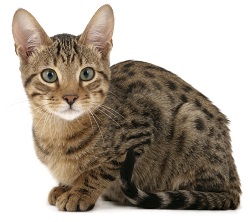
The Serengeti cat breed is still being developed today. This athletic spotted cat has enormous ears as well as the longest legs of any domestic purebred cat. Serengeti cats come with spotted coats on a silver or tawny brown background, though they can also be solid black.
Head and body
A Serengeti cat has a modified wedge-shaped head with a tabby “M” mark on its forehead. The wide, tapering ears sit on top of the head and are deep, like big furry cups. Kitty’s amber, hazel, or green eyes are wide set, big, and round. The cat’s nose is broad. Its muzzle is full and not very long.
Serengetis have an unusually long, muscular neck that flows up from the shoulders and connects to the head without tapering. Combine that graceful neck with big ears and the Serengeti cat’s upright posture, and you’ve got a beautiful cat that looks like a statue when it sits still.
The Serengeti cat’s body is long, but not extreme. The breed’s shorthaired ancestors have given it strong bones and lots of lean, rippling muscle. The shoulders and hind end are at the same level, giving a Serengeti cat a very upright posture. Those long legs have medium boning and good musculature. The medium-sized paws are oval, and the cat’s tail is fairly long, thick, and tapering.
The Serengeti cat coat
This shorthair has a fine-textured, dense coat that naturally lifts up away from the body. Sometimes it has a metallic sheen when the sun hits it just right.
Serengeti tabby cats can be any shade of brown. There are also silver Serengeti cats with black spots, or ebony smoke. Whatever the colors, there is always a nice contrast between the light foreground and dark spot colors. Those spots cover the cat’s body. Solid black Serengetis sometimes show ghost spots. The legs usually have spots or broken stripes, and there are broken stripes on the neck and face. The tummy, chin, and front of the muzzle are light colored or white. The Serengeti cat’s tail has a dark tip and rings of dark fur that are the same color as the spots.
Serengeti Personality and Temperament:
Once it gets used to new surroundings, a Serengeti cat is confident and very outgoing. This breed is lively and independent, but it always stays focused on its human family. Serengetis socialize with everybody and bond closely with one or two favorites. They get along well with older children and will make friends with other resident pets after a proper introduction, preferably at a young age.
Friendly and active
Your Serengeti cat isn’t aloof; it’s just getting accustomed to its new surroundings. Soon Kitty will come around for introductions and greetings. Shortly after that, you will feel that this friendly kitty has always lived with you. A Serengeti sticks close to you so it can get involved in whatever you’re doing. You can train these smart cats. As relatively talkative cats, they also enjoy a good chat.
Serengeti cats like the hustle and bustle of family life. They aren’t as hyper as first-generation Bengals or Savannah cats, but they are frisky. Serengetis tend to have bursts of energy, racing to and fro, as well as pouncing on things. Although they love children of all ages, this unpredictability is sometimes a bit too much for young kids. Older children will probably be entertained by it, and they will certainly love how the Serengeti cat interacts with them.
These cats get along well with other resident pets, including dogs. Just introduce everybody slowly, preferably while the Serengeti is still young.
Lively and intelligent
Like its domestic shorthair ancestors, the Serengeti cat is independent. It won’t get lonely while you’re at work, but it probably will greet you at the door with a toy in its mouth. This rambunctious and self-confident feline may even try to take over the house, but it responds to attention and loving direction.
A Serengeti is usually too busy bustling around to be a lap cat, but it will occasionally nestle in close to you for a cuddling session. It is definitely a “Velcro cat” with its favorite people. Serengetis take an intelligent interest in their surroundings and enjoy the extra attention that comes with training. Many owners train their Serengeti cat to fetch and do tricks.
Grooming and Upkeep:
 Serengeti cats don’t shed very much. They are also very easy to groom. Your Serengeti cat will need to have its claws trimmed and teeth cleaned on a regular basis.
Grooming tips
Short-haired cats can handle their own grooming. All you will ever have to do is run a brush and a comb over them every now and then to remove dead hair and get rid of any dirt. Some Serengeti cat owners run a piece of silk over that beautiful spotted coat to make it shine.
Those big ears tend to collect dirt and other irritants. Check them during a grooming session. If they are red or smell funny, just wipe them out gently with a cotton ball that has been dipped in cat-safe cleaner. Never use a cotton swab in a cat’s ear – the tiny structures are delicate and can easily be damaged.
Claws and teeth
Serengeti cats groom their claws by scratching, which also stretches Kitty’s back muscles. This doesn’t remove all the layers of dead nail, so you will have to help out by clipping the nails every ten days or so. Just ask your vet what clippers to use and how to trim your cat’s claws safely.
This grooming can seem a little intimidating if you’ve never done it before. Don’t worry – it goes quickly with experience and the right tools. It’s even easier to do if you have trained your Serengeti from youth to accept your handling of its feet and mouth.
All cats are prone to gingivitis and need to have their teeth cleaned. The vet can give your Serengeti a dental treatment, but it involves general anesthesia, which is risky. You can keep Kitty’s teeth clean yourself. Just use either a gauze-covered finger or a special brush and cat-safe toothbrush. It doesn’t have to be done after every meal, but try to do it at least a couple times a week.
Serengeti Nutritional and Exercise Needs:
The Serengeti cat may look wild, but you won’t have to feed it raw meat. Regular cat food is fine. Like all domestic cats, Serengetis are carnivores and need more protein in their diet than dogs do. They are very active and need lots of room for exercise.
A strict carnivore
“Strict” doesn’t mean “fussy.” It means that house cats can’t live without meat. They get most of their energy from protein. Cats also need just the right balance of fat and carbohydrates, as well as vitamins and other nutrients.
A serving of any commercial cat food that meets Association of American Feed Control Officials (AAFCO) standards contains the right amount of protein and other life-sustaining nutrition for your Serengeti cat. The AAFCO sets its guidelines based on either feeding trials or nutrient profiles (one profile for kittens and one for adults). Just look for the words “complete and balanced” on the label.
Canned food also has enough water in it to keep Kitty well hydrated. However, if the Serengeti prefers kibble, be sure to offer it plenty of fresh, clean water.
Exercise needs
The Serengeti cat may be a little shy at first, but once it feels comfortable, this is one confident cat. Serengetis are always on the move, climbing, playing with toys, and doing occasional wind sprints. These medium-sized cats do quite well as indoor cats, but they need some romping room.
Keep your Serengeti busy with hunting games that call for stalking, pouncing, and batting lots of things around. Puzzle games will intrigue your cat, and the interaction and attention that come with training it to do tricks and play fetch will be a source of great enjoyment and time for you and your cat to bond.
This powerhouse enjoys leaping, too. Serengetis can easily reach your counter or the top of the refrigerator in a standing jump. A ceiling-high cat tree will provide a good workout as well as a high seat from which the Serengeti cat can survey its domain. Just make sure cat furniture is securely fastened, because these cats can cause a lot of damage as they race around.
Characteristics Unique to the Serengeti Cat:
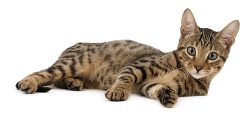 A Serengeti cat has longer legs, bigger ears, and a sturdier bone structure than its Bengal and Oriental Shorthair forebears. It is usually smaller than a Savannah cat, with a larger head and a longer tail.
Serengeti cats, Oriental Shorthairs, and Bengals
Serengetis have the long body of the Oriental Shorthair, but their appearance is much less extreme. They also have medium boning, while Oriental Shorthairs are very fine-boned. The spotted coat is another very good way to tell the difference between a Serengeti cat and an Oriental Shorthair. However, spots won’t help you identify a Serengeti if there is a Bengal present, unless the Bengal has rosettes.
A rosette is a light-colored spot with a dark rim; leopards have them, and Bengals are the only domestic cat breed to have them. A Serengeti cat always has spots, not rosettes.
Look at the legs and ears, too. These are both dramatically longer in Serengeti cats than in Bengals. The ears on a Serengeti are actually as long as the head and they sit close together atop the cat’s head.
Serengeti cats and Savannah cats
The Serengeti was developed to resemble a serval, while the Savannah cat is an actual hybrid between servals and domestic cats. Both have long legs and ears. It is possible to tell them apart?
Yes. There is a big difference in size. Savannah cats of the F1 and F2 generations are close to their serval ancestor. They’re huge. Even the females can weigh over 20 pounds! Further generations get closer to Serengeti cats in size, but these late-generation Savannah cats are still heftier than the Serengeti cat.
The head on a Serengeti cat is proportional to its body, but a Savannah cat’s head always appears too small for its body. Serengeti tails are long, thick, and tapered. A Savannah cat has a medium long, rather bushy tail.
Health and Wellness:
Serengeti cats are generally healthy, but they are more prone to develop lower urinary tract problems. Like all domestic cats, the Serengeti needs immunization from feline distemper and some other serious cat diseases.
Feline lower urinary tract disease
Serengetis occasionally develop crystals in their urine that clump together into bladder stones. These stones can irritate the bladder lining, causing cystitis and urinary tract infections. They also get into the urethra, making it difficult and painful for your Serengeti to urinate.
Treatment for bladder stones varies, depending on their chemistry. Struvite stones are primarily composed of magnesium, ammonium and phosphate. A special feline diet is available to dissolve struvites, but regular cat food is now formulated to reduce the likelihood of stones and struvites are less common now. The other type of bladder stone is made out of calcium oxalate. It can’t be dissolved by a change in diet. The veterinarian may be able to flush these of the bladder. If that doesn’t work, your Serengeti may have to have surgery.
Not all Serengeti cats develop urinary tract problems. Talk things over with your vet. Learn about signs and symptoms and what you can do to help your pet avoid this problem.
Routine health maintenance
All domestic cats need to be vaccinated against feline distemper (sometimes called parvovirus or enteritis) and two upper respiratory infections – FHV-1 and FCV. These core vaccinations are given as a series over ten weeks, either as three separate vaccines or combined into a triple vaccine. Kittens as young as 8 weeks or adults can get these vaccinations. Once the initial series has been given, your Serengeti will just need boosters every one to three years, depending on the vaccine.
Rabies is also considered a core vaccination in the US and in other parts of the world where the disease is rampant. Local laws vary, so check with your vet to see what is needed where you live and where you might be traveling with your Serengeti.
There are other feline vaccines available, but they may not be needed for your cat. It depends on such things as whether the Serengeti goes outdoors, is exposed to other cats, or will be bred. Ask the vet if any of these non-core vaccinations are necessary for your cat.
Interesting Facts about Serengeti Cats:
- There is no serval blood in the Serengeti cat.
- Some breeders are trying to get acceptance from the cat fancy for snowy white Serengeti cats with light tabby striped points on their faces, ears, legs, and tails.
- On average, Serengetis live into their teens.
- There can be quite a size difference between male and female Serengeti cats, the males being much bigger.