Welcome to our Selkirk Rex Cats page! Here you will find everything you could ever want to know about Selkirk Rex cats and a complete list of all the Selkirk Rex catteries we have located in the USA.
Selkirk Rex Cat Breeders Near You

Selkirk Rex
- Are you a cat breeder who isn’t listed? Add your information here.
We also highly recommend reading checking out our latest news articles at our blog. Find information on cat health, nutrition, holistic healing, basic care, toys, and much more!
Selkirk Rex Cat Breed Information
General Information:
Height/Length: 9-11 in
Weight: 9-16 lbs.
Lifespan: 15-20 years
Coloring: Any
Area of Origin: Sheridan, MT, United States
Similar Breeds: Persian, British Shorthair, American Shorthair
Breed History and Origins:
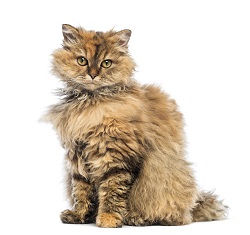 All Selkirks originated from a kitten found at a shelter in Sheridan, Montana, in 1987. This kitten, first named Curly-Q, was markedly different from her littermates—she had distinctly curly hair, including her whiskers! A local cat lover noticed the kitten and brought her to Jeri Newman, a local Persian breeder. Newman had been fascinated with cat genetics for years, and quickly adopted little Curly-Q. As the kitten followed her new owner around, pestering her for attention, she earned a new name: Miss DePesto, or Pest for short.
Interested in reproducing both her curly fur and loving disposition, Newman bred Pest to one of her champion Persians. In the ensuing litter, three of the kittens had their mother’s curly hair. This proved that Pest was not descended from Cornish or Devon Rex stock, since both of those breeds’ curly-haired traits are the result of a recessive gene. If Pest’s fur was also the result of a recessive gene, then none of her kittens would have had it. Newman came to the conclusion that Pest must be the holder of a new mutation that gave her a unique coat.
Newman decided to develop a new breed that bore this curly coat. Allowing all colors and patterns, she asked a variety of other breeders to help her create this new breed. In this way, a variety of breeds were added to the breed’s stock: Himalayan, Exotic Shorthair, American Shorthair, British Shorthair, and more Persians were bred to Pest’s descendants. In a short three years, a cat had been produced that could reliably reproduce its curly coat in ensuing litters. The breed was submitted to the principal cat breeders’ associations for consideration.
TICA, or The International Cat Association, accepted the Selkirk Rex in its New Breed category in 1990, and the Cat Fancier’s Association (CFA) added the Selkirk to its Miscellaneous Class in 1992. Both of these associations granted Championship status to the breed extremely quickly—TICA granted it in 1994, and, after a two-year stint in the provisional ranks, the CFA accepted the Selkirk fully in 2000. As of 2014, only the Cat Fancier’s Federation has yet to grant the Selkirk Rex Championship status.
Size and Physical Characteristics:
| Advantages | Challenges |
| Relaxed, easygoing temperament | Can’t be left alone for extended periods |
| Can be playful and energetic | Tendency to PKD and HCM |
| Good with children | |
| Rarely need bathing | |
| Not prone to obesity |
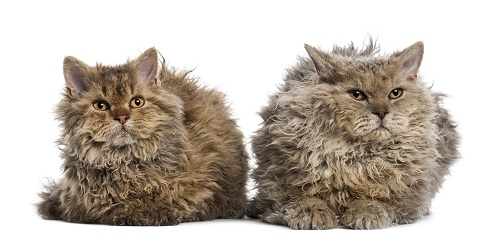
Unlike other Rex breeds, the Selkirk does not have fur that grows in waves. Known as the “cat in sheep’s clothing,” this breed has a much more tousled appearance. This sometimes leads to comments about the cat’s grooming, but it is perfectly natural for this breed. Their curly hair extends to their whiskers and the fine hair inside their ears. Kittens born with curly whiskers will always grow into fully curly cats, but they will go through a strange phase once they reach 16 weeks of age in which their fur suddenly straightens. The fur will gradually re-curl, reaching its final waviness at around eight to ten months.
Selkirks come in both shorthair and longhair varieties. The shorthaired coats feel plush and dense in texture, while longhaired Selkirks feel more like a sheep’s wool. The difference between the two coat types is most evident upon examination of the cats’ ruffs and tails. Longhairs have “plumy” fur in these places, whereas on shorthairs the fur remains the same length over the entire body. The curly coats are most pronounced on full-grown males and spayed females. These coats can come in any of a variety of shades and patterns.
The Selkirk Rex is also unlike the Devon Rex or Cornish Rex by virtue of its build—these are far more stocky cats, with straight backs and rectangular frames. While the shoulders and hips are about the same width, the Selkirk’s body is a little longer than it is tall. They are medium-to-large in size, with a well-muscled chest and heavy boning. While females tend to be a little smaller than males, they are not any more dainty. A Selkirk Rex’s head is broadly rounded with full cheeks. The ears are medium-sized and fit smoothly into the round curve of the cat’s skull. Their noses are not snubbed like their Persian ancestors, but they do have a flat muzzle of medium length.
Personality and Temperament:
 Just like their ancestor Miss DePesto, Selkirk Rexes are eager to hop on any lap. Over the generations, however, these cats have grown far more patient and mellow. Although they are very social, they will only ask for attention when they feel lonely—and even then, it is only in a quiet, polite voice.
In general, a Selkirk Rex has a very relaxed personality, taking life as it comes. This makes them very adaptable, meaning that they get along well with other pets, gentle children, and they accept big changes in their life readily. Their mellow personalities do not, however, indicate that they are layabouts—Selkirks are smart cats with a silly and playful side. They may figure out where the cat treats are kept and how to get to them, opening cupboards and doors along the way.
Owners are often amused by their Selkirk’s goofball antics as it crawls up their shoulder for a better view or play peek-a-boo with the kids. As intensely social cats, Selkirks cannot be left alone for extended periods of time. If you can’t take your Selkirk with you on your travels, make sure to find a neighbor or a kennel that will make sure that it gets plenty of attention.
Nutritional and Exercise Needs:
Selkirks are neither finicky eaters nor gluttons—they will happily tuck into their meals, but will not beg for any extras. Although the breed is not prone to obesity or overeating, it is best to prevent either by setting specific meal times and not leaving a filled food bowl out.
Selkirk Rexes will receive plenty of exercise if played with once or twice a day. They enjoy interacting with their human companions, so some of their favorite activities involve a jump toy and their owners. With their clever and inquisitive minds, puzzle toys make smart additions to a Selkirk’s toybox. These will occupy the cat’s mind enough to keep it out of mischief, all while letting the cat move its body. Although they usually prefer to keep close to the ground, these cats can also appreciate a good cat tree with plenty of nooks and crannies to investigate.
Grooming and Upkeep:
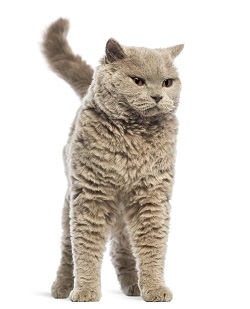 The Selkirk Rex’s hair may seem like a lot of work, but they only rarely need baths. A good combing is necessary a couple of times a week, but brushing too often can straighten the curls. A Selkirk’s coat can get a little greasy, which means it’s time to bathe your cat with a greasebusting soap like Dawn. If the cat gets dirty, you can bathe it with shampoo formulated for humans’ curly hair. Instead of blow-drying the cat after a bath, gently pat it down with a towel until its coat is as dry as possible. Otherwise, its fur may become poodle-like.
Baths, as well as normal hygenic activities like teeth brushing and ear cleaning, should be done when the kitten is still young so the cat will not struggle or get stressed when it comes time to perform these necessary tasks.
Characteristics Unique to the Breed:
Although it is a Rex breed, the Selkirk is not related to either of the other two Rexes. Their fur is unique in its curl, a natural mutation. These are some of the most recent natural cats to be accepted in the major cat associations. Because of their newness, they will be allowed to outcross to Persians, Exotic Shorthairs, and British Shorthairs until 2020. By this point, the breed should stabilize and have a wide gene pool.
Health and Wellness:
As the result of many types of cats carefully bred over the years, the Selkirk has a good degree of hybrid vigor. However, some of the breeds that have gone into its making have brought their own genetic problems into the mix. This is particularly prevalent in kittens that are the product of outcrosses to other breeds.
PKD, or polycystic kidney disease, can be inherited from their Persian ancestors. In this disease, cysts grow on the cat’s kidneys, resulting in renal failure and death. It can be screened for at any vet’s office, and should be done when the cat is still a kitten. Hypertrophic cardiomyopathy (HCM) can also be screened for, and should also be done at the earliest opportunity. With HCM, the first symptom is usually sudden death, the result of thickened muscle in the heart. A larger breed, the Selkirk is prone to developing hip dysplasia, which can cause crippling pain. Keeping the cat’s weight down helps prevent this.

Interesting Facts about the Selkirk Rex:
- The Selkirk Rex is the only cat breed to be named after a person—these cats share a name with Jeri Newman’s stepfather. The “Rex” in the name is in order to associate them with the Cornish and Devon Rexes, which also have curly coats.
- The major cat associations accepted the Selkirk into their ranks faster than almost all other breeds, with as little as seven years between the breed’s original litter and Championship status.