Welcome to our Savannah Cats page! Here you will find everything you could ever want to know about Savannah cats and a complete list of all the Savannah catteries we have located in the USA.
The Savannah cat: the appearance of this descendant of the wild serval and the domestic cat makes you think of the Serengeti, but it’s right at home in your living room. Selective breeding has made the Savannah cat a loving pet for experienced cat owners who want adventure in their lives as well as a faithful companion. You don’t need a license to own one, but there might be laws prohibiting Savannah cat ownership where you live.
Savannah Cat Breeders Near You

Savannah Cat
- Are you a cat breeder who isn’t listed? Add your information here.
We also highly recommend checking out our latest news articles at our blog. Find information on cat health, nutrition, holistic healing, basic care, toys, and much more!
Savannah Cat Breed Information
The Savannah’s History and Origins:
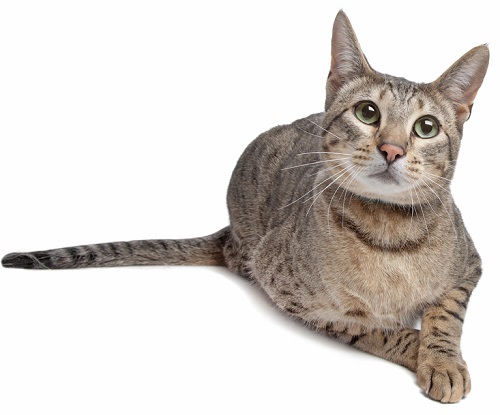
Savannah cats are a breed. They have been around since the late 1980s. Many of their characteristics depend on how far removed from the serval they are. There is controversy about breeding wild-nonwild hybrids, but the International Cat Association recognizes the Savannah cat as a championship breed.
Servals, house cats
The Savannah cat breed began in 1986. That’s when cat breeders crossed a Siamese with a serval (a long-legged spotted African wildcat). This produced a beautiful F1 (first-generation hybrid) kitten with combined serval and domestic cat characteristics. They called the kitten Savannah and decided to develop a wild-looking, friendly spotted breed from her. Outcrossing with other spotted and short-haired breeds eventually produced the modern Savannah cat.
Because the serval is so much bigger than domestic cats, there is more variation in Savannah cat size and temperament than in other breeds. The filial number (F-number) tells you what to expect with any given Savannah. Basically, the lower the number, the bigger a Savannah cat will be and the more it will resemble its 25- to 30-pound serval ancestor. An F1 Savannah is around 50 percent serval; an F2, around 30 percent; an F3, around 16 percent, and so on.
A rare and controversial champion
The breeding of wild-nonwild hybrids like the Savannah is controversial. In North America, laws in some states, provinces, or cities regulate owning a Savannah cat. Australia, which has a large feral cat population that is killing off some native wildlife, has banned the Savannah cat, citing “the potential . . . to establish a self sustaining population in Australia, and the consequential impacts they would have on the environment.”
On the other hand, the International Cat Association appreciates the natural beauty and grace of Savannah cats. The association registered the Savannah as a preliminary new breed in 2001 and gave it full championship status in 2012.
Despite success in the cat fancy, there are still only a few hundred purebred Savannahs in the world today. Savannah cats are rare and expensive because they are hybrids. Some are sterile. Also, genetic variations mean that kittens in a single litter may not meet the standard even when both parents are Savannahs.
Generally, F1-F3 males are sterile and are sold as pets. Females of these generations are kept for breeding. This is reversed in later generations, when most males are bred and most female Savannah cats are offered as pets. Sterile Savannahs will still need to be neutered or spayed, because their hormones are still active.
Size and Physical Characteristics:
| The Savannah Cat | |
| Head: | Small in proportion to body. Face triangular from brow line to muzzle. Large ears. |
| Fur: | Short to medium, slightly coarse. Colors: Spotted tabby, black smoke |
| Adult Weight: | Males: 17-28+ pounds (F1), 14-20 pounds (F4-F5).Females: 13-19 pounds (F1), 10-13 pounds (F4-F5). |
| Size/Shape: | Medium, though it may appear bigger. Long, lean, athletic body. Medium boning. |
| Legs: | Unusually long. Trim and muscular. Hind legs longer than forelegs. Oval paws. |
| Tail: | Medium in length and thickness. Can fluff out at base as a greeting. |
| Voice: | Talkative, including chirps and a loud hiss. |
The Savannah cat is the largest purebred domestic cat. Yes, this spotted beauty is bigger than even the Maine Coon! However, it’s tall and lean, not muscle-bound or bulky. That beautiful coat can have a solid color, but most Savannahs show a spotted or marbled tabby pattern.
Head and body
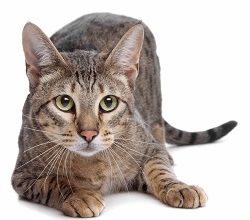
A Savannah cat’s head is small in proportion to the rest of its body. The face is broad across the eyes and brows and then tapers down the jawline to a cute little rounded muzzle. The ears are huge, just like in the serval. They sit high on the head and have wide bases.
Many Savannahs have strongly colored bands of dark and light fur on the back of the ear. These bands are called ocelli, and they are used to fool predators. Out in the wild, the ocelli make it seem that the cat is staring at whatever is sneaking up from behind to attack it. Humans have used a similar trick to protect themselves from tiger attacks.
Savannah cats have medium large eyes that can be any color. The deep-set eyes are slightly hooded at the brow line. There is often a dark furry “tear line” angling away from the outer eye corner. Kitty’s nose is broad at the top, with a rounded tip. The Savannah cat’s neck is long and trim.
The body is long and muscular, with a full chest and powerful shoulders and hips. Everything about a Savannah cat’s build is symmetrical and graceful. This breed has long legs, but not as extreme as those on a serval. There is plenty of muscle on Kitty’s dense, medium-sized leg bones, but it’s meant for agility and speed, not extra bulk. The hind legs may be a little longer than the forelegs, and the haunches are deep and powerful.
Savannah cat fur
The spotted coat is what makes the wild appearance of a Savannah cat so perfect. There are two layers of fur, but the coat isn’t dense and sits close to the cat’s body. The outer guard hairs are coarser than the undercoat, and the spotted fur is softer than the guard hairs.
The International Cat Association calls Savannah cat spots, broken lines, and marbling a tabby pattern, but servals also have spots that either merge into stripes or give the animal a speckled appearance. Servals have a tawny background to their spots, but Savannah cats can also come with black, brown, or silver ground colors. Savannahs also have rosettes – a light-colored spot that is surrounded by a rim of dark fur. The cat fancy doesn’t approve of rosetted Savannahs but some owners love this appearance.
Personality and Temperament:
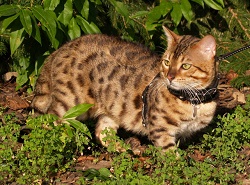 Savannah cats are a new breed and there is a lot of variation in personality between individuals. This basically depends on the F-number (how close the Savannah is to its wild serval forebear), and how well the cat has been socialized by its breeders. Ideally, a Savannah is adventurous and confident. Savannahs are extremely expensive, so it’s nice that the cats that are generally easiest to get along with are also the lowest priced. A Savannah cat loves its owner and is devoted. It can be trained to wear a leash and do some tricks. It’s a good idea to childproof your home when a Savannah moves in.
Nature and nurture
F1 and F2 Savannah cats are calm compared to pet servals or early-generation Bengal cats, but they do have high energy levels. They bond with just one or two people and will either be aloof or hide when anyone else is around. Bonding is so intense that it’s difficult to move an F1 or F2 Savannah to a shelter or a new owner. An F1 Savannah kitten usually sells for $15,000 to $20,000, while an F2 goes for “only” $4,000 to $11,000.
Some F2 Savannahs get along well with families and with children, but this sociability is more commonly found in F3 generations and higher. These F3-plus Savannah kittens generally cost less ($1,500 to $9,000) because they have more of the domestic cat’s traits and fewer serval traits.
It’s not all genetics, though. Every Savannah cat should be handled frequently and socialized from a young age. As it gets older, exposure to other humans and pets also helps the Savannah cat develop an outgoing, friendly personality that it will keep through life.
Affectionate and smart
Some people call the Savannah a “dog” cat. This interactive and friendly feline actually has a personality that’s all its own. It isn’t a lap cat, but it will stay close to you. Your Savannah cat may even give you loving head butts now and then! Savannahs also chirp and make a snake-like hissing sound that’s a little unnerving when you first hear it. This happens more often in early-generation Savannahs. A later-generation cat tends to meow and purr like its domestic ancestor.
Yes, you can train a Savannah cat to fetch. It wants to please you, like a dog, but Kitty also enjoys the running and hunting aspects of the game and may need to be reminded to bring back the item they have hunted and captured. Savannah cats are smart enough to learn other tricks. They can get into doors and drawers. Prey-like small resident pets will also trigger the Savannah’s hunting instinct, and it won’t be deterred by a door or lid. Be sure to lock up anything you don’t want your Savannah to get into.
Grooming and Upkeep:
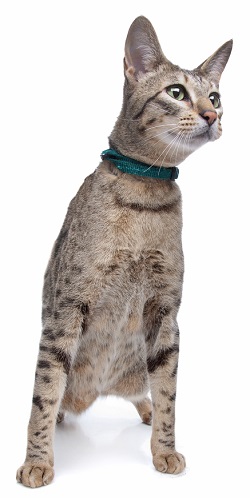 This is a low-maintenance pet, thanks to its short hair and dense, pelt-like coat. A Savannah cat should be taught while young to accept handling and bathing. This cat’s large ears require care. You will also have to trim the cat’s nails and keep its teeth clean.
Grooming tips
A Savannah cat will groom itself, but weekly brushing also reduces fur balls and removes dead hair. Savannahs do shed, especially in the spring and fall. It isn’t excessive, though. You’ll have to bathe your Savannah regularly if you plan to show it. Consider getting Kitty accustomed to a bath anyway, starting from a very young age. A Savannah cat’s size and agility can otherwise make bathing a challenge. This shouldn’t be too difficult, because these cats love water. Sometimes they will even join their owners in the shower! Just remember to use a cat-safe shampoo.
Those big ears easily pick up dirt. When grooming your Savannah, check them for redness or an odd smell. To clean the ears, just wipe them out with a cotton ball that has been dipped in a cat-safe cleaner, or use drops. Using a cotton-tipped applicator can harm the delicate inner ear structures.
Nails and teeth
Savannah cats groom their claws by scratching. This stretches their back muscles, too, but it doesn’t remove all the layers of dead nail. The claws keep growing, too. They should be inspected during grooming sessions and trimmed every ten days or so. Claw clipping isn’t difficult if the cat has been trained from a very young age to accept it. This job goes quickly with experience and the right tools. Check with the veterinarian about how to do this safely.
All domestic cats have a tendency to get gingivitis if their teeth aren’t cleaned regularly. This doesn’t mean brushing after every meal, of course, but Kitty’s teeth should be wiped gently with a gauze-covered finger once a week or so. You could also use a toothbrush and cat-safe toothpaste. As an alternative, the vet can do a dental treatment, but it is more expensive and also exposes your Savannah to the risks of general anesthesia.
Nutritional and Exercise Needs:
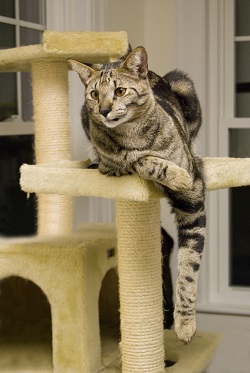 There is more conflicting advice on Savannah cat nutrition than on any other cat breed. One thing everybody agrees on: Savannah cats must have plenty of room to exercise, as well as very sturdy furniture and toys.
Savannah cat nutrition
All domestic cats are descended from desert wildcats that got all their nutrition and water from their prey. This is why cats generally need more protein than dogs do. They also need the right balance of other nutrients. Finally, they need taurine – an amino acid that their bodies can’t make.
Commercial cat foods in the US and Europe that are labeled “complete and balanced” meet standards set by the Association of American Feed Control Officials (AAFCO). A serving of this food gives your Savannah enough protein as well as the correct proportions of other nutrients. Canned food also contains enough water for Kitty to live on. If your Savannah prefers kibbles, it will get slightly dehydrated. Just make plenty of fresh, clean water available all the time and Kitty will drink enough to stay healthy.
Does the Savannah cat require more taurine than other domestic breeds? Some experts say that it does. If you aren’t sure consult your vet. It’s a useful rule of thumb to never give a cat nutritional supplements that haven’t been prescribed by a veterinarian. Too much can be as harmful as too little, and sometimes it’s a very fine balance.
Exercise needs
It varies a little by F-number, but any Savannah cat has a lot of energy to burn off each day. These beautiful animals aren’t destructive, but they are agile. A Savannah may jump eight feet straight up to get onto a cabinet and then turn around, drop down to the counter, and leap gracefully over a couple of chairs to land once on the table and ultimately skitter off into the next room – all this before you even realized where the cat was in the first place.
Loving owners with a life commitment to this purring powerhouse know that owning one is an adventure. Make sure there is plenty of horizontal room for racing spurts. There should also be vertical climbing space for your Savannah, too. If you use cat furniture, it should be ceiling high and well secured to the floor and wall.
Durable toys made out of rugged man-made material are a must. Whirling feather toys or other lightweight hunting games are all right because they are made for chasing. Anything that can be pounced on has to stand up to a lot of abuse. Something like those little plastic balls with bells on them won’t last long with a Savannah cat on the prowl.
Characteristics Unique to Savannah Cats:
The Savannah is one of the few registered wild-nonwild hybrid cat breeds. Savannah cats are also known for their and their beautiful coats.
The controversy over hybrids
The Cat Fanciers Association flatly refuses to recognize any hybrid breeds. They and some other major associations believe that the temperament problems haven’t been solved yet. What ends up happening, they argue, is that owners often can’t handle the cat and they eventually get rid of it.
It’s a tragedy when any pet is abandoned, but no one can say how often this occurs with the Savannah. Ownership doesn’t require an exotic pet license, so it is less likely that you might buy something wild that’s being passed off as a Savannah to get around the law.
However, breeders do go back to the serval to maintain the appropriate look in the Savannah. That means there will always be F1 and F2 Savannah cats around. They can be very energetic, and the bonds they form are so strong that they can’t be placed into another loving home if their owner doesn’t keep them.
The Savannah cat can live into its late teens or more. If you decide the Savannah cat is for you, then be aware that you will be making a lifetime commitment to a rollicking big cat that needs quite a bit of interaction, tons of food, and lots of love. These are not meant to be deterrents to owning a Savannah cat; they are just parts of everyday life with one of these beauties.
Big and beautiful
Wait… tons of food? Well, not literally, or not all in one serving anyway. However, Savannah cats have inherited their big bodies and long legs from the serval, so they need more food than a typical house cat does to stay active and healthy.
The Savannah cat’s gorgeous fur sometimes looks just like a serval’s. Those spots, broken lines, and stripes are fascinating. Breeders have seen to it that the Savannah has different coat colors, too. Even a solid-colored Savannah cat will have “ghost spots,” but its long legs and enormous size will show that, too.
Health and Wellness:
 There hasn’t been a lot of inbreeding in the Savannah cat’s family tree, so this is a very healthy breed. Some breeders say that some Savannahs may be born with smaller livers than usual, because this happens in servals and that this can affect how they react to anesthesia. Savannah cats need all the core vaccinations required for any domestic cat. However, there is conflicting information about the type of vaccines a Savannah should get, so be sure to discuss this with your veterinarian.
Anesthesia for the Savannah cat
Some types of anesthesia used for cats are processed by the liver. Some experts express concern that a cat born with a small liver can develop problems from anesthetics. Ketamine is often mentioned in this regard. Others point out that Savannah cats are developed enough to have the same metabolism as any other cat.
The jury is still out on this one. It’s another good topic to mention the next time you take your Savannah to the vet.
Health maintenance
Core vaccinations are given to all cats to protect them from feline distemper, which is sometimes called parvovirus or panleukopenia, and from two severe upper respiratory infections called FCV and FHV-1. These immunizations are administered to kittens as young as six weeks. They can also be given to adults. After the initial series, your Savannah just needs a booster every one to three years.
Rabies vaccinations are also required in the US and anywhere else this disease is found. There is some conflicting advice about the type of rabies vaccine Savannah cats should get. No rabies vaccine has been approved for wild cats, and some exotic cats have died after receiving a vaccination that used live virus. This is why some experts say to only use the vaccination that uses the killed virus. However, others point out that there is no way to know if the killed virus is effective. To work through some of these questions, you should talk with your veterinarian about vaccinating your Savannah cat.
The Savannah cat can be trained to use the litter box just like any other house cat. However, F1 or F2 Savannahs might go somewhere else if they are mad at you. This is not uncommon; other cat breeds sometimes do the same thing.
Interesting Facts about Savannah Cats:
- The first kitten with a serval and a house cat for parents was named Savannah, after the African grass plain. The breed was named after her.
- A solid black Savannah cat can have “ghost spotting.”
- Savannah cats take three to four years to mature.
- As of this writing, you can own an F5 or later Savannah cat everywhere in the state of New York except New York City, where they are banned.
- F1 and F2 Savannah cats can be up to two and a half times as large as regular domestic cats. F3 males are bigger than house cats, too. F3 females and all generations starting with F4 are more “normal” in size, that is, more in the range of a Maine Coon’s size.