Welcome to our Ragdoll Cats page! Here you will find everything you could ever want to know about Ragdoll cats and a complete list of all the Ragdoll catteries we have located in the USA.
Ragdoll Cat Breeders Near You

Ragdoll
- Are you a cat breeder who isn’t listed? Add your information here.
We also highly recommend reading checking out our latest news articles at our blog. Find information on cat health, nutrition, holistic healing, basic care, toys, and much more!
Ragdoll Cat Breed Information

General Information:
Height/Length: 12-15 in.
Weight: 10-15 lbs. (females) 15-20 lbs. (males)
Lifespan: 12-15 years
Coloring: Pointed with blue eyes
Area of Origin: Riverside, CA, United States
Similar Breeds: Maine Coon, Turkish Angora, Ragamuffin
Breed History and Origins:
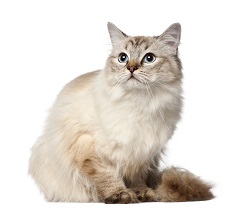 Ragdolls were first bred in the 1960s, when a longhaired white cat named Josephine began producing kittens that were incredibly affectionate and went limp like a rag doll when they were picked up. Ann Baker, the neighbor of Josephine’s owner, began breeding these kittens in order to maintain not only that trait, but also the bright blue eyes of their mother.
Due to a lack of early documentation, it is still unclear just what kinds of cats Baker chose for her breeding program, but most of them were probably random-bred cats like Josephine. It seems that a breeding with a black and white tom produced a solid black male and a seal-pointed female. Josephine would later birth a litter sired by a long haired brown cat that created another seal point kitten and a black and white male. These four kittens, along with Josephine, provided the foundation for the breed now known as the Ragdoll.
As the Ragdoll began to solidify as a breed, Baker trademarked the Ragdoll name and contracted breeders as franchises under her. In 1971, she developed a registry for the breed, naming it the International Ragdoll Cat Association. However, as the breed grew in popularity, her claims about its origins became stranger, which made it even more difficult for the still-developing Ragdoll breed to be taken seriously. A group of Ragdoll breeders eventually broke off to form the Ragdoll Fancier’s Club, which would produce the cats that gained Championship status in all the major associations. In 2000, the Cat Fancier’s Association became the last of these associations to accept the Ragdoll. Before being granted Championship status, the Ragdoll was accepted by the CFA as a Miscellaneous breed in 1993.
Size and Physical Characteristics:
Ragdolls are very large cats, with most males tipping the scales at upwards of 15 pounds (6.8 kg) and females ranging upward of 10 pounds (about 4.5 kg). One male Ragdoll weighed in at a whopping 35 pounds (about 15.9 kg)! Ragdolls often gain their size in a number of growth spurts during the first few years of life. Around age four, Ragdolls settle into their final size.
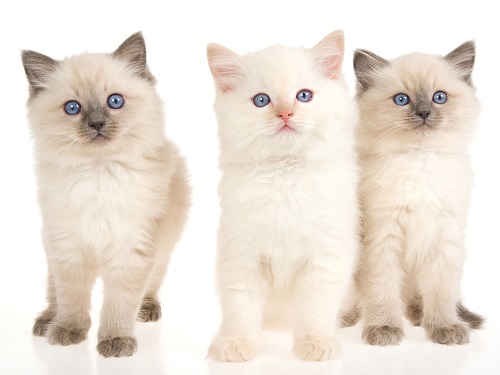
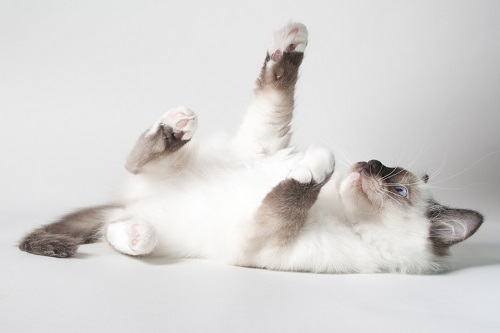
Their long coats seem to enhance their size. These coats have been described as rabbit-like in texture—very soft and with a light undercoat. This means that a Ragdoll’s coat is less likely to mat or shed. The coat can come in a few different colors, but this breed is well known for its pointed patterns. This means that a Ragdoll’s face, paws, and tail are darker than the cat’s body. The pointed pattern has the greatest amount of variety color-wise, with options ranging from chocolate and lilac to a blue-cream lynx point. Acceptable pointed patterns include: a mitted pattern, in which the legs, ears, face, and tail are all darker than the body, but the paws are lighter; a colorpoint pattern with very dark points; a van pattern, where only the ears, tail, and face have darker coloring; and a bi-color pattern in which the points are restricted to the cat’s face, ears, and tail, with some shading on the back.
A Ragdoll cat is a big-boned cat, which lends the breed its large, solid frame. Ragdolls are built on broad lines, but most of their mass is made of muscle. Some may have a little fat on their stomach, but the rest of their body should be well-muscled. Ragdolls’ hind legs tend to be slightly longer than their front legs, and their tails are long and well-plumed. This breed’s face is broad, just like the rest of the body, and wedge-shaped. While they tend to have a round forehead, the Ragdoll’s head is never domed. They have medium, gently flared ears that begin with a broad base until they taper to a rounded tip. Their eyes are large and oval-shaped. One of the most remarkable traits of Ragdolls is their bright blue eyes. Some Ragdolls may be born with odd eyes, meaning that only one eye is blue, but only blue-eyed cats will get anywhere in the show ring.
Personality and Temperament:
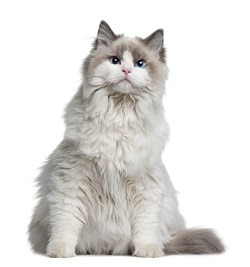 Sweetness and affection are two traits that the Ragdoll was first bred for, and those have been passed on to their descendants. This breed gets its name from their tendency to go limp like a rag doll when they are picked up. They will also “ragdoll” around the house by lying on their backs, legs slack in complete relaxation. Some have speculated that this breed is resistant to pain, but this is patently untrue. Ragdolls are just as susceptible to pain and discomfort as any other breed.
The Ragdoll has been called a “puppycat” by many, citing their tendencies to follow their human companions around the house, play fetch, and stay close to the ground. As some of the most docile cats around, Ragdolls make great companions for everyone—including dogs and “dog people.”
They make excellent companions for children, often submitting to becoming a kid’s “doll” as long as they are treated gently. Children should also be taught how to support the cat’s back legs when picking it up.
They are quick to adapt to new situations, since their philosophy seems to be to take everything in stride. This, combined with the fact that they take to leashes well, makes them good travel buddies. Most Ragdolls, however, are happiest when hanging out around the house.
Ragdolls actively seek out human companionship, often asking in a polite meow to be picked up and cuddled. They stay close to the ground, preferring chasing a toy across the floor to climbing the drapes.
Nutritional and Exercise Needs:
Ragdolls tend to thrive on a diet of high-quality kibble and wet food. It may be tempting to give such a large cat more food, but any Ragdoll owner should stick to the guidelines provided on the food’s packaging. This, as well as making sure to only feed the cat about twice a day, will help to avoid obesity in the cat. However, kittens going through growth spurts will often need a little extra food to keep up with their sudden growth. Rationing can begin once the cat has reached its full size.
Despite the Ragdoll’s laid-back personality, they are still energetic cats. Cat trees are not much use to this breed, but a laser pointer and some mouse toys will be plenty to get a Ragdoll up and moving. This breed does not wind down as it ages, instead maintaining its kittenlike playfulness throughout its lifetime.
Grooming and Upkeep:
A Ragdoll has a minimal undercoat, which makes it resistant to matting and shedding—but not mat- or shed-proof. Owners of this breed should run a steel comb through the cat’s coat at least twice a week to remove any dead hair—a practice that may increase as the cat sheds its coat for summer. Ragdolls also need to be bathed on a regular basis, but this can be done every few months. With such long fur, this breed may need a little help with cleanup after using the litter box. A baby wipe will take care of any mess left in the fur. Besides coat care, the Ragdoll only needs the usual upkeep for a cat: regular nail trimmings, teeth cleanings, and ear cleaning. It is best to establish these routines early in the cat’s life to avoid distrust and make sure that the Ragdoll is comfortable with the procedures.
Characteristics Unique to the Breed:
The Ragdoll’s tendency to go limp when picked up is only shared by the Ragamuffin breed, which was developed from the same stock, but developed separately due to trademark issues.
| Advantages | Challenges |
| Gentle and good with children | Requires grooming more often than most breeds |
| Affectionate, almost dog-like | Higher risk of obesity |
| Adaptable | Tendency to several serious diseases |
| Relatively healthy overall | |
| Laid-back |
Health and Wellness:
Overall, the Ragdoll is a healthy breed, but there are a few diseases and disorders that appear with some frequency. Blue-eyed cats—particularly those with white fur—have a tendency to be deaf. Heart disease has taken the lives of some Ragdolls at an early age. Hypertrophic cardiomyopathy—a hereditary form of heart disease—plagues some lines. With this disease, the first symptom is usually sudden death. Ragdolls in particular have a mutated gene that causes this to happen when the cat is only about 15 months old. Thankfully, your cat can be screened for this disease at your vet’s office, which may allow you to take steps to prevent his early death.
Ragdolls also have an elevated risk of bladder stones and FIP, or feline infectious peritonitis. The latter is a viral infection that can cause cold-like symptoms, such as sneezing, coughing, and discharge from the nose. Sadly, this is usually fatal as the disease progresses.
In large breeds like the Ragdoll, hip dysplasia can be a problem in older age. Although dysplasia has not been reported as a problem for this specific breed, you should note any discomfort the cat may gain as it ages.
An Interesting Fact about the Ragdoll:
The Ragdoll’s founding breeder, Ann Baker, has made some strange and outrageous claims about how the breed was formed. Josephine, the cat who mothered the breed, had several litters of kittens before getting into a car accident. She only produced Ragdoll kittens after the accident. Baker later claimed that the medical team that patched up the cat had, in fact, altered her genes as part of a secret CIA project. This has been completely unsubstantiated, and, in fact, scientists have stated that this would have been impossible with the technology present in the early 1960s.
As the breed grew in popularity, Baker made more elaborate and outlandish assertions about the development of the breed. She claimed to have crossed the cats with skunks, or that the cats had human genes or alien influence in their makeup. Of course, Baker could produce no evidence to support any of these impossible claims.