Welcome to our Peterbald Cats page! Here you will find everything you could ever want to know about Peterbald cats and a complete list of all the Peterbald catteries we have located in the USA.
There are very few cat breeds that do not shed a lot of hair; most of them are nearly hairless. Some people are not used to the sight of a hairless cat, but hairless breeds do exist, and they are very lovable. For many people who are allergic to cats, these breeds might be the perfect choice. One such breed is the Peterbald.
Peterbald Cat Breeders Near You

Peterbald
- Are you a cat breeder who isn’t listed? Add your information here.
We also highly recommend reading checking out our latest news articles at our blog. Find information on cat health, nutrition, holistic healing, basic care, toys, and much more!
Peterbald Cat Breed Information
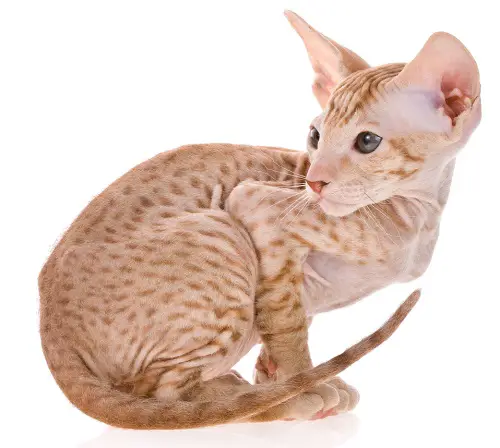
The Peterbald is a relatively new hairless breed originating from St. Petersburg, Russia – hence the name Peterbald. This elegant Russian breed is truly one-of-a-kind. They can be totally hairless, or might have a coat that feels like a peach. Some might even have slightly longer coat that feels like a man’s bristly beard or like plush short velvet.
Peterbalds are social cats of medium size that are easy to groom and even easier to handle. Gentle, peaceful, good-natured, and energetic, they love attention and make an ideal family companion for everyone, especially for first-time cat owners.
They inherited Oriental blood in their veins, which is why they have Oriental dog-like attachment to their humans. They love communicating with everyone around them and are not as independent as some other breeds are, so they constantly crave companionship. They love people, but love other animals as well, especially cats and dogs.
General Information:
Height/Length: medium
Weight: 6-10 pounds
Lifespan: 10 -12 years
Coloring: all colors and markings are acceptable
Area of Origin: St. Petersburg, Russia
Similar Breeds: Devon Rex, Sphynx, Russian Blue
Breed History and Origins:
Prior to 1988, the only known hairless cat was the Sphynx. In 1988, a cat with a weird-looking coat was reported in Russia. The cat was a female who steadily shed her fur, so the owner thought that she might suffer from a medical problem that causes hair loss. However, it turned out that the cat was completely healthy, and later she amazed her owner, having a litter with both normal-coated and hairless offspring. Irina Nemykina got a kitten from this breed and started a program for breeding. That is when the breed Don Sphynx became popular.
The gene that occurred from this mutation is a dominant gene, so the Don Sphynx was actually the first hairless cat. These cats are sturdy, elegant, highly intelligent, social, and good-natured. All in all, they are loving and affectionate animals.
The Peterbald was created in 1994 in Russia as a result of breeding a Don Sphynx male and an Oriental Shorthair female. Olga S. Mironova is the Russian felinologist who did the experimental mating. The first two litters resulted in four Peterbald kittens that became the founders of the Peterbald breed.
In 1996, the Russian SFF (Selectional Feline Federation) adopted this breed. One year later, the Peterbald was accepted in TICA (The International Cat Association), and in 2003, Peterbalds were accepted by the WCF (the World Cat Federation). The most common abbreviations for this breed are PBD, PD, PTB and PSX.
Nowadays, the Peterbald breed is developed in the direction of Siamese and Oriental types, denoting large, set-apart ears, long muzzle, flat cheekbones, long legs, and elegant bodies. Therefore, according to all standards, Peterbalds should be mated with Siamese or Orientals or semi-longhaired variations of those. The Balinese and Javanese were eliminated from the outcrossing list.
The Championship class competition accepted the Peterbald breed in 2009. Even today, Peterbalds remain a rare and desired breed. A person has to spend some time with a Peterbald in order to appreciate their beauty and gentle nature. Hairless cats can really be beautiful.
Size and Physical Characteristics:
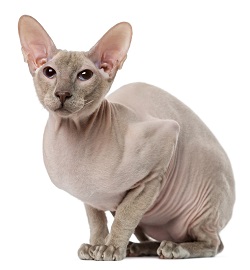 Peterbalds are elegant and graceful cats. Although they appear to be hairless, most Peterbalds are covered with a short, fine coat. However, it is more accurate to say that the perfect Peterbald is without fur. Their body is soft and warm to the touch.
The look of the Peterbald is different from other breeds. Their wedge-shaped head is long and narrow with high cheekbones and oval eyes. Their whiskers are broken off near the skin, while their ears are large, set straight and broad at the base.
These cats are in medium size with visible wrinkles all over their body, especially on the head, neck, tail, underbelly, and on top of their legs. Their body is long, lean, sturdy, and muscular, with medium-fine boning and firm musculature. Their legs are long with medium oval paws and long, prominent toes.
As for coloring, all colors and patterns in every combination possible are acceptable in Peterbalds.
Adult females weigh 6-8 pounds, while adult males weigh 8-10 pounds. However, size and weight vary according to bloodline.
Peterbalds have five coat types:
- Bald – some cats are born with no coat and are sticky to the touch; they do not grow whiskers or eyebrows.
- Flock – these cats are 90% hairless. They feel like chamois leather and are not sticky at all. The best thing about their flock coat is that it doesn’t matter in which direction they are petted; there is no wrong way when petting them. Eyebrows and whiskers are curly, kinky, or broken. Flock Peterbalds are the most desirable type of Peterbalds.
- Velour – these cats are 70% hairless. The length of their coat is 1-5 mm, so there is some resistance when they are brushed in the wrong way. They appear hairless from a distance, but their fur is visible.
- Brush coat – these cats have a wiry coat with length of about 5mm. The brush type of coat is unique and can be found in Peterbalds only. Whiskers are always kinky or curly.
- Straight coat – Peterbalds with straight coat have normal whiskers and a short coat. These cats actually do not have the hairless gene.
Personality and Temperament:
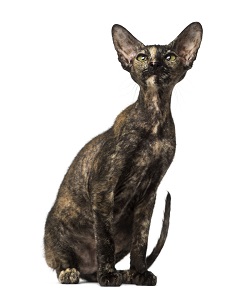 Due to the fact that this breed is relatively new and still being developed, their personalities and temperaments can also vary, since they depend on the cat’s bloodline. Peterbalds are trusting and gentle, loving to spend time with people who are equally playful. They are loving, friendly, frisky, and active, and get along well with everyone: their owners, strangers, children, other cats, and cat-friendly dogs – if proper introductions are made first, of course. Most visitors will become their friends in no time.
Peterbalds are never aloof. They are social, outgoing, friendly, and affectionate. Very people-oriented, they need attention and human love, so they always wrap their paws around their humans and give them forehead presses and chin licks.
Highly active, they follow their owners around the house, supervising their every move and offering their “help”. They will sit by their owners while they drink their morning coffee, crawl under the blankets when they go to bed, and sit by them during meals. They love to assist their owners in different chores around the house, because that way, their owners will have more time to pet them.
Since Peterbalds have Oriental and Siamese ancestors, they are quite vocal and communicative, but that does not mean they are loud and annoying; their voices are soft.
They always meet their owners and visitors at the door, wagging their long tail. They are extremely devoted to their humans and do not do well when they are on their own, so leaving them alone for a longer period of time is not okay. People who are busy working should consider getting another Peterbald to keep the first company.
Nutritional and Exercise Needs:
Peterbalds and Nutrition
The quantity of food served to Peterbalds should be adapted to their needs. There is nothing easier than overfeeding a cat and nothing harder than helping your cat break the habit of eating too many snacks. Peterbalds, as most cats, are prone to obesity. Changing foods can cause an upset stomach, so if that happens, owners should add a tablespoon of pumpkin with no spices to settle their upset tummy.
Using plastic bowls is not good because plastic has scratches that might allow bacteria to collect. Instead, owners should put cat food in stainless steel, glass, or ceramic bowls; and needless to say, their dishes should be cleaned regularly.
Peterbalds have a high metabolism, so they burn off calories quickly, leading to losing body heat quicker. That is why they need help staying warm, as well as extra food for restoring their fuel supply.
Fish products are bad for Peterbalds because they can shut down the kidneys and cause heart failure. Dry formula food along with boiled chicken breast (with fat, grease, and skin washed off) is what vets recommend when it comes to healthy nutrition for this breed.
Peterbalds chew a small portion of their food because their teeth tear meat rather than grind food. A canned-food-only diet might cause tartar buildup on the cat’s teeth, which is why dry food needs to be added to their diet as well.
Owners should keep their Peterbalds’ dishes full at all times. It almost goes without saying that they must also always have a fresh water bowl available.
Peterbalds and exercising
There are plenty of cat toys on the market today. Nevertheless, even the best and most expensive toys will not get a Peterbald’s attention if there is no interaction during playing. They are not into toys as much as they are into playing with playmates. Having a playmate doubles their interest, as well as the time they spend exercising.
Owners should play different games with their Peterbalds in order to keep them in shape and on the move. Tossing a ball or a piece of paper across the floor, playing fetch or playing hide and stalk are the games these cats find very interesting. They do not need expensive toys specialized for cats; instead, they love cardboard boxes, paper sacks, flashlights, and other simple household objects. Adding a scratching post and a cat tree for climbing and jumping is also recommended.
Sometimes the best exercise comes from a fellow cat, so owners who leave their cat alone during the day should get another cat; the benefits of a companion kitty are endless.
Grooming and Upkeep:
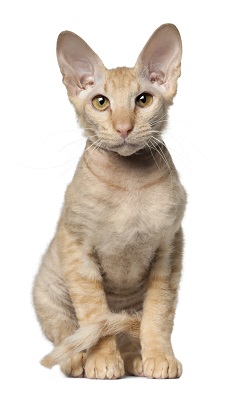 The fact that these cats do not have hair does not mean they are maintenance-free. As a matter of fact, the lack of hair means they require special care.
First of all, they must be kept clean, so bathing once a week and using cat wipes or baby wipes daily for wiping down their skin is something every owner must do. Peterbalds are hairless, which means they are oilier, so they need frequent bathing because they cannot soak up the oils off their skin. Over-bathing leads to skin problems, but bathing once a week won’t hurt. Getting Peterbalds used to water should be done as early as possible. Owners should be extra careful when bathing them because their ears must be kept dry.
Peterbalds should not be exposed to strong sunlight because they will get sunburns like people do, so they can end up with severe skin damage and painful skin conditions. They also must be protected from cold weather, so they need to wear kitty sweaters.
Most Peterbalds have no eyelashes, causing buildup to accumulate in the corners of their eyes. Because of that, their eyes should regularly be wiped with a clean, moist washcloth. Baby wipes and soaps will make their eyes burn.
Their teeth should also be checked since these cats are gentle and vulnerable to mouth infections. If they are accustomed to the activity when they are kittens, they will enjoy when their owners brush their teeth with a toothbrush and toothpaste made especially for cats. Finally, a Peterbald’s claws should be cut twice a month.
Characteristics Unique to the Breed:
Peterbalds are the ultimate attention-seekers. They crave kisses and cuddles and will not stop until they have undivided affection and attention from everyone around them.
However, as with every cat breed, Peterbalds have a few challenges: they produce a lot of oil and need more frequent bathing. They are also picky with their food, so owners must feed them with a high-quality, healthy food.
Some owners like to dress their Peterbalds in cute little sweaters to keep them warm, but some cats are uncomfortable when wearing clothes. If your cat doesn’t like wearing sweaters to keep warm, it might be wise to keep one bed with a heating pad beneath it available for them.
| The Peterbald | |
| Head: | Long and narrow head with a straight profile, big set-apart ears, muzzle in a wedge shape and almond-shaped eyes |
| Coat: | Peterbalds can be bald, flocked, brush, or velour, or have a straight coat |
| Adult Weight: | 6-10 pounds: females weigh 6-8 pounds; males weigh 8-10 pounds |
| Size/Shape: | Muscular, elegant body of a medium size |
| Legs: | Long legs with oval paws and long toes |
| Tail: | Long, whip-like tail |
| Voice: | Quiet |
Health and Wellness:
Since this breed is relatively new and still developing, there is no information about inherited conditions. So far, no serious health problems have been associated with their hairless gene. However, Peterbalds might inherit conditions from Siamese and Oriental Shorthairs, like liver amyloidosis that causes liver failure, or dilated cardiomyopathy that leads to enlargement of the heart muscle.
Peterbalds are prone to plaque buildup, gingivitis, and tartar formation – conditions that might lead to periodontitis, a disease that affects the tissues that surround and support the teeth. This disease is pretty serious, as it might cause bone, tissue, or tooth loss, and if not treated on time, it could begin to affect the overall health of the Peterbald.
3 Interesting Facts about the Peterbald:
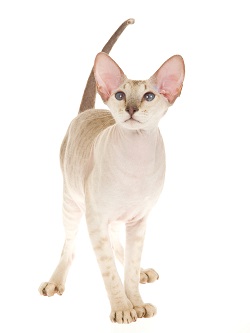 Peterbalds have a very high metabolism, causing them to require more food than other cats.
- Scratches and wounds on Peterbalds heal faster than on coated cats.
- Even though they have no hair, Peterbalds are not considered hypoallergenic.
Why Choose a Peterbald?
Although they look kind of weird (people in general are not used to hairless cats), Peterbalds are outgoing, energetic, and athletic. They make truly lovely and affectionate pets and are very cuddly and affectionate. The popularity of this breed is on the rise, so those who want an exotic, rare, and extremely affectionate and friendly cat, the Peterbald is the ideal choice for them.