Welcome to our Oriental Shorthair Cats page! Here you will find everything you could ever want to know about Oriental Shorthair cats and a complete list of all the Oriental Shorthair catteries we have located in the USA.
Oriental cats are members of the Siamese group and are divided into two categories: Oriental Shorthair and Oriental Longhair. Like all members of the Siamese group, Orientals are long, elegant, slender cats. They are talkative, lively, intelligent, and extremely attached to their people. All members of this breed have pretty much the same physical characteristics, except they all differ in color and coat length. What makes the Oriental Shorthairs unique is their vast array of colors.
Oriental Shorthair Cat Breeders Near You

Oriental Shorthair
- Are you a cat breeder who isn’t listed? Add your information here.
We also highly recommend reading checking out our latest news articles at our blog. Find information on Cat health, nutrition, holistic healing, basic care, toys, and much more!
Oriental Shorthair Cat Breed Information
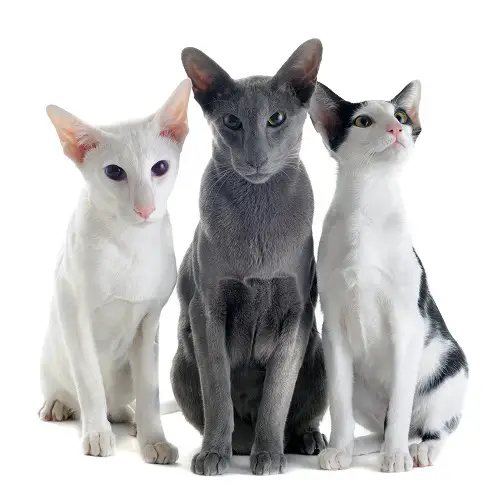
The Oriental Shorthair is a man-made breed that was developed to explore every possible color and color combination. Some people call them “Ornamentals” due to their array of colors and patterns. They are actually the most colorful cats on the planet.
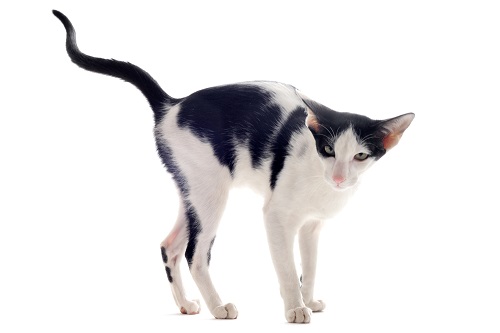
As their name suggests, their coat is short, but it is also glossy and fine. Oriental Shorthairs are described as non-pointed Siamese cats because their color or pattern covers their entire body, not just the ears, face, legs, and tail. Unlike the Siamese, Oriental Shorthairs have green eyes. They are athletic cats with long, svelte bodies. Fun-loving and lively, they are always into everything that is going on around the house, supervising the move of every human in the household.
Oriental Shorthairs have the same loving personality as the Siamese: smart, curious, and chatty. Their voice is kind of distinctive and they love to “talk” to their humans about anything and everything. They are very attached to their humans, so those who are considering getting an Oriental Shorthair should prepare themselves for a lifetime commitment. People who appreciate sculptural looks of a cat breed, and also want a cat that will show endless love should look no further – the Oriental Shorthair is the ideal cat for them.
General Information:
Height/Length: medium
Weight: 5-10 pounds
Lifespan: 10 -15 years
Coloring: every color possible
Area of Origin: Thailand, United States, UK
Similar Breeds: Siamese
Breed History and Origins:
Orientals are cats that originated in the 1950s in the UK. The Oriental Shorthairs seen today are not a direct import from Thailand, but a Siamese hybrid developed in the 1950s. They are actually a color remake of the Siamese. The creation of this breed was somewhat deliberate; breeders were working on creating a cat with personality and look of the Siamese, but in a wide range of colors. They started by crossing Siamese cats with Russian Blues and domestic shorthairs. Several years later, the American breeders were fascinated with the Oriental cats developed in England, so they decided to cross Siamese, Abyssinians, and domestic shorthairs to create a brand new look. The body style remained the same. The cats that resulted from this crossing were backcrossed to the Siamese again in order to preserve the personality traits and the physical appearance.
In a few generations, breeders successfully produced cats that looked like Siamese, except this new breed had a wide variety of colors. There were cats with Siamese points and non-pointed cats. Those with Siamese points were used in breeding programs for Siamese, while the non-pointed cats became the basis for a brand new breed: the Oriental. In the 1970s, the cats from the new breed were crossed with American Shorthairs and produced cats with even more colors and patterns.
Oriental Shorthairs today
The Oriental Shorthair was accepted for registration in 1972 by the CFA. In 1976, this breed got provisional status, and one year later the Oriental Shorthair was granted full championship status. In the 1970s and 1980s the popularity of this breed rapidly increased and it was ranked high on the lists of the most popular shorthaired breeds. In 2013, this breed was ranked 12th on the list of the most popular CFA recognized shorthaired breeds.
Today Oriental Shorthairs come in hundreds of colors and patterns.
Size and Physical Characteristics:
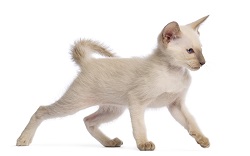 The overall impression of the Oriental Shorthair is that these cats are slender, graceful, and elegant. Like the rest of the breeds of the Siamese group, Orientals have a long and lean body, and they look heavier than they actually are. They are true athletes with a surprising muscle weight; they are built like dancers or runners. People are usually fooled by their tubular, svelte body, but the Oriental Shorthairs are neither fragile nor frail.
They body, head, and neck are long. When looked at from the side, their profile is straight, and the chin lines up with the nose. The head itself is heart-shaped and smooth, the ears are large and wide-based, and the eyes are almond-shaped, both set at an angle that follows the wedge. Their legs are long, slim and slender with small and oval paws, and their tail is long and whippy.
Except for the coat color, Oriental Shorthairs and Siamese are indistinguishable. The coat of the Oriental Shorthair is short and close-lying with a glossy and fine texture. They come in more colors than any other cat breed, including shaded, solid, smoke, bicolor, parti-color, and tabby. Depending on the color of their coat, they eyes might be blue, green, or odd – where one eye is blue and the other is green.
The variety of coat colors as well as hair shaft patterns present in Oriental Shorthairs is extensive. Oriental Shorthairs with shaded patterns have a white undercoat with colored tips. Those with solid coat have a uniform color; each hair of the coat is free of tipping and banding. The hair shaft in cats with a smoke pattern has a narrow band of white at the base. The bicolor pattern is created by adding the white spotting gene to any accepted color. Parti-color Orientals have patches of red and cream which can be well-defined blotches or marbled. Finally, the coat in tabby Orientals has a band of color in the middle of the hair shaft.
Personality and Temperament:
The personality and temperament of Oriental Shorthairs are equally as colorful as their coat. This breed, like the Siamese, is intelligent, sociable, and lively, and loves to play. These cats are fetchers, always returning their toys to their humans. They will choose one human and claim him as their own. They will always interrupt their owners in everything they do. Their favorite part is when they help their owners select items from the fridge. Highly curious, they will do anything to be involved in their humans’ activities.
They love to talk and ask questions, and they always expect an answer. They will tell owners what is on their mind in a loud and raspy voice, and they will expect feedback. They are agile cats that enjoy playing interactive games with their humans.
Oriental Shorthairs live by the motto that anything worth doing is worth doing with positivity and enthusiasm. They are playful and active entertainers. When there is no one around, they can be found snooping around in cupboards, drawers, or closets.
At the end of the day, they will curl in the lap of their favorite human companion to cuddle. With the right care and enough attention, these trusting and people-oriented cats grow into dedicated and loving companions.
Like the rest of the Siamese group, Oriental Shorthairs are not for people who have an active social life most of the day. As it was already mentioned, the Oriental bonds with one person and becomes depressed and unhappy if left alone too long. Sharing life with this breed is a huge responsibility. Given the necessary amount of attention and love, the Oriental Shorthair will become man’s best buddy and will repay with years of affection and love. When compared to the Siamese, the tone of the Oriental Shorthair is milder, but still, they are more vocal than the average cat, so people who love peace and quiet should opt for a more soft-spoken breed.
Nutritional and Exercise Needs:
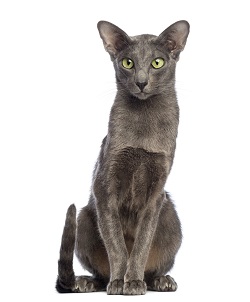 Oriental Shorthairs and Nutrition
In the “old days” when cats lived outside, they hunted prey and lived to be 20 without all the health problems they face today. Now there are liver disease, kidney disease, diabetes, urinary crystals, etc. The saying “you are what you eat” is not just for people; it is for every living creature, including cats.
Oriental Shorthairs do not require special food. As any other cat, they are carnivores, so they need meat. Chicken has protein and is great for cats, but that does not mean they should eat nothing but chicken. They can eat regular cat food, as long as the ingredients are healthy and the food has enough protein. Choosing foods with high levels of quality proteins (no grains and little to no meat byproducts) is recommended.
Owners should feed their Oriental Shorthairs both dry and wet food. Although this breed is not prone to overeating, there are some cats that would eat everything that is in the bowl. Cats, in general, do not drink enough water, so leaving water bowls around the house is another thing owners should consider.
It is wise to shut the door of every kitchen cupboard and put food out of sight because Oriental Shorthairs are curious and inquisitive.
With the proper diet, they will have better health for many years to come.
Oriental Shorthairs and exercising
Orientals are lively, playful cats. They enjoy regular play sessions, so owners should provide them with physical exercise and mental stimulation games.
Those who play together, stay together. In general, cats are lazy and sleep most of the day, but that is not the case with the Oriental Shorthairs – they are never tired and always on the move.
They are all fetchers, returning their toys to the hands of their owner. Every Oriental Shorthair has a favorite toy: catnip sacks, rattle mice, wads of crumpled paper, feather toys, pens, and so on. They will play with any item they can chase around the living room floor. They are very active and energetic, so they can often be found playing for hours with something as simple as a cardboard box.
Owners should give them the affection and attention Orientals desperately need, and they will do anything to please their humans. These elegant cats remain spirited, loyal, and playful well beyond their youth.
No high shelf or cupboard is safe from these high-jumping cats. They are very curious, so they should not be allowed to roam outside because they might get into trouble. Orientals love heights, and that is why owners should provide them with cat trees and perches.
Grooming and Upkeep:
The short, fine coat of Oriental Shorthairs is easy to care for. Owners do not need a great number of tools for grooming.
Oriental Shorthairs do not need to be bathed very often (unless they become unusually dirty). Some cat breeders say that they started bathing their kittens at an early age on a regular basis, but Oriental Shorthairs are too intelligent to fall for that.
Combing needs to be done once a week with a stainless steel comb or brush with soft bristles to remove dead hair. In order to make the coat shine, owners should groom it with a soft cloth.
In order to keep their eyes clean, owners should wipe them with a small, damp cloth. Your cat will show with body language whether he has eye distress. If an Oriental Shorthair is pawing at his eyes, owners should give them a good eye inspection. If there is watering, discharge, tear-stained fur, white or red eyelid linings, or crusty buildup in the corners, owners should consult the vet.
Ear cleaning is another grooming procedure that needs to be done once a week. Liquid ear cleaner placed on a clean cotton ball can wipe away any earwax or debris that can be seen on the inside of the ear. Cleaning the ear canal can cause infection or trauma, so that should only be done by a vet.
Teaching the Oriental Shorthairs to accept having their claws trimmed while they are kittens is recommended. This way, they will grow up being comfortable with nail trimming.
| The Oriental Shorthair | |
| Head: | Long, heart-shaped face with strikingly large gremlin-like ears |
| Coat: | Short, close-lying, glossy coat in all traditional colors |
| Adult Weight: | 5-10 pounds: females weigh 5-8 pounds; males weigh 8-10 pounds |
| Size/Shape: | Medium, athletic, and muscular |
| Legs: | Long, slender legs with small oval paws |
| Tail: | Long, whippy tail |
| Voice: | Vocal; loud, raspy voice |
Characteristics Unique to the Breed:
Oriental Shorthairs are low-maintenance cats that are perfect for owners who do not have plenty of time to devote to grooming procedures. However, they do demand a lot of attention when it comes to playing and cuddling because this cat is happy when they relax with their owner and share a blanket together. They have their moment of playfulness, so it is of great importance to keep cat toys on hand in order to meet their demands for playing and fun.
However, they can be quite temperamental, so they might not be the ideal choice for families with newborns and small children that do not understand they can’t play with the kitty whenever they want.
Health and Wellness:
Oriental Shorthairs are in general healthy cats, but they can suffer from the same diseases as the Siamese breed, including the following:
- Hereditary liver amyloidosis causes amyloid to be deposited in the liver, causing lesions, liver rupture, liver failure, and hemorrhage. The adrenal glands, gastrointestinal tract, spleen, and pancreas might be affected as well. Treatments vary depending on the cause, but in general, they include antibiotics, vitamins, anti-inflammatory drugs, liver protectants, and fluids. With these treatments, the Oriental Shorthair might be able to lead a normal life.
- Kidney disease – Oriental Shorthairs might be affected by kidney disease caused by blockages, infections, tumors, or toxins. The treatment options depend on the cause of the damage, but usually include flushing the kidneys with intravenous fluids, medications and special diets.
- FLUTD is feline lower urinary tract disease, also referred to as cystitis. Stress, infections, bladder stones, or not urinating enough can lead to this disease. Cats diagnosed with FLUTD will probably require pain relief, special diets, drinking plenty of water, and lifestyle adjustment to reduce stress.
- Feline asthma is another common ailment in Oriental Shorthairs. It occurs when irritants and allergies cause the lower airways and lungs to become sensitive and inflamed. Symptoms include wheezing and coughing.
- Eye conditions – Orientals can suffer from glaucoma, conjunctivitis, cataracts, and entropion. Treating the primary cause is important, but there is nothing to do for the inherited form.
3 Interesting Facts about the Oriental Shorthair:
There are more than 300 possible color, pattern, and coat length combinations in Oriental Shorthairs.
Oriental Shorthairs are an offshoot of the Siamese breed, but the Oriental’s coat does not have points.
Oriental Shorthairs are also known as “Ornamental” due to their coat colors.
Why Choose an Oriental Shorthair?
Having more than 300 color, pattern, and coat length combinations, the Oriental Shorthair might be the most colorful cat breed on Earth. These cats have the same sleek coat, elegant body and chatty temperament as the Siamese, but unlike Siamese cats, Orientals come in any color possible. Very popular, the Oriental Shorthair is for cat lovers who want an elegant cat like the Siamese, but prefer a cat with distinctive colorations.