Welcome to our Ocicat Cats page! Here you will find everything you could ever want to know about Ocicat cats and a complete list of all the Ocicat catteries we have located in the USA.
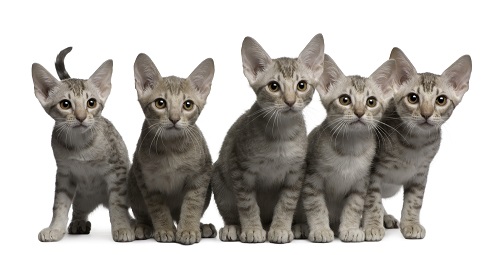
The Ocicat is a safe, indoor version of the wild cats that many would love to have as pets if it were possible. Ocicats are the only domestic cats bred to look like wild cats, yet there isn’t a wild cat in this new breed’s bloodline. These beautiful spotted kitties are as tame and friendly as their ancestors: the Abyssinian, the Siamese, and the American Shorthair.
Ocicat Breeders Near You

Ocicat
- Are you a cat breeder who isn’t listed? Add your information here.
We also highly recommend reading checking out our latest news articles at our blog. Find information on cat health, nutrition, holistic healing, basic care, toys, and much more!
Ocicat Cat Breed Information
Breed History and Origins:
Ocicats appeared by accident in 1964, when a spotted kitten was born while an American cat breeder was trying to develop a cat that looked like a Siamese but had the color pointing of an Abyssinian cat. A mistake in the breed’s paperwork later led to the American Shorthair being included in Ocicat breeding programs.
Tonga, the spotted kitten
In the 1960s, Mrs. Virginia Daly, a cat breeder in Michigan, wanted to develop a Siamese cat that had reddish-brown points, the color of an Abyssinian cat, on its face, paws, and tails instead of the usual dark fur.
In 1964, one of the kittens born of Siamese and Siamese-Abyssinian parents had spots all over its coat. Mrs. Daly’s daughter called it an Ocicat, because it looked like an ocelot, a wild cat found in parts of Central and South America. They named the spotted kitten Tonga. Because it didn’t have the look she was trying to develop, Tonga was then neutered and placed in a loving home.
After that, Mrs. Daly read an article by geneticist Clyde E. Keeler, who had developed the Himalayan cat breed with Virginia Cobb in the 1930s. Dr. Keeler said that he would like to bring back an Egyptian spotted cat, so Mrs. Daly wrote to him about Tonga. He was very interested, as he had already seen a write-up in the Detroit newspapers about Tonga.
Unfortunately, Tonga couldn’t breed, but his parents produced more spotted kittens. Dr. Keeler gave Mrs. Daly tips on how to develop the breed with these new Ocicats.
Paperwork error improves the breed
At first, the new Ocicat kittens were shown in the Exhibition Only category at shows, but in 1966 the breed was registered with the Cat Fanciers Association. The minutes of the meeting where the CFA first recognized the Ocicat mistakenly described it as a combination of Abyssinians and American Shorthairs, not what it really was – a combination of Abyssinians and Siamese cats. The papers were later corrected to include the Siamese, but the American Shorthair was there to stay.
The American Shorthair brought beautiful silver fur coloring as well as a sturdier, more powerful build to the Ocicat breed. Its new genes also made ocicats much healthier.
Ocicat Size and Physical Characteristics:
 Ocicats combine the good features of their purebred ancestors into a look that’s all their own. They are sleek and beautiful like the Abyssinian and Siamese, but they also are sturdy and muscular, with gorgeous fur coloring, like the American Shorthair.
Head and body
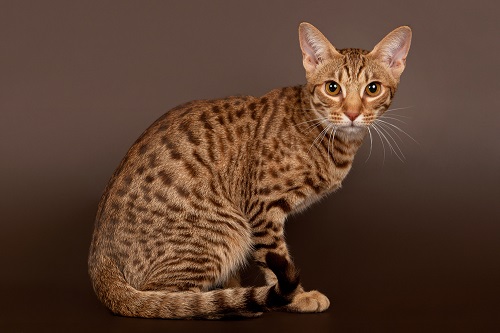
An Ocicat’s head is shaped like a slightly rounded wedge, with a broad muzzle and a strong chin. Its ears are fairly large and may have tufts at the tip, like a lynx. The eyes are large and almond-shaped. They come in all colors. Cat fanciers don’t show Ocicats with blue eyes because this is a sign that Kitty is carrying more Siamese genes than a purebred Ocicat should have. By the way, there is no correlation between an Ocicat’s eye color and fur color.
These cats have a lovely arching neck and a medium-long body. Their bodies are graceful, but ocicats are heavier than they look thanks to their solid build. They are trim athletes, not muscle-bound wrestlers. The legs are moderately long and powerful. Ocicats have oval paws, generally with five toes on each fore paw and four on each hind paw. Their tails are fairly long and don’t taper very much.
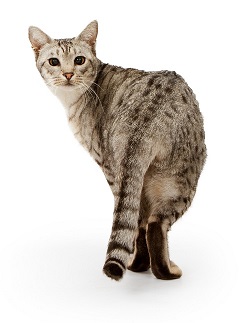
Ocicats have a single smooth coat of short, plush fur. It comes in any of 12 colors. The three basic fur colors are tawny (black or dark brown), chocolate, and cinnamon. Then there are dilute varieties of these colors – blue, lavender, and fawn – plus any of these six mixed with silver.
Ocicat fur patterns are beautiful. Cat fanciers prefer spots, but these wild-looking domestic kitties also come in solid colors or with points like a Siamese, as well as in tabby patterns. They have a dark “M” pattern on their foreheads, as well as “mascara lines” around the eyes. The “M” extends up over their heads and turns into little spots over the neck and shoulders.
A spotted Ocicat’s body is covered with thumbprint-sized spots. The fur on its legs and throat has dark lines called “broken bracelets.” Its tail fur shows dark rings and spots. The cat’s darkest fur is usually on its mascara lines and on the tip of the tail. The lightest fur is on Kitty’s face.
All hairs of an Ocicat’s coat are ticked. That is, they have alternating bands of light and dark colors. Hairs in the background color have light colors on their tips, while hairs in the pattern color have dark tips.
Ocicat Personality and Temperament:
The Ocicat looks wild, but it is as sociable and docile as any other domestic cat. It is very affectionate and will fit into any home environment. Ocicats need training and can be rambunctious, so they aren’t ideal pets for the first-time cat owner.
A friendly, adaptable cat
An Ocicat is easygoing and enjoys being around humans and meeting new people. This cat breed gets along great with children and doesn’t mind the hustle and bustle of family life one bit. The more activity, the more opportunities to interact with everybody!
Ocicats do build close bonds with one person and will be almost dog-like in showing their affection to that special someone. They aren’t jealous, though, and will also socialize with other family members and any resident pets, including dogs.
The easygoing nature of an Ocicat, combined with its desire to always be in the thick of things, make it very adaptable. This is one cat that loves to travel. It will get lonely if left alone longer than eight hours or so and will gladly join you on vacation.
Intelligent and boisterous
These cats learn their names and can remember many words. They can be trained to wear a harness and will do tricks. Ocicats also can teach themselves how to open doors and drawers and are very curious. You will have to cat-proof your house up to and including the ceiling fan, as well as use child-proof locks for anything you don’t want Kitty to get into.
Ocicats take playtime seriously. They will tolerate your leaving for a job eight hours a day but will be waiting at the door when you get home, probably holding a toy and looking up at you expectantly.
Many Ocicat owners say that playtime is mandatory with these lovable little devils. It’s no burden. Watching their antics and chatting with them is a great way to unwind after work. At 3 a.m., not so much, but that’s something you and Kitty will have to work out together.
Speaking of playtime, Ocicats often hoard toys. They will argue and try to hide their playthings when you come to gather them up at the end of the day.
Ocicat Grooming and Upkeep:
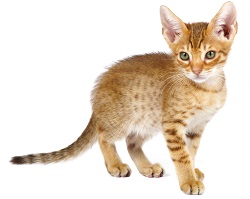 The Ocicat’s coat is beautiful and intricately patterned, but grooming is very easy. The only other regular care this cat needs is claw trimming and dental care.
A low-maintenance pet
Ocicats have a single coat of short fur. They may shed a little, but not very much. All you need to do is gently brush them once a week or so, more frequently during the spring and fall shedding seasons. Some owners skip the brush and just rub down their Ocicat with a chamois to remove dead hairs and make its fur shine. If you do that, just make sure you use pure chamois with no added chemicals.
Unless you plan to show your cat, bathing shouldn’t be necessary. If you do want to wash your ocicat, any cat-safe shampoo will do. You might even want to use the shampoos cat fanciers use to highlight Kitty’s coat: bronze-toned shampoo for tawny, chocolate and cinnamon cats, pearl-tone wash for fawn, lavender and blue Ocicats, or a whitening shampoo for any of the six silver fur colors.
Claws and teeth
Cats groom their claws by scratching, but this doesn’t remove all the dead layer of nail. Also, their claws keep growing and can get long enough to hurt the cat. For both these reasons, you will need to trim their claws every couple of weeks.
If you’ve never done this before, the attempt to go after those 18 claws (five on each fore paw and four on each hind paw) may seem a little overwhelming, but it’s really very simple and goes quickly after a little practice. Your veterinarian can show you the proper tools to use and how to clip the nail safely.
Don’t forget the teeth! Ocicats are especially prone to gingivitis because of their Siamese and Abyssinian background and need regular cleaning. The vet could do it, but that would mean putting the cat under general anesthesia, which is always a little risky. An Ocicat should be trained from a young age to accept tooth brushing. Sometimes all that’s needed is a gauze-wrapped finger, but your vet can also show you the right tools and point you toward cat-safe toothpastes (never use human toothpaste for your cat).
Nutritional and Exercise Needs:
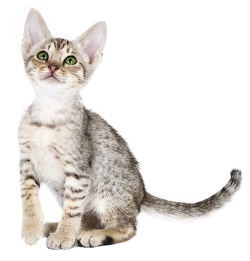 Ocicats, like all domestic cats, need about twice the protein dogs do, and they should be encouraged to drink water. These cats are also extremely active by nature and need lots of exercise daily.
Protein and water
Although Ocicats are one of the very few cat breeds that actually look wild, it’s a fact that all domestic cats are descended from African wildcats. As desert hunters, those wildcats developed a metabolism that depended on prey for energy. There aren’t a lot of carbs and fat in the Sahara.
This is why domestic cats are carnivores out of necessity. Unlike dogs, cats must eat meat to survive. Commercial cat food that meets guidelines set by the Association of American Feed Control Officials (AAFCO) will provide the right amount of protein and other nutrients to give your Ocicat a complete and balanced diet.
It’s important to think about water when deciding if you’re going to feed Kitty canned food or dry kibbles. There isn’t a lot of water in the Sahara, either. The wildcat got all the water it needed from its prey. Today, canned food gives your cat the same amount of water per serving that prey would, but the cat will get a little dehydrated if it just eats dry food. That’s why you should always have plenty of fresh water around when giving your Ocicat a diet of dry food.
Playful and full of pep
First off, lock up your fragile things. These cats will get into everything they can. They’re definitely not lap cats.
Ocicats keep their kittenish level of activity all their adult lives. However, they love attention and so will often do what you tell them to, especially if you engage their intelligence and give them options.
They love heights, so ceiling-high cat furniture that has multiple levels, built-in scratching posts, and detachable toys can keep them occupied for hours. Hunting games are popular both for the activity they offer as well as the chance to spend extra time with you. Whirling feathers, laser dots, toy mice, and rolling balls that can be ambushed are good. So are puzzle games that Kitty can interact with.
Unique Ocicat Characteristics:
Ocicats are the only domestic cats that have been completely developed by humans and bred to resemble wild cats. Some people confuse them with other spotted domestic cats, especially the Egyptian Mau, the oldest naturally spotted domestic cat breed. Here is how to tell them apart.
Size can be a good way to tell the two breeds apart. Female Ocicats are noticeably larger than their Egyptian Mau sisters, but males in both breeds are big, between 10 and 15 pounds.
Eye color also helps. If Kitty’s eyes are any color but green, it probably is an Ocicat, though this breed sometimes has green eyes, too.
Check the fur color. Sometimes it is quite different. However, Egyptian Mau cats and Ocicats may have very similar coloring.
Check the spots. Ocicat spots look like a thumbprint, while those on an Egyptian Mau can be any size and shape. An Ocicat has plenty of spots on its tummy fur, while the Mau’s belly spots look more like buttons on a vest.
While you are looking at its fur, check to see if Kitty’s individual spot hairs are ticked. Does each hair have alternating bands of light and dark color? If so, that’s ticking and Kitty is probably an Ocicat. However, bronze and silver Egyptian Mau cats can have ticking, too. This is not a problem. Mau spots are only dark on the tips of the hair. The hairs of an Ocicat’s spot will be ticked all the way down.
| The Ocicat | |
| Face: | Round with plump whisker pads, slanted eyes, and big ears. |
| Fur: | Short. Patterns: usually spotted, but also classic tabby, solid, or pointed. |
| Adult Weight: | Males: 10-15 pounds. Females: 7-12 pounds. |
| Size/Shape: | A bit larger than most domestic cats. Athletic, very muscular. |
| Legs: | Medium-long, muscular, and proportional. |
| Tail: | Long, about two-thirds of the length of the body. Not whip-like. |
| Voice: | Talkative and chatty, though not as loud as a Siamese. |
Health and Wellness:
Ocicats look like wild cats, but they were developed from two purebred lines that have associated hereditary diseases. Fortunately, the addition of the American Shorthair’s wider gene pool makes this breed generally quite rugged and long-lived.
Hereditary health concerns
Some Abyssinian cat lines are prone to liver or renal amyloidosis. There rare diseases cause liver or kidney failure. Renal amyloidosis also leads to high blood pressure. Both have been found in a few Ocicat lines. They usually show up by the time the cat is five years old. There is no cure for either disease, but medical treatment, medication, and special diets can prolong the cat’s life.
PK deficiency is another hereditary disease that Abyssinians tend to get. It also has been found in some Ocicats. This genetic disorder doesn’t shut down any major organs, but it can make Kitty anemic. DNA testing can identify carriers of this disease before breeding, so this problem will eventually disappear.
Both Abyssinians and Siamese cats sometimes get retinal atrophy, and this, too, has affected some ocicats. There is no cure, but blind cats can live long and otherwise healthy lives if they are kept indoors. The condition in Ocicats can be detected when they’re as young as seven months. There is also a genetic test to identify carriers of this gene.
Siamese cats have hereditary problems with hypertrophic cardiomyopathy (HCM). This has been found in some Ocicats. HCM is the most common form of heart disease in cats. It has been diagnosed as early as three months but usually shows up between one and five years of age. It can be treated with drugs and special diets.
Generally very healthy
That’s a long list of possible health problems, but most Ocicats are actually very healthy.
It certainly helped Ocicats when American Shorthairs were bred into the line. Shorthairs have been around for hundreds of years and have a very healthy gene pool, with no associated hereditary diseases. They have brought these cats good health as well as sturdy bones and muscles.
Your Ocicat will be bounding around the house happily for many years. This breed can live into its late teens when kept indoors and given plenty of love and attention.
Interesting Facts About Ocicats :
- This breed looks like the Ocelot, or dwarf leopard. Known as Leopardus pardalis, this little wildcat has been seen as far north as Texas and as far south as Argentina.
- Ocicats have no wild cats at all in their line, though like all domestic cats, their very distant ancestors were desert wildcats.
- From its beginnings in the US state of Michigan, the Ocicat breed has spread throughout much of the world, including North and South America, the United Kingdom, Europe, Japan, Thailand, Australia, and New Zealand.
- Outcrossing with Abyssinians is still allowed by cat fancier associations, but not with Siamese or American Shorthairs.
- The Ocicat breed went through an 11-year hiatus right after it was established, when Mrs. Daly had to care for a sick family member. She returned to cat breeding in the 1980s.
- Ocicats are the 18th most popular breed, according to the Cat Fanciers Association.