Welcome to our Norwegian Forest Cats page! Here you will find everything you could ever want to know about Norwegian Forest cats and a complete list of all the Norwegian Forest catteries we have located in the USA.
The Norwegian Forest Cat is beautiful, rugged, and friendly. It is a new breed for international cat fanciers, but farmers in Norway have welcomed the semi-longhaired “skogkatt” (Norwegian for “forest cat”) as a hunter and companion for hundreds of years. As a breed Norwegian Forest Cats are prone to a couple of hereditary diseases, but overall these robust, healthy animals make very good pets or show cats.
Norwegian Forest Cat Breeders Near You

Norwegian Forest
- Are you a cat breeder who isn’t listed? Add your information here.
We also highly recommend reading checking out our latest news articles at our blog. Find information on Cat health, nutrition, holistic healing, basic care, toys, and much more!
Norwegian Forest Cat Breed Information
History and Origins:
The Norwegian Forest Cat is a new breed to cat associations. However, these beautiful long-haired cats have been known throughout Northern Europe for hundreds of years, though no one knows how they got there. Forest cats almost disappeared as a pure breed during World War II but were brought back and now are recognized by all the major cat fancier associations.
Legend and fact
In Norse legend, two white forest cats pull a chariot belonging to the Norse goddess Freyja. In another story, a giant-king challenged Thor to pick up a forest cat. The God of Thunder could only lift the skogkatt up far enough to get one of its legs off the ground, but that impressed the giant-king because it was a magic kitty.
In the real world, the origin of the Norwegian Forest Cat is unclear. This kitty isn’t descended from native wildcats, and it doesn’t look like any other breed.
Some think that Roman traders brought their cats into northern Europe 2,000 years or so ago. Others suggest that the Vikings brought short-haired British cats back to Norway because they kept rodents under control on board ship. Those Viking cats then supposedly bred with longhaired Asiatic cats brought into Europe by the Crusaders. The result was the semi-longhaired Norwegian Forest Cat we see today.
Whatever happened, cats were in Scandinavia by 800-1200 AD, when the Norse legends were written down. These smart felines must have realized that a working life on the farm is a lot easier than the struggle for survival in a subarctic wilderness. Rural people in turn welcomed them into their homes for companionship as well as pest control.
Challenges in the 20th Century
During the early 1900s, many people left Norway for America. Other rural folk moved to Oslo as the country modernized. This migration left fewer homes available for forest cats. These lovely animals weren’t forgotten, though. The first Norwegian Forest Cat clubs appeared in Oslo during the 1930s. People began working to register them and to get international recognition for the breed.
Then World War II happened. Forest cats, like other animals, were left on their own, displaced from farms and the city alike. They intermingled with Norway’s shorthaired cat (the hauskatt) and almost disappeared as a pure breed.
After the war, the Norwegian Forest Cat Club went back to work. King Olav V helped out after he came to the throne in 1957 by making the forest cat Norway’s national cat. However, it wasn’t until the 1970s and early 1980s that the Norwegian Forest Cat started to get the international recognition it so richly deserved. The International Cat Association allowed it to compete for championships in 1984. The Cat Fanciers Association and the American Cat Association followed suit in the early to mid-1990s.
Size and Physical Characteristics:
| The Norwegian Forest Cat | |
| Face: | Triangular and symmetrical. |
| Fur: | Double coat, top layer waterproof, 4-6 inches long, longer on legs and ruff. |
| Adult Weight: | Males: 12-16 pounds. Females: 9-12 pounds. |
| Size/Shape: | Large-boned and muscular. Body moderate in length. |
| Legs: | Medium length. Hind legs longer and more muscular. Paws with fur tufts. |
| Tail: | Long and bushy. |
| Voice: | Generally low and quiet, louder when living with dogs. |
Norwegian Forest Cats are big and muscular. How big? Not quite as big as lynxes, though they sometimes have tufted ears like lynxes do. How muscular? They can climb rocks and grip a tree strongly enough to walk down it face first!
The head and body
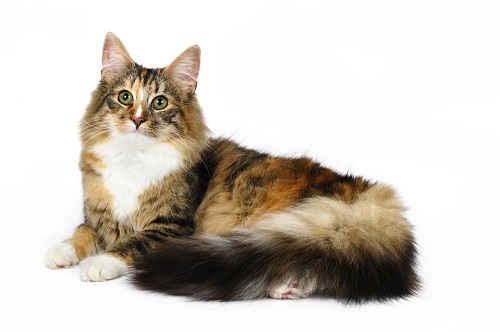
A forest cat’s face is shaped like an equilateral triangle. It has a very sturdy round chin and large, almond-shaped eyes that are usually green-gold, but can vary from pure gold to pure emerald green. The outer corner of each eye will be set higher than the inner corner.
The nose comes down from the forehead in a straight line. The skull curves gently and sits on a short, muscular neck. The ears of a Norwegian Forest Cat rise symmetrically with the triangle shape. They are medium to large in size and sometimes have tufts of hair as much as 4 inches long.
These cats have a medium-length body that takes around five years to mature and is ruggedly built. Their bushy tail is just as long as their body. Forest cat legs are proportionate and have sturdy bones. The hind legs are a little longer than the forelegs, with deep muscular flanks. These back legs appear straight, but the front legs toe out a little. Norwegian cats have big round paws and lots of furry tufts in between their toes.
Norwegian Forest Cat fur
An adult Norwegian Forest Cat has a gorgeous two-layered fur coat. Its dense wooly undercoat is covered by a longer, glossy outer coat that is waterproof and puffs out in a beautiful ruff around the head, neck, and chest. There are also long fur britches on the cat’s hind legs.
Norwegian Forest Cat kittens are born just with the wooly undercoat. For a short time they look short-haired, though they do have bushy tails. The overcoat starts coming in at around three months of age. It may take as long as two years to fully develop.
Forest cats have different looks depending on the season, especially if they spend time outdoors. They shed their undercoats in spring and grow them back again in the fall. Cat fanciers sometimes put a cat outside in the winter for an hour or so daily to maximize the thickness of its winter coat before a show.
Norwegian Forest Cats come in solid colors as well as every possible mix of two different shades, including the very popular brown and white. If you are going to show your cat, you should know that associations don’t accept colors like lilac or pointing (dark fur on the face, feet and tip of the tail) because these are a sign that the cat has bred outside its line.
Personality and Temperament:
 Norwegian Forest Cats look wild, but they make good indoor pets. Just as with other cat breeds, forest cats live longer and are healthier if they spend their entire lives inside. They’ll be quite happy to do this because they really like being around people.
A friendly, nurturing personality
The Norwegian Forest Cat enjoys being around other animals as well as spending lots of time with its owners. Mothers are especially loving and will even adopt another cat’s kittens. Forest cats have been known to come and get somebody when something was out of place or when another animal or person in the family was having difficulties.
Once it gets used to you, a forest cat enjoys your company so much that it gets lonely when left at home. You might want to consider getting two cats, preferably littermates, or having some other pet around if you have to spend a lot of time outside the home.
These intelligent animals adapted to the harsh Scandinavian winter, and they will also adapt to just about any living environment. However, they are independent. As loving as forest cats can be, they dislike being held. Don’t worry – petting, head bumps, conversation, and other signs of affection are right up their alley.
Norwegian Forest Cats are quiet, though they can get loud when there is a dog in the home. They purr a lot when around someone they love.
Sociable, independent, and curious
Unlike some breeds, Norwegian Forest Cats don’t bond closely with one favorite person. This means that they are good with families and with other pets. It might take them a while to get used to everybody, but then they will enjoy all that attention and companionship.
Forest cats aren’t leery of dogs or strangers. They are good with children but will walk away from a child who tries to manhandle them. In fact, with any socializing, this loving but independent cat will usually be the one to set limits, not you.
These intelligent cats enjoy toys that challenge their minds as well as their bodies. A moving puzzle toy that rewards them with a treat will keep them busy for hours. They can be trained and will also enjoy interacting with you over catnip mice, whirling feathers, and other hunting games.
Grooming and Upkeep:
 For a cat with such luxurious fur, the Norwegian Forest Cat needs surprisingly little grooming most of the time, especially if it remains indoors.
Bathing and combing
Great news! You won’t have to bathe your forest cat much. Its outer coat is naturally oily and therefore waterproof. At most, it may need a light dusting with a dry, cat-safe shampoo powder to remove excess oil and dirt.
Of course, cats do sometimes get dirty enough to need a bath. Since this will wash out the forest cat’s protective oil layer on its fur, check with the vet on how to do it and which products to use.
A Norwegian Forest Cat needs combing or brushing only about once a week, except in the fall and spring . During these shedding seasons – especially in the spring when the undercoat is coming off – the cat should be groomed daily.
Their lightly oiled fur makes it easy to comb these friendly cats. Their coat care is related to their fur color. Brown and tortoiseshell tabbies tend to be more oily and are the easiest to care for. Solid blue or blue tabbies have dense coats that take longer to groom. Solid white forest cats and those with red or silver tabby coloring, have softer coats that also need more care.
Other routine care
Other grooming requirements include attention to the ears. These are big enough to collect dirt and mites. Check them from time to time, and if you need to, wipe the ear out gently with a cotton ball that has been soaked in a cat-safe cleaner.
Norwegian Forest Cats have a tendency to get gingivitis. Even if you don’t usually clean your pet’s teeth, it is a good idea to do so with these cats. Your vet can give you pointers and recommend what tools and toothpaste you will need. It is best to start this when the cat is young so it will learn to accept the treatment.
The cat generally grooms its own claws by scratching, but you will need to trim them every week or two. Cat trees have built-in scratching posts. You can also try setting up separate scratching posts. It may take a little time to find the combination of scratching material and post location that works for your cat.
Nutritional and Exercise Needs:
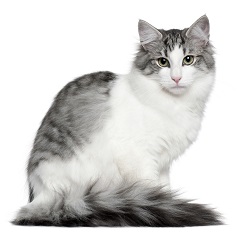 Because of their size, Norwegian Forest Cats need more food than many other domestic cat breeds. They are only moderately active, so it is important that they get enough exercise.
Water and a balanced diet
Like all cats, forest cats are obligate carnivores. This means that they must eat meat. Dogs are carnivores, too, but cats have a different metabolism. They need a diet that’s higher in protein. Any commercial cat food that meets guidelines set by the American Association of Feed Control Officials (AAFCO) will have the right balance of protein and other nutrients for your kitty.
Both canned and dry cat foods provide a complete and balanced diet, no matter what your cat’s age. There are formulas available for kittens, pregnant and nursing cats, and older cats (a cat is considered senior at 7-8 years and geriatric at 10-12 years).
Canned food has much more water in it than dry food does. Since cats don’t automatically drink when they need to, giving them canned food ensures that they get enough water every day. If a cat is fed just dry food, it’s especially important to have fresh water available all the time.
Whether you give a forest cat canned food, dry food, or a combination of the two, there’s no fixed amount of food that’s exactly “right.” Most owners go through a period of trial and error until they find what works best for their cat.
Exercise and heights
Norwegian Forest Cats crave activity as much as they do attention. With other cat breeds, something like a cat tree is usually optional. Not so with forest cats. In the wild, they spend a lot of time up in a tree where they can look out over their territory. They will want to do the same thing in your home.
There are many kinds of cat trees and other cat furniture available. The only requirements are that it should be ceiling high and stable enough to handle the cat’s weight.
Because of its hunting background, the forest cat also loves to run. Hide-and-seek games, chase toys, and toy mice that can be ambushed are all good ways to exercise your cat. However, Norwegian Forest Cats are used to fishing outdoors and aren’t afraid of water. If you have an aquarium, make sure it has a tight cover that’s resistant to this little Viking’s muscular claws and feet.
Characteristics Unique to the Breed:
Norwegian Forest Cats are famous for their rugged build, beautiful fur, and gentle personalities. They resemble Siberian Forest Cats and the Maine Coon but have a different head shape.
Rugged and beautiful
The Norwegian Forest Cat is all muscle and bone. Its body is sturdy and well balanced. “Climbing” is the key word with this animal. If you can’t find Kitty, look up. He will probably be on top of a cabinet or at the highest level of the cat tree.
The fur of Norwegian forest cats grows thick or thin depending on their environment. They have quite different looks at different times of the year. Those who spend a lot of time outdoors in the winter may resemble little lions! In the spring, after shedding that wooly undercoat, the forest cat only has its long outer cat. Its paws and tail will stay bushy all year long.
Norwegian Forest Cats vs. Siberians vs. Maine Coon Cats
Some say that Leif Erikson brought a Norwegian Forest Cat to North America, where it went wild and eventually became the Maine Coon. Others say that the long-haired Siberian Forest Cat bred with the Viking’s short-haired British cats to produce the Norwegian Forest Cat.
There is no clear scientific evidence for any of that, but the three breeds certainly resemble each other. You can tell purebreds apart by looking at the head.
Both the Maine Coon and the Siberian have wedge-shaped heads. The Norwegian’s head is shaped like an equal-sided triangle. In addition, its profile shows a straight line from the brow to the tip of the nose. The Maine Coon’s nose in profile is gently curved, and the Siberian’s is slightly concave.

Health and Wellness:
Thanks to their rugged background, Norwegian Forest Cats are generally healthy. An indoor cat can live up to 14 years or more.
Health problems specific to Norwegian Forest Cats
Two inherited diseases are associated with forest cats. The worst is glycogen storage disease, type IV (GSD IV). This causes an abnormality in glucose metabolism. Kittens who have it die at birth or a few months later from heart or neuromuscular disease.
GSD IV is recessive. Cats can be healthy but still pass the disease along to their kittens. Genetic tests have been developed to identify which forest cats are GSD IV gene carriers. They can still live long and healthy lives, but they will be kept out of breeding programs. In this way, slowly but surely, GSD IV is being eradicated from the Norwegian forest cat line.
Some Norwegian forest cats also carry a gene for PK deficiency. This causes hemolytic anemia. It’s not fatal like GSD IV, but it makes the cat very sick. Again, it’s a recessive gene, which means healthy cats who carry the gene can pass it on. Fortunately, there is also a genetic test for this hereditary disease.
General health maintenance
Most forest cats are robust. They tend to be a little more prone to dental disease than other cat breeds. Besides tooth care, they just require the usual wellness routine of immunizations and watching their weight
Follow your vet’s recommendations for vaccinations. Some are only given depending on the cat’s age and health, as well as whether it stays indoors or is let outside. However, all cats need to be vaccinated against rabies, if it is required by local law, and for feline distemper (panleukopenia or FPV). The distemper vaccination is usually given in combination with other vaccines against the two major causes of upper respiratory disease in cats – FCV and FHV-1.
Kittens are given a series of these core vaccinations over their first 16 weeks of life. Adults that haven’t had the series can get it any time, although females shouldn’t be vacccinated while in heat. After that, depending on the vaccine, the cat will need to get an update every 1 to 3 years.
Is your Norwegian Forest Cat obese? Don’t wait until it gets to the point where, like Thor, you can’t lift your kitty!
Here’s how to tell your cat is fat:
- You can’t feel Kitty’s backbone and ribs
- Viewed from the top, you can’t see a “waist” – a narrowing between the back of the rib cage and Kitty’s hips
- Viewed from the side, Kitty’s tummy doesn’t tuck up between the rib cage and the legs.
Interesting Facts About Norwegian Forest Cats:
- Wild Norwegian Forest Cats catch fish in streams and lakes.
- In legend, they were called the “fairy cat.”
- In 1599 a Danish priest called Peter Friis described what he thought were three types of lynx in Norway: the wolf-lynx, the fox-lynx, and the cat-lynx. Today people think that his “cat-lynx” was the Norwegian Forest Cat.
- Norwegian Forest Cats were the first cat breed to develop a gene mutation for amber fur color.
- A white forest cat named Solvfaks was the hero of a children’s book, “Solvfaks: Who Went Out Into The Wide World.” This book, written in 1912 by a famous Norwegian poet, is the first documented mention of the Norwegian Forest Cat.
- A brown-and-white tabby kitten named Pans Truls, back in the 1930s, became the model for today’s breed standard.
- Unlike some pedigreed cat breeds, the Norwegian Forest Cat developed all its show characteristics in the wild, without help from humans.