Welcome to our Mekong bobtail Cats page! Here you will find everything you could ever want to know about Mekong bobtail cats and a complete list of all the Mekong bobtail catteries we have located in the USA.
The Mekong Bobtail cat is a medium-sized cat with a short coat. They are affectionate, playful and agile cats, so it is no wonder they won over the hearts of people worldwide. The Mekong Bobtail is a slender and elegant cat, and owners describe them as glossy, silent, affectionate, playful, and friendly. With their short tail and powerful body, these cats have a distinctive and unique look.
Mekong Bobtail Cat Breeders Near You

Mekong Bobtail
- Are you a cat breeder who isn’t listed? Add your information here.
We also highly recommend reading checking out our latest news articles at our blog. Find information on Cat health, nutrition, holistic healing, basic care, toys, and much more!
Mekong Bobtail Cat Breed Information
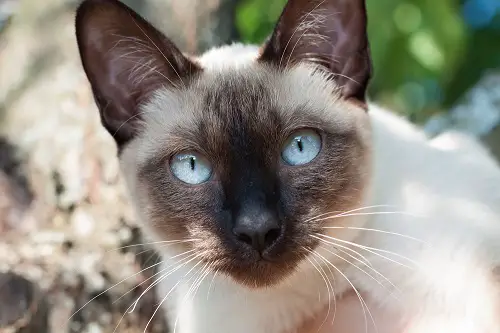
Mekong Bobtails have an excellent health and a wonderful, balanced character with an outgoing and trusting personality. They crave attention from their owners. Their expression might be wild, but they are affectionate and gentle cats that love their family and are friendly toward strangers, children, and other pets.
Their favorite hobbies are playing interactive games with their owners, napping, going for walks, and chasing battery-powered toys around the house. They can be great companions to everyone as they are well-suited to any home. Owners should not let a Mekong Bobtail outdoors unsupervised.
Mekong Bobtails are dog-like cats. While walking, they produce specific clip-clopping sounds (same as dogs) because the claws on their hind legs are visible. In most cat breeds, the hind legs’ claws are hidden inside, but that is not the case with this breed. They are very loyal as well, which is another dog-like personality trait.
They are very thoughtful and intelligent, and can be trained to understand several commands. However, it is up to the cat as to whether the command will be followed once i is understood.
Many people think that this breed is a Vietnamese cat breed, when in fact it was developed in Russia; the reason why it is named Mekong Bobtail is because the cats from this breed are very similar to a bobtail cat breed from the Mekong River region. They are naturally born with a short, kinked tail.
General Information:
Height/Length: medium
Weight: 8-10 pounds
Life Span: 15 -18 years
Coloring: all colors and markings are acceptable
Area of Origin: Russia
Similar Breeds: Kurillian Bobtail
Breed History and Origins:
Legends associated with the Mekong Bobtail
There are many legends regarding the history and origins of the Mekong Bobtails. According to many legends, these cats were first spotted in palaces and temples of ancient Siam. They had bodies in light, unusual color, dark tail and paws, and an elegant mask over their face. Because of their bravery, loyalty, and intelligence, these cats have earned respect and honor from everyone.
It is believed that the first Bobtail cat was taken from China to Japan and it has become the forefather of today’s Japanese bobtails. Charles Darwin wrote that cats in huge areas like the Malayan Archipelago, Siam, Burma, and China all have short tails.
In the 18th century, about 200 cats were given to Nicholas II by Chulalongkorn, King of Siam, as a sign of strong and friendly relations between Russia and Thailand. Most of the cats had short, kinked tails.
The offspring of these bobtails that were brought to Russia from Asia have become founders of the new Mekong Bobtails.
Some people thought that old-typed Siamese or Thai cats were used for breeding in order to create Mekong Bobtails, but it was later stated that that is not correct.
In 2004, the breed standard for these cats was adopted under the name “Mekong Bobtail” or MBT. The name of this breed is symbolical and comes from the name of the Mekong river.
Mekong Bobtail cats today
Nowadays, there are over 1,500 Mekong Bobtail cats in the feline clubs of Russia, Latvia, Poland, Germany, Czech Republic and Belarus. Although this breed is still rare, the popularity is continuing to increase thanks to their bright character, striking appearance, cleanliness, high intelligence, and excellent health.
Size and Physical Characteristics:
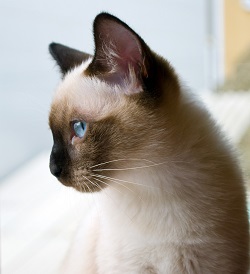
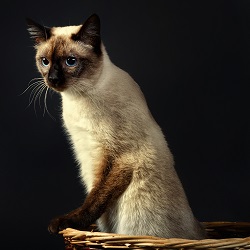 The Mekong Bobtails are medium sized colorpoint cats with a short tail that has the form of a brush or pom-pom. Their head has a short wedge shape with gently rounded contours. The ears have an average size, broad at the base, and are turned slightly outward. Their eyes are set straight, vivid blue in color and oval in shape. Their body is athletic and muscular, medium sized and rectangular. Their back is straight with a minimal rise. The legs are medium in length and slender with oval paws, and their tail is the most distinctive feature of these cats; it is composed of curves and/or kinks.
The Mekong Bobtail is a tiny, delicate, tenuous cat that weighs no more than 10 pounds. They are available in all colors and color combinations. The length of their tail is due to this breed’s origins, as well as the genetics. Visually, their tails are not visible, but can be felt by touch. There are not two identical tails in Mekong Bobtail cats, so this breed’s tail could be a form of identification.
Their legs are rather slender in comparison to their body. The hind legs are longer than the front legs.
Seal pointing is the main and most common type of pointing. Other less common colors are red point, red tabby point, tabby point, seal tortie point, blue point, and chocolate and lilac point.
Personality and Temperament:
When entering a new home, Mekong Bobtails do not need much time to adjust to the new environment and people. They start acting normal within a few days. They will quickly become best friends with their humans and will follow them everywhere. The Mekong Bobtail is not shy when it comes to showing love and affection.
Their character is clever, highly intelligent, independent, playful, trainable, sociable, and gentle. People who are looking for a dog in cat’s body should look no further; this is the breed they’ve been searching for their whole life. They are loyal and devoted to their humans, and are extremely happy when they are allowed to either sleep in bed with their humans or relax on their lap. They will watch TV with their owners, watch them read a book or a newspaper, and lie on their computer keyboards. Mekong Bobtails are always willing to lend their paw when their owners need it (and when they don’t).
Whatever their lifestyle is, these cats enjoy company, whether that of their humans or pets. Mekong Bobtails are moderately active, making them easy to live with. They are highly intelligent and love when their brain is challenged with puzzle toys or learning new tricks. They want interactive toys because they want their owners to join the fun.
Their playing is endearing and interactive. They will demonstrate their hunting abilities by catching insects that made the huge mistake of entering the cat territory. Mekong Bobtails also love to carry their toys in their mouth, as if the toy was a caught rodent.
They are quite talkative and produce a vast range of meows and chirps. They can even learn what their name is and respond when called. They can be seen riding on their human’s shoulder so that they can supervise everything that is going on the house. All in all, the Mekong Bobtail is an intelligent and inquisitive cat that does not miss a trick.
Nutritional and Exercise Needs:
Nutrition
When it comes to cats and nutrition, there is one thing people should consider: feeding a diet close to what the cats would eat in the wild is the best nutrition plan.
Mekong Bobtails should primarily eat a raw meat. It is logical that the more similar their diet to natural conditions is, the healthier the Mekong Bobtail will be. That gives the answer to the debate of “wet food vs. dry food.” A cat’s natural diet would be wet food, so owners should focus on buying more wet canned food and less dry food. Wet food also keeps the cat protected from getting kidney diseases caused by a lack of water intake.
Byproducts, synthetic minerals and vitamins, food colorings, preservatives, fillers, and gluten are some of the ingredients that need to be eliminated from the diet plan of the Mekong Bobtails.
Needless to say, owners must make sure that their cat has a well-balanced diet and access to fresh and clean drinking water at all times.
Owners must also follow the general rules for colorpoint cat feeding. Due to the fact that the color of the coat depends on food, they must pay attention to the composition of the food they are planning to buy for their Mekong Bobtail. The more magnesium, copper, iodine, and calcium, the sooner the coat will get darker. Eliminating algae additives is recommended for Mekong Bobtails.
 Mekong Bobtails and exercising
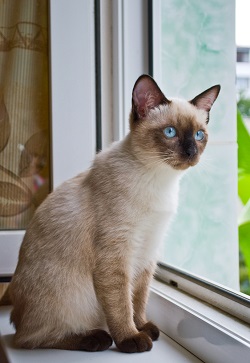
Although Mekong Bobtails will play with anything, they love when they have playmates. Owners should teach their kitty that hands are not toys; those who ignore this advice while their Mekong Bobtail is still a kitty will regret when the kitty become a cat and develops full-sized claws and teeth.
Interactive playing lets the Mekong Bobtails hone their hunting skills, helps them maintain a healthy weight, and strengthens the bond between them and their owners.
Catnip mice, balls with bells in them, and wand toys are some of the toys that these cats like to play with. Some excellent toys are already in every household: straws, wads of paper, boxes, and so on. Playing fetch, chasing the laser pointer, running around the house, and exploring wardrobes will always be their favorite physical activities.
Aside from playtime being enjoyable and fun for both the cat and the owner, it is a powerful tool when it comes to modification of the cat’s behavior. Playtime done right can really make the Mekong Bobtail happy and healthy.
Grooming and Upkeep:
The grooming procedure of the Mekong Bobtail cat is not daunting at all. As a matter of fact, if done right, it can be very easy and enjoyable. Owners are required to spend a little time every couple of months bathing, brushing and trimming.
These cats shed a moderate amount, so they are easy to maintain. Mekong Bobtails groom themselves, and thus they keep their fur clean from debris that might have caught in it. However, they require brushing at least once or twice a week in order to remove dead hair. Today’s market is full of special cat grooming tools which will make the job easier and more comfortable for both the owner and the cat.
Mekong Bobtails do not require frequent bathing, but when occasional circumstances warrant it, owners must first groom the coat in order to enable the specialized shampoo easily spread through the coat.
Nail clipping needs to be done twice a month. Although Mekong Bobtails are not too wild about this procedure, nail clipping is best done while the cat is sleepy.
Ear cleaning also needs to be done twice a month in order to prevent wax and dirt buildup. The visible parts need to be cleaned. If there is debris inside the ear canal, the owner should consult a vet.
Brushing your cat’s teeth is another crucial step of the grooming procedure. With a regular teeth brushing, development of periodontal disease is prevented. Poor oral hygiene in Mekong Bobtails can lead to bad digestion and gum disease.
Characteristics Unique to the Breed:
| The Mekong Bobtail | |
| Head: | Head with gently rounded contours. The profile of the head is curved, the top is slightly flat, and the chin is firm. |
| Coat: | Short, glossy coat |
| Adult Weight: | 8-10; males and females do not differ in weight |
| Size/Shape: | Muscular, elegant, slender body; medium size |
| Legs: | Medium length, slender legs and oval paws |
| Tail: | Curves and/or kinks in different combinations that start at the base |
| Voice: | Talkative |
The main feature of this breed is their character. Mekong Bobtails can be very dog-like – the most devoted and loyal friend with a big heart. They form a strong bond with their humans and are happy when their human is happy, sad when their human is sad.
Mekong Bobtails are inventive, and highly intelligent. Their passion and patience when it comes to children and other pets is commendable. That’s right: they get along with everyone, including exotic animals like parrots, guinea pigs, rabbits, and even rats. They are pretty talkative, but neither clamorous nor annoying.
The Mekong Bobtails follow their owners wherever they go. Just like dogs, Mekong Bobtails react to a door bell. They joyfully greet their humans at the door, and due to their curiosity and attachment to owners, they want to participate in every family function. They are diplomatic, neat, well-behaved and obedient cats. Most cats do not like traveling, but traveling with a Mekong Bobtail is a big pleasure.
Health and Wellness:
 Mekong Bobtails are generally healthy cats, but due to their tails, they can have spinal problems that might affect their ability to control defecation. Other common issues for this breed are tapeworms, fleas, and feline lower urinary tract disease. Steps for reducing occurrences of this disease are:
- Feeding small meals several times a day
- Providing clean, fresh water at all times
- Keeping their litter box clean
- Minimizing major changes in their routine
- Following a healthy diet
4 Interesting Facts about the Mekong Bobtail:
- The Mekong Bobtail has the ability for reproducing even in old age. Litters are registered that were born from a cat of 23 years old.
- The family of a Mekong Bobtail is a matriarchal one; the female is the head of the family.
- Males do not have the habit of marking their territory.
- The Asian short-tailed cats were mentioned by Charles Darwin and Harrison Weir in their books.
Why Choose a Mekong Bobtail?
Mekong Bobtails are intelligent, inventive, affectionate toward children and other pets, and have a keen intuition. They are also very curious, which is not annoying at all. It is sweet actually; they follow their human everywhere they go trying to help them with all their activities.