Welcome to our Manx Cats page! Here you will find everything you could ever want to know about Manx cats and a complete list of all the Manx catteries we have located in the USA.
The tailless Manx cat is one of the world’s oldest cat breeds, though no one is sure of its origin. These shorthaired cats are native to the Isle of Man and have sturdy, muscular bodies. They are the most dog-like of all domestic cats and are great with families and with other pets. The gene mutation responsible for the lack of a tail also makes Manx cats prone to spinal deformities. Most cats are quite healthy, though, and can live to for 13 years or more.
Manx Cat Breeders Near You

Manx
- Are you a cat breeder who isn’t listed? Add your information here.
We also highly recommend reading checking out our latest news articles at our blog. Find information on cat health, nutrition, holistic healing, basic care, toys, and much more!
Manx Cat Breed Information

History and Origins:
Tailless cats have been known on the Isle of Man for hundreds of years. Their origin is a matter of legends and guesses. British cat fanciers included them in the very first cat shows, held late in the 19th century, and the breed is now popular around the world.
Stories about the Manx cat
One legend says that the Manx was the last cat aboard the Ark and got its tail clipped off when Noah shut the door. Others imagine that mother cats chewed off the tails of their kittens so humans wouldn’t take them. The most imaginative (and genetically impossible) story is that these tailless cats with long hind legs are a result of interbreeding between cats and rabbits!
More realistic guesses about its origins connect the Manx cat with an Isle of Man promontory called Spanish Head. During the Age of Sail, ships often carried cats aboard to keep rodents away from the food stores. Supposedly two ships of the ill-fated Spanish Armada sank off the coast here in 1588. No sailors survived, but the cats managed to swim ashore.
Manx cats do like water and can swim. A cat might also survive a shipwreck in which sailors weighed down by heavy armor drowned. However, there is no evidence that tailless cats ever lived in Spain. Where did the Spanish get them?
Perhaps it was some other group of sailors, ones who weren’t wrecked but instead visited the island regularly. The Isle of Man has always been a stop for ships coming from all parts of the world to trade with Britain and Ireland. A few other bobtail cat breeds do exist in Asia and elsewhere. Perhaps a few became ship cats and were carried to the Isle of Man on some long-ago merchant ship?
The Manx cat’s history
There is actually no genetic connection between the Manx cats and Asian tailless cats. A few bobtails in Europe might have originally come from the Isle of Man, or perhaps they were brought to the island. Nobody knows for sure.
In any case, tailless cats did appear and were isolated on the island for many centuries, where they developed into a unique breed. The Manx cat was easily domesticated and earned its living by hunting rodents and providing companionship on rural farms and in villages.
The first historical mention of a Manx cat was in 1810, when painter Joseph Turner noted that he had seven of them. By the 1870s, British cat fanciers were putting Manx cats into shows. When the Cat Fanciers Association was founded in America in 1906, these cats were one of the first registered breeds. They have just become more and more popular as pets and for show ever since.
The Cymric
Cymrics resemble Manx cats, but they have long hair. This breed might have started when Manx cats bred with Norwegian forest cats during the Viking occupation of the Isle of Man, or it might be the result of another gene mutation.
Size and Physical Characteristics:
| The Manx Cat | |
| Face: | Round head with round muzzle and prominent cheeks. |
| Fur: | Cottony dense undercoat, glossy outer coat, over 30 colors and patterns. |
| Adult Weight: | Males: 10-12 pounds. Females: 8-10 pounds. |
| Size/Shape: | Medium size. Round, no matter what angle viewed. |
| Legs: | Short, with strong bones. Hind legs much longer than forelegs. |
| Tail: | Rumpy: No tail. Riser: A little bump, up to 3 vertebrae. Stumpy: 4 or 5 vertebrae. Longy: More than 5 vertebrae; usually not as long as other breeds. |
| Voice: | Soft with a unique trill. Chatty. |
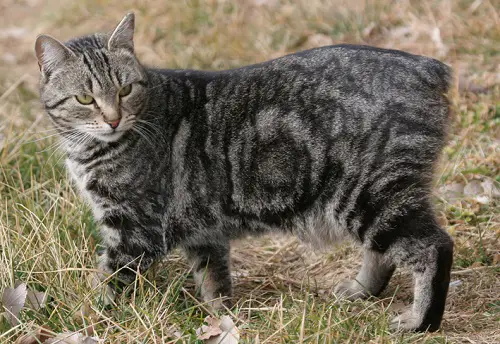
The first thing you notice about a Manx cat, of course, is its lack of a tail. This round, compact kitty is also surprisingly heavy for its size. Its muscle and bones are well developed, thanks to the heritage of being a working farm cat. Manx cats also have beautiful fur that comes in all colors and patterns.
Tailless and round
Ideally, a Manx has no tail at all. A rumpy riser has a little bump at the rear end that won’t stop a cat show judge’s hand during a stroke along the cat’s back. This bump usually has one to three vertebrae.
American cat associations only show rumpies or risers, but Manx cats also come with longer tails. Stumpies have up to five vertebrae in their tails, while longies have more than five vertebrae. Breeders often dock the tails of stumpies and longies while the cat is a kitten, since it tends to get arthritic later in the cat’s life.
The key word for a Manx cat’s overall shape is “round.” Its body can actually be drawn as a set of circles. The long hind legs and short spine make the back arch upwards in a pretty curve. Flanks are deep and circular. The chest is broad and curves outward.
Manx cats have a round forehead, whisker pads, and cheeks. Their eyes are big and round, set at a slight slant pointing down toward the nose. Even the tips of their large ears are rounded rather than pointed.
Colorful eyes and fur britches
These cats have a double coat of fur. The layer closest to the skin is dense and cottony. The outer coat is more open and a little coarse and glossy. It generally is shortest around the shoulders and gets longer over the animal’s lower back, hips and legs, where it forms furry britches.
On the Isle of Man, Manx cat fur originally was usually colored black, black and white, gray-striped tabby, tortoiseshell, and sometimes solid white. Today, thanks to mixed breeding, cats may have any color or pattern. Some coat colors also feature dark fur outlines around the rims of eyes, nose, and mouth.
If you want to show your cat, you should know that the International Cat Association accepts all Manx colors, but most other associations draw the line at chocolate, lavender, or dark points like a Siamese. They do this because these colors are common in hybrids but not in purebred Manx cats.
A Manx cat’s eyes may be gold to copper, hazel, green, blue, or odd-colored (a different color in each eye). Solid white cats usually have blue, copper, or odd-colored eyes.
Personality and Temperament:
 Manx cats turn the classic “dogs are friendly, cats are aloof” assumption upside down. They are loving, intelligent, and very loyal and protective. A Manx cat adapts well to most home environments and gets along easily with other pets.
The “dog cat”
Manx cats enjoy being around people. They come when called and follow their owners everywhere, including into the shower. A Manx cat may not like its own bathtime, but it enjoys splashing around in water.
These cats are protective and will tell you when someone is at the door. Of course they won’t bark, but they will talk to you, even when the two of you are alone, with quiet chirps, calls, and trills.
They can be walked on a leash and enjoy a pickup game of fetch. Unlike many dogs, though, a Manx cat can figure out how to open a door. So far, these intelligent kitties haven’t worked out locks!
Good with families and pets
A Manx cat might adopt the entire household or just bond with one person. That bond can be so strong that the cat needs no other companion. However, if your cat is going to be left alone for extended periods, it’s a good idea to have another animal around to keep it company.
This cat breed is friendly enough to tolerate children most of the time, especially if the cat is young when they are introduced. When things get too intense, your cat will quietly signal that playtime is over by walking away or wiggling out of little arms.
Manx cats can be shy around strangers. If you often have a lot of friends over, the cat will soon get used to it. However, this leeriness around strangers might also mean that the kitten you picked out for its shy, calm nature will instead boisterously greet you and want to be close once it knows you.
A Manx fits in well with other pets, including dogs. However, it has a strong hunting instinct and may go after birds, fish, or rodent-like pets. Aquariums should be securely covered to keep your cat from fishing for a tasty treat.
Grooming and Upkeep:
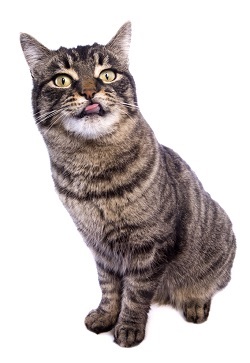 The thick, double coat of a Manx cat needs care. Luckily, this is very easy to do since the breed is mellow and enjoys the attention and shared time.
Grooming and bathing a Manx cat
All you have to do with a shorthaired Manx is comb or brush it once a week, more often during the spring and fall shedding season. Doing this cuts down on hairballs, too. When grooming a rumpy Manx, be careful around the area where the tail would be. Sometimes nerves are close to the surface here, and the cat might be very sensitive.
Manx cats like to play in water, but they dislike baths as much as any cat does. A show cat needs to be bathed every week. Pets can be washed less often. Be sure to use a shampoo designed for cats, and have a nice warm towel ready to wrap this wet shorthair in afterwards.
Routine Manx cat care
Despite its history as an outdoor working cat, the Manx can be kept inside all its life. Generally, indoor cats are healthier and live longer. If it does go outside, you will need to watch out for fleas, ticks, and other parasites. There are several ways to prevent or treat infestations. Your vet can help you decide the best treatment for a Manx cat with fleas. The important thing to remember is that the yard and the house must be treated, as well as the cat, or the problem will continue.
Be sure to trim the cat’s claws regularly, too.
Tooth care is always challenging for cats. They quite naturally don’t like anyone messing around with their teeth. Some dry foods and treats claim to clean teeth, but this has never been definitely proven to be effective. The loving Manx may allow you to brush its teeth with a vet-approved toothpaste, especially if you start doing it when the cat is young. If it doesn’t let you, then the vet might have to do dental cleaning at regular intervals, although this exposes the cat to the risks of general anesthesia.

Nutritional and Exercise Needs:
The Manx cat doesn’t need any special food. These lively kitties get plenty of exercise while interacting with you and with other pets.
Protein and water are important
Unlike dogs, cats get more energy from protein than they do from carbohydrates. Commercial cat foods that meet standards established by the American Association of Feed Control Officials (AAFCO) are designed to give this to them along with the proper balance of other nutrients.
A Manx cat can live on either dry and canned cat food. Canned food also contains the same amount of water the cat would get from its prey. This water content is important because domestic cats don’t always feel the urge to drink, even when they should. Instead, they get water from their prey.
Cats will get slightly dehydrated if they only eat dry kibbles. It will help to feed your cat a mix of canned and dry cat food. Just make sure that there is always plenty of fresh water available when using dry food.
Active and intelligent
Manx cats are surprisingly agile. Long, heavily muscled hind legs give a Manx cat excellent balance for jumping and running even though it doesn’t have a tail. These intelligent cats also need thinking games to keep them interested in life.
Your kitty won’t expect you to play chess with it, but it will appreciate puzzles that challenge it and dispense treats or catnip when it figures out how they work. The Manx has round, flexible paws that are good at batting toys around or trying to catch that intriguing red laser dot.
Plan to spend some time each day playing fetch, twirling a feather, or giving your Manx something to ambush or carry around in its mouth. This former farm cat loves hunting games and will be delighted to interact with you.
Always praise your kitty exuberantly. Never ever yell at it. Manx cats quickly learn what a firm, gentle “no” means. They’ll behave because they want to please you and bask in your attention. For backup, a water squirt bottle or mister is all that’s needed.
The Manx’s unique tail
An animal’s tail is an extension of its spinal column. Cats usually have anywhere from 19 to 23 vertebrae in their tails. Manx risers only have one to three vertebrae, and stumpies have four to five.
The gene mutation that affects the tail is called M. It is dominant. That means that the M gene produces a tailless cat even if only one of the cat’s parents contributes the gene. Before genetics was understood, this dominance led to a superstition that just having a Manx cat near another cat would make the next litter of kittens tailless.
A litter of Manx kittens will usually be a mix of rumpies, risers, stumpies, and longies. Some kittens may even have normal tails. Genetically speaking, cats with normal tails aren’t Manx cats at all because they don’t have the M gene, but they are born within the breed. Cat fanciers consider them tailed Manx.
Health and Wellness:
Manx cats are quite healthy and active. However, the M gene that affects their tail length also makes them prone to spine problems.
Manx syndrome
A cat’s spinal cord normally doesn’t go all the way through the tail, but those tail bones do protect the nerves that control Kitty’s hind leg sensation and movement as well as its bowel and bladder function.
The M gene mutation that makes tailless Manx cats so special is technically a spinal defect. Sometimes it shortens the cat’s spine too much and causes serious problems. This is called Manx syndrome.
The hereditary disease shows up in the first few weeks or months of life. A kitten will have problems walking or may even become paralyzed. It will also get urinary and fecal incontinence. Megacolon, a condition where the cat can’t pass stool, is associated with Manx cats, but that is actually a secondary effect of Manx syndrome.
Some inherited disorders can be bred out of a cat line, but this isn’t possible with the Manx cat since the problem is caused by the same gene that makes them unique. There is no cure, unfortunately.
Manx cat breeders have learned to use tailed cats in their breeding program to reduce the likelihood of Manx syndrome appearing in kittens. Using tailed cats also cuts down on the number of miscarriages that happen when two tailless cats breed.
Breeders also keep Manx kittens longer before selling them. Therefore it is unlikely that you will buy a kitten with Manx syndrome from a reputable breeder.
Routine health care
Manx cats need the core immunizations that all cats should get. Rabies vaccinations are given according to local law. The feline distemper vaccine is often given in combination with two other vaccines that immunize your cat from the most common upper respiratory diseases in cats.
Core vaccinations are first given when cats are six weeks or older and then again every three or four weeks for the next ten weeks. Adult cats can get this series, too, although females shouldn’t receive the vaccinations while they are in heat. Afterwards, the cat will only need a booster every three years.
Your Manx cat may need other vaccinations depending on where you live and the cat’s lifestyle (things like whether it is kept indoors or goes outside, or whether it is exposed to other cats). The vet can tell you which non-core vaccinations might be necessary.
It’s also a good idea to talk with the vet about intestinal parasites if your cat has had fleas. Some over-the-counter worming treatments can be poisonous, or they may not treat the specific parasite Kitty has picked up. This is definitely a job for a professional.
Obesity is one of the most common health problems in cats. Manx cats are one of the top ten “fat” breeds. They’re active, but their overall round shape and big-boned stockiness make it hard to tell by looking when your cat is getting overweight.
These cats like to be held, so you can check the cat’s weight by just picking it up and getting on a scale. Subtract your weight from the total, and voila!
If there is excess poundage, never fear. Your pet will enjoy the extra attention that comes when you encourage it to exercise a little more. You can also cut calories by using special formulas or simply by being aware of how much food you give. If there is anything left over, serve Kitty a little less next time.
Interesting Facts about Manx Cats:
- Stimpy, Ren’s pal on the cartoon “Ren & Stimpy,” is a rumpy (not a stumpy) Manx.
- One of the earliest known championship Manx cats was a brindled tortoiseshell female Manx cat owned by Mr. J. M. Thomas. She won cat shows at London’s Crystal Palace three years running: in 1880, 1881, and 1882.
- Cats with amputated tails have been passed off as Manx cats ever since the breed was first shown.
- The Manx cat population on the Isle of Man has declined ever since the breed became popular.
- Images of the Manx cat first appeared on commemorative coins issued by the Isle of Man in the 1970s and have been on every annual collector’s coin since 1988. They’re hidden in the background if another breed is featured.
- Koko, the famous gorilla who understands many sign language words, has had three Manx cats for companionship. When one of them escaped and was hit by a car, Koko signed “cry, frown, sad, trouble.”