Welcome to our LaPerm Cats page! Here you will find everything you could ever want to know about LaPerm cats and a complete list of all the LaPerm catteries we have located in the USA.
The LaPerm, a uniquely curly-haired breed of cat that originated in Oregon as the result of a mutation, has won the hearts of worldwide cat lovers with its tendency to bond well with humans and its friendly and affectionate nature.
LaPerm Cat Breeders Near You

LaPerm
- Are you a cat breeder who isn’t listed? Add your information here.
We also highly recommend reading checking out our latest news articles at our blog. Find information on Cat health, nutrition, holistic healing, basic care, toys, and much more!
LaPerm Cat Breed Information

LaPerm cats may be famous for their bed-head look, but they also love to be around people. You’re the leader with this affectionate animal. LaPerms will cuddle when you’re in the mood, and they will gladly join in when you’re ready to play. A LaPerm cat only needs routine care and lots of affection.
History and Origins of LaPerms:
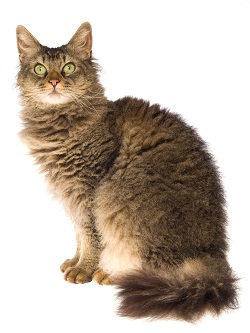 The LaPerm cat breed originated as a spontaneous mutation in the 1980s. Today it is popular all over the world.
A new rex breed
In 1982, a barnyard cat in Oregon named Speedy had a bald kitten whose skin was marked in a tabby pattern. Within a few months, the little baldy had grown out a beautiful rex coat of soft curly fur with a tabby pattern. Its owners, Linda and Dick Koehl, christened the odd-looking kitten Curly.
The Koehls weren’t professional cat breeders and didn’t realize at first that they had a new breed. Over the years, though, as more and more rex-coated kittens began appearing in the neighborhood, they began to confine the cats and control their breeding.
In 1992, Linda took four of her special cats to a show in Portland to see what cat fanciers thought of the new look. They were a big hit. With the help of geneticists and other cat breeders, the new rex breed was established. Its waves and loose curls resembled a woman’s hairdo, so the new breed was called LaPerm (the “la” was added in the Chinook tradition of including the French article with something’s name).
International acclaim
In 1997, the LaPerm Society of America was formed as part of the Cat Fanciers Association, and the CFA accepted LaPerms for championship competition in 2008. These rex kitties arrived in Japan in 1997 and in the United Kingdom in 2002. Today the LaPerm cat is popular throughout the British Commonwealth, as well as in Europe and Russia.
This breed’s biggest fans are in the UK. They formed the LaPerm Cat Club in 2004 and joined the Governing Council of Cat Fanciers (GCCF) three years later. The GCCF didn’t give LaPerms championship status until 2012, but that’s understandable. This organization has the strictest pedigree rules for the breed.
While other breeders are still outcrossing the LaPerm to widen its gene pool, the GCCF doesn’t register a cat as purebred LaPerm unless it comes from three generations of LaPerm-to-LaPerm parents. The Cat Fanciers Association is going to go with the same requirement in 2015.
Size and Physical Characteristics:
| The LaPerm | |
| Head: | Rounded wedge, almond-shaped eyes, medium to large ears |
| Fur: | Short or long rex. Individually unique coat. All colors and patterns. |
| Adult Weight: | Males: 7-10 pounds. Females: 5-8 pounds |
| Size/Shape: | Medium to long. Sturdy and muscular. |
| Legs: | Proportionate. Round paws. Hind legs slightly longer than forelegs. |
| Tail: | Tapers to round tip. Plumed in long hair, “bottle brush” in short hair. |
| Voice: | Generally quiet. Purrs a lot when near owner. |
The LaPerm cat is medium-sized but heavier than it looks. Its famous fur comes in a variety of colors and patterns. Shorthaired LaPerms have the classical curves and waves. Longhaired LaPerms have a unique frizzy look that some call the “gypsy shag.”
Sturdy and well balanced
Because of their farm cat background, LaPerm cats have a lot of muscle, but their bones are medium fine. They walk high on their feet, with hips higher than shoulders, and are very graceful.
Everything about a LaPerm is in proportion. LaPerm cats carry their beautiful heads up high. Their bodies are long and a little tubular, like a Siamese cat, but less extreme. Their moderately long legs end in round paws that they love to reach out and touch you with.
Their heads are shaped like a wedge with rounded edges and gentle contours. Whisker pads are very full and round, with a moderately strong pinch. Medium to large ears continue the line of the wedge. Long-haired LaPerms often have furry ear tufts.
The cat’s profile may look straight, but you will be able to feel a slight dip to the nose where it meets the eyes. Those eyes are medium-sized and set wide apart. Eye color isn’t related to fur color and might be copper, gold, yellow, green, blue, aqua, or odd-colored.
The rex coat and a gypsy shag
A few LaPerm cats have straight hair, but they usually come with a rex coat of either short curls or waves, or semi-long curls. Curls and waves go in all directions, giving your kitty a tousled look. They are tightest on the tummy, neck, and the bases of the cat’s ears. A long-haired LaPerm’s frizzy “gypsy shag” may have tight ringlets of long corkscrew curls.
This breed doesn’t keep the coat it is born with and also tends to molt, that is, shed the entire coat and then grow it back. You will never know what a LaPerm kitten is going to look as an adult until it is several months old.
In the early years of the LaPerm cat breed, most kittens were born bald or went bald soon after birth. Their coats first came in at three to four months of age. Now that the breed is better established, more kittens have short fur when they’re born, which they soon shed.
Kittens born with straight fur may develop the curly rex coat after they shed, or they may be straight-haired cats all their lives. Kittens born with wavy or curly coats always grow back a similar rex coat. It’s notable that cat fancier associations don’t have a category for straight-haired LaPerm cats.
Personality and Temperament:
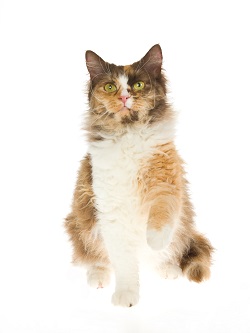 LaPerm cats are very people-oriented. This makes them perfect companions in just about any environment, as long as humans are around.
They enjoy being handled and petted. They won’t hesitate to pet you in return – gently touching your face or arms with their paws or rubbing their face against yours to show their appreciation of your attention.
This friendliness and patience makes them good around children who are old enough to know not to pull on the semi-longhaired LaPerm’s curly fur. LaPerms also enjoy the extra attention that comes their way when your friends and family are visiting.
This loving breed forms close bonds. Kitty will miss you if you have to be away a lot, but by then you may have fallen so deeply under the LaPerm spell that you already have more than one around. If not, LaPerm cats also get along well with other family pets.
Engage mind as well as body
A LaPerm cat is smart enough to invent new ways of getting into trouble if it’s bored. Kitty needs a lot of attention and should get daily mental challenges as well as exercise.
This former barnyard cat enjoys any hunting game that gives it a chance to use strategy as well as physical agility and strength. The moving laser dot is always popular. Anything that can be ambushed or batted around will also be a big hit.
Puzzle games are good for this intelligent feline. LaPerms also enjoy the attention and interaction that comes with pickup games like fetch.
The only thing to remember is that kittens trained to play with fingers and arms don’t understand why it isn’t alright to do the same thing as an adult. Always use a toy or some other object during play. This teaches them not to think of your tender skin as prey in a game.
Grooming and Upkeep:
A LaPerm cat is very easy to groom, but its tendency to shed and regrow its fur may occasionally surprise you.
Caring for LaPerm fur
Short-haired LaPerms don’t shed very much for the same reason that Poodles don’t shed – the curls hold the fur in place. These kitties just need combing once every few weeks. Long-haired LaPerms shed a little more and should be groomed every week to remove dead hair and keep the hair free of tangles and matting. It’s best to use a comb with rolling teeth because this doesn’t get caught in the rex curls.
Don’t panic if your cat loses all or part of its coat. Kittens sometimes go bald or have very sparse coats until they are around four months old. It can happen during adulthood, too. It is perfectly normal in LaPerms and usually starts with a patch at the top of the head. Then coat always grows back.
It’s worth noting that spayed and neutered LaPerm cats usually have thick, healthy fur all their lives.
Other routine care
A LaPerm cat’s ears are big enough to pick up dirt. Check them during routine grooming. If they need cleaning, just wipe them out with a cotton ball that has been dunked in some cat-safe cleaner.
All cats tend to get gingivitis as they age, so it’s a good idea to brush their teeth from time to time. This is less of a problem with the LaPerm because it doesn’t mind handling and is very friendly. Your vet can suggest the right toothpaste and techniques.
Kitty will groom its own claws during scratching and playing. All it needs is a good, sturdy post. It might take a little experimenting to find the right material and place for one. Cat trees also come with built-in scratching posts. All you will have to do after that is carefully trim its claws every couple of weeks.
Nutritional and Exercise Needs:
Diet really highlights the difference between dogs and cats. Dogs are omnivores – they live on many kinds of foods. Cats are carnivores – they must have meat to survive. They also have to have plenty of water available.
Protein gives cats energy
Down through the ages, cats have become very efficient at turning protein into energy. This works well for hunters out in the wild, but it puts domestic cats at a disadvantage. They can’t live on the same food as we do and need about twice as much protein as a dog does. Cats also depend on their prey for certain vital nutrients like taurine and vitamin A. A diet without the right balance of fatty acids will take the shine off their coats.
Basically, Kitty just isn’t very adaptable when it comes to nutrition.
For a balanced diet that also has the right amount of protein, look for commercial canned, semi-moist, or dry cat food that meets guidelines set by the American Association of Feed Control Officials. This will be on the product label in the United States. European cat food producers follow AAFCO guidelines, too.
Thanks to their desert ancestors, today’s domestic cats don’t have a fully developed drink reflex. This means that they don’t always drink water even when they need to.
The bodies of cats’ prey contain 70% or more water. This is enough for cats to live on in the wild. About 75% of a serving of canned cat food is water, which works out well for your domestic LaPerm cat. However, it means that cats that only eat dry food will get slightly dehydrated. Always have plenty of fresh water available.
Active and curious
The LaPerm cat is descended from working cats. It’s a natural athlete with a sense of humor. However, LaPerms will come and sit quietly in your lap, if you want them to. Their number one rule is always “we aim to please.”
Don’t be surprised if Kitty even climbs up on your shoulder for a ride. It wants to keep an eye on things from a height while still being close to you. If you’re not in the mood for company, it will be just as happy on a cabinet top or at the highest level of a cat tree.
LaPerm cats can be trained to play fetch and other games. They also are very curious and will go exploring when your lap or shoulder aren’t available. The same impulse that makes them reach out to touch you also makes them reach out and play with anything that catches their attention. Yes, they are quite capable of getting into cupboards and drawers!
Characteristics Unique to the Breed:
LaPerm cats are famous for their beautiful coats as well as for their dog-like loyalty and affection.
The rex coat
The LaPerm cat gets its curly or wavy coat from a natural genetic mutation. This type of coat is called “rex” because it resembles the short, wavy fur of a breed of rabbits that became famous and was associated with Belgium’s King Albert in the early 20th century.
Unlike some rex cat breeds, LaPerms have the same multiple layers of fur that regular cats have, although their undercoats aren’t very thick. Their fur is either short or semi-long. It can be any color or pattern, though tabbies, tortoiseshells, and reds are most common.
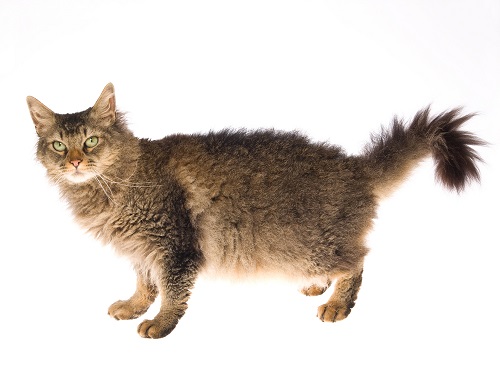
The furry details on each cat are different. Shorthairs generally have springy waves or curls that stand up from the cat’s body and spread out in all directions, giving Kitty a tousled look. This soft fur feels a little like mohair. The tight waves make the tail look like a bottle brush.
Longhaired LaPerms have ringlets of silky curls that sometimes part along the back and fall gracefully down either side. These little corkscrews may be frizzy or loose and bouncy, presenting a nicely rumpled “gypsy shag” appearance.
The gene for this beautiful coat is dominant. That means that only one parent needs to have it for one or more of the offspring to share the trait. Because LaPerms that have been neutered or spayed tend to have full coats all the time, some experts speculate that hormones also are involved.
A loyal little friend
LaPerm cats are so tuned in to people that young kittens have been known to stop nursing and try to locate the source when somebody speaks.
Unlike many other naturally energetic and inquisitive cats, a LaPerm will stop what it is doing when called and will happily settle down on your lap or alongside you. Not that you will often have to call. Members of this breed like to follow you around as if they were dogs.

Health and Wellness:
Some cat breeds that have developed from a genetic mutation tend to have specific health problems, but not the LaPerm. It is very healthy, although like all domestic cats, it is prone to obesity.
Robust but not hypoallergenic
Pets, just like people, can come down with just about anything, but the LaPerm cat breed does very well overall. There are no specific diseases associated with LaPerms. If kept indoors, a LaPerm can live into its teens or even longer.
Because of these cats’ rex coats, some people believe LaPerm cats are hypoallergenic. They’re not, although LaPerm shorthairs may be a little less likely to cause allergies because they shed less dander.
Cat allergies are caused by dander and dried saliva that are on the fur, not by the fur itself. What happens is that the cat licks off dander while grooming. That mixture then dries and blows off into the air, triggering allergic reactions in sensitive people.
Routine care
All cats need what veterinarians call core vaccines to protect them from feline distemper as well as from two of the most common upper respiratory viruses – FCV and FHV-1. These immunizations can be given separately or combined in a triple vaccine. Depending on local laws, your cat might also need a rabies immunization.
Adult cats or kittens as young as six weeks of age get core vaccinations once, and then every three or four weeks over the next ten weeks. After this initial series, the cat will just need boosters, either yearly or every three years.
It isn’t necessary for every cat to get every vaccine that’s out there. Your vet can help you decide what non-core vaccinations your LaPerm might need, depending on its lifestyle (indoors or outdoors, around other animals or not, and so on).
Interesting Facts about the Breed:
- LaPerms almost didn’t get established. Curly, from whom the breed is descended, once dozed off on a truck engine and was badly injured when the Koehls started it up, unaware she was in there. Another time, Curly decided to have her litter outside under a tree during a storm. Her owners heard dogs barking and came out to find Curly standing over her newborns, holding off the dogs! Mother and kittens were rescued and brought inside. They did just fine.
- LaPerm eyes appear almond-shaped at rest, but get round when something interesting is going on.
- The first champion LaPerm was French Maid of Shoalwater in 2003.