Welcome to our Khao Manee Cats page! Here you will find everything you could ever want to know about Khao Manee cats and a complete list of all the Khao Manee catteries we have located in the USA.
The Khao Manee is Thailand’s best kept feline secret. For centuries, only the royal family could own this short-haired white cat. The breed almost disappeared during World War II and decades of social upheaval in Thailand. To save it, export restrictions were lifted in 1999, but Khao Manee cats are still rare, both in Thailand and in the West. The Khao Manee cat is healthy, athletic, and very friendly. It makes a wonderful pet, even if you have never owned a cat before.
Khao Manee Cat Breeders Near You

Khao Manee
- Are you a cat breeder who isn’t listed? Add your information here.
We also highly recommend reading checking out our latest news articles at our blog. Find information on Cat health, nutrition, holistic healing, basic care, toys, and much more!
Khao Manee Cat Breed Information
History and Origins:
This white cat’s name, Khao Manee, means “White Gem.” The breed has been known in Thailand for centuries, and now this royal cat has an international presence.
Monks and kings
Cats were first domesticated in the Middle East and then carried all over the world. They probably moved into Thailand over a thousand years ago, when wandering Buddhist monks arrived and built monasteries there.
The Khao Manee is one of four native cat breeds that subsequently developed from those original cats (the other three breeds are the Siamese, the Burmese, and the Korat). Its has been documented there since the 14th century, when it was known as the Khao Plort, or “All White.”
During the days of absolute monarchy, a Khao Manee cat could only be owned by the king or his family. If you killed one, even by accident, it was as bad as killing a monk. The sentence was death!
In the late 19th century, one of Thailand’s greatest kings, King Chulalongkorn, gave his family permission to breed Khao Manee cats. He himself owned nine of them and sometimes posed with one in his official portraits. The royal family continued to breed these beautiful white cats, eventually ending up with about 300 of them.
Social upheaval threatens the Khao Manee
When Chulalongkorn’s grandson Prajadhipok was crowned in 1926, a Khao Manee cat was carried behind him during the coronation procession. Six years later, a revolution turned the country into a constitutional monarchy. Nine years after that, Thailand was invaded and occupied by Japan during World War II.
Thailand survived the war, but the Khao Manee almost disappeared. They had lost their royal protection and had mixed in with the general cat population. Very few purebred native white cats were left.
There were also very few Khao Manee cat breeders in Thailand, so in 1999 an American cat breeder was allowed to bring Khao Manee cats to the United States. She began a breeding program in the state of Arizona. In 2009, the breed was also established in the United Kingdom.
Today, the Khao Manee is still very rare, but breeders in several US states as well as in the United Kingdom, France, Slovenia and Thailand are working hard to build up their numbers.
American cat fancier organizations have yet to recognize the Khao Manee cat, but the International Cat Association lists it in their Advanced New Breed program, which is the last step before it gains full championship status.
Size and Physical Characteristics:
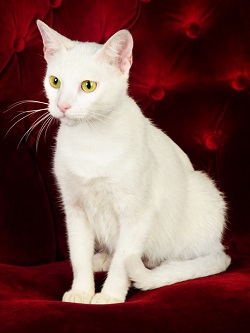 A Khao Manee cat looks like a plush toy, but its body is lithe and muscular, not too heavy and not too thin. It has long legs, a long body, and a long tail, but everything about this breed is rounded and symmetrical – much less extreme than its cousin, the Siamese cat.
Graceful and sturdy
An adult Khao Manee stands about 10-12 inches (25-30 centimeters) tall at the shoulder, with an athletic but relaxed appearance overall. It may have a little floppy loose skin hanging down instead of a tummy tuck. This cat usually stands with all four of its little oval paws planted firmly on the ground, as if it is getting ready to spring.
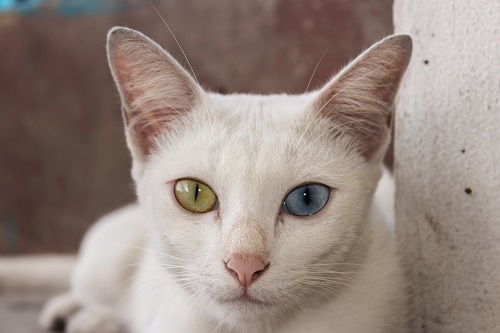
It’s a beautiful animal, but the first thing that you notice are its oval eyes. They slant down towards the nose and may be blue, green, amber, or odd-eyed. Its brilliantly colored eyes, set in snowy white fur, have earned this cat breed the nickname “Diamond Eyes.”
Those living gems shine in a heart-shaped face that has distinctive high cheekbones. A Khao Manee cat’s ears are large, wide at the base and rounded at the tip. If you could draw straight lines between Kitty’s two ear tips and its nose, it would form an equilateral triangle.
Snow-white fur…usually
Khao Manee fur is a little longer than the fur on one of its cousins, the Burmese cat. There is little to no undercoat. Most people describe their coat as soft and cottony, though the breed standard says that its smoothness is more important than softness.
Kittens will sometimes have a dark patch on their heads, but that disappears as the animal grows up. The cat breed’s fur is almost always a beautiful snowy white, though true colors show through in a few Khao Manee cats.
Yes, that’s right. White isn’t their true color.
In terms of genetics, white fur happens when there is a slight change that masks the parts of the gene that give color to Kitty’s fur. When the masking gene isn’t quite as strong as usual, the cat’s true fur colors will show through.
Other than appearance, these colorful Khao Manee cats are just the same as the other members of their breed.
Khao Manee Personality and Temperament:
 These cats might have been the favorites of kings once upon a time, but their true nature is anything but aloof. Khao Manee cats are active, playful, and intelligent. They love to clown around and interact with people.
People-oriented
The Khao Manee is very easygoing and adaptable. It can fit into just about any environment and makes a great pet for singles or families, as well as for first-time cat owners. This cat enjoys being handled, which makes it a good playmate for children, though there should be adult supervision nearby.
Once Kitty is comfortable with its human family and knows its home territory thoroughly, it will gladly greet strangers at the door. The more humans, the merrier! A Khao Manee cat may even jump up on a stranger’s lap or shoulder in order to get attention.
Smart and affectionate
While not as fiercely loyal as some cat breeds, a Khao Manee cat does have its favorite people and likes to spend a lot of time socializing with them. It may be built like an athlete, but this is the ultimate lap cat and will spend hours with you, chatting and blissfully purring, if you let it.
These cats are also very inquisitive. They will poke into everything and painstakingly explore every corner. Khao Manee cats are intelligent enough to keep themselves occupied, but they will enjoy spending extra time with you, if you want to train them to play fetch or do tricks.
This breed’s need for affection is something to consider if you must be away from home for long periods of time. It might be a good idea to have another outgoing cat around to keep your Khao Manee cat company.
Grooming and Upkeep:
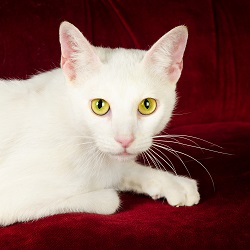 These kitties are low maintenance and just need basic routine care.
Grooming
Khao Manee cats don’t shed much. They just need brushing about once a week and don’t need regular bathing.
This breed’s large ears can pick up dirt. Check the ears during grooming sessions. If they seem dirty or have an odor, gently wipe them out with a cotton ball that has been soaked in a cleaner that is safe for cats.
Claw Care
Cats stretch their back muscles and groom their claws by scratching, but you will have to clip the claws every couple of weeks. Your veterinarian can show you what tools to use and how to clip the claws safely and painlessly.
Don’t forget the teeth. Cats can get gingivitis just like people do and need to have their teeth cleaned at regular intervals. The vet uses general anesthesia for a dental cleaning, with all the risks that come with any anesthetic. A better alternative might be to train this intelligent and friendly animal early in its life to let you brush its teeth with one of the special brushes and toothpastes that are designed for cats.
Nutritional and Exercise Needs:
Khao Manee cats have been royal pets for centuries, but feeding them won’t break your budget. Don’t feed them too much, though, and make sure they get plenty of exercise.
Protein and water are important
Cats need about twice as much protein in their diet as dogs do. This is because they are descended from hunting wildcats who developed a metabolism designed to get energy mostly from protein, not carbohydrates.
It isn’t difficult to give domestic cats a complete and balanced diet. Commercial cat foods in the US and Europe that comply with guidelines set by the American Association of Feed Control Officials (AAFCO) will have exactly the right amount of protein. These foods also contain the right proportions of fat, carbohydrates, and other nutrients.
Water is another consideration. Domestic cats don’t always have the urge to drink water, even when they need it. Canned foods are about 75 percent water, roughly the same amount that the cat would get from prey. Dry kibbles don’t have this built-in water supply. Be sure to have plenty of fresh water available if you are serving dry cat food. Kitty might be slightly dehydrated, but it will drink enough to survive.
Lap cats need exercise
Khao Manee cats are active and move gracefully, thanks to their powerful legs and lithe musculature. However, they enjoy attention and will spend hours in your lap. That can lead to obesity, so it’s a good idea to redirect them into play frequently enough to give them plenty of exercise.
These intelligent cats will chase laser dots and whirling feathers, but they really enjoy a game that rewards them for thinking – a puzzle, perhaps, or a hunting game that calls for strategy. A Khao Manee cat will stalk, pounce, and ambush toy mice, rolling balls with bells in them, or even crinkled-up pieces of paper.
Cat furniture also encourages exercise. A window seat will force your Khao Manee to exercise by jumping up there before it can lay down. Cat trees come with built-in scratching posts and also give Kitty a good workout.
Unique Characteristics of the Khao Manee:
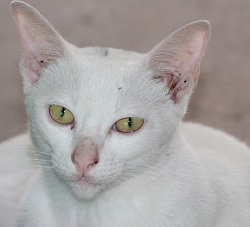 The Khao Manee’s white fur and beautiful eyes distinguish it from the other three native Thai breeds. Its unusual odd-eyed appearance is also very popular in the West. This cat breed is rare and expensive.
White cats are lucky
The Khao Manee is Thailand’s only native white cat. Some say that nature selected its color. However, these royal cats were bred white to white. Doesn’t that mean that humans selected their color? Not according to the country’s cat legends.
Since the 14th century, Thai people have made poetry about “lucky” and “unlucky” cats. The book of these poems is called “Tamra Maew.” The Burmese, Korat, and the Siamese cat breeds are in there, and in one of the oldest versions, so is the Khao Manee. It was called Khao Plort (“All White”) back then:
“The sixth feline completely white, eyes of clear mercury, this cat if in any house, brings long life and title, material wealth coming in with no decrease will be entertained with all things in happiness.”
The color described as “clear mercury” was probably blue. Since Thai cat owners today consider the breed to have two varieties – those with blue eyes and those with amber eyes – this means either that the amber eye color developed later or that only blue-eyed Khao Manee cats were considered lucky back then.
In the West, Khao Manee cats with odd-colored eyes are the most popular. If you have ever seen a picture of a white cat with different colored eyes, it was probably a Khao Manee.
A rare cat’s dilemma
This cat breed almost disappeared in its native country and is only very slowly being brought back. This puts the purebred Khao Manee in a catch-22. It is rare, so it is expensive. However, it’s expensive, so it’s rare.
How expensive? Buyers who have traveled to Thailand in search of a Khao Manee report prices there being as high as 60,000 Thai Baht, or a little over $1,800. That is probably the upper limit, but the average price for a Khao Manee in the West is still high, somewhere around $1,000.
We all would like to see more of this beautiful and affectionate breed. Hopefully, as more and more Khao Manee are bred, prices will drop and their popularity among pet owners will soar.
Health and Wellness:
This breed of cat is very healthy. Like all white kitties, though, it is prone to sunburn. White cats are generally prone to deafness, but this isn’t a problem for the Khao Manee. Your kitty will need core vaccinations for health maintenance and may also need other immunizations, too.
White cats, eye color, and health problems
Genes play a role in other things besides the color of a cat’s coat. The dominant gene that turns the coat white also makes some cats deaf in one or both ears. This is especially true in white cats with blue eyes.
However, deafness is rare in Khao Manee cats, even those with two blue eyes. No one knows why. The best guess is that careful breeding over the centuries has made the difference.
If you do have a deaf cat, it will still be healthy and perfectly capable of living a long and happy life. All you have to do is keep it indoors, and that is a good idea anyway with white cats. They tend to get sunburned, especially their ears. Sun exposure can also lead to skin cancer, so it is especially important to keep a Khao Manee cat indoors all the time.
Another problem associated with Khao Manee eye color is folliculitis, which is inflammation of hair follicles. Some Thai owners believe that amber-eyed cats are more prone to get this. However, the problem hasn’t been reported yet in the West.
Vaccinations
Domestic cats need core vaccinations against feline distemper and two very serious types of upper respiratory infection. These are given in a series over ten weeks. Adult cats that haven’t been vaccinated yet can get it any time, although female cats shouldn’t get it while they’re in heat. Afterwards, Kitty will only need booster shots annually or every three years, depending on the type of vaccine.
Besides feline distemper and the upper respiratory infection vaccinations, the rabies vaccine may be a core requirement, too. It depends on where you live or will be traveling. The details will vary according to local law. This immunization is necessary in places, including the United States, where rabies is endemic.
There are also non-core vaccinations, like the one for feline leukemia, but not every cat needs them. It depends on your cat’s lifestyle (exposure to other cats, for instance) and whether you will be breeding the cat. Your veterinarian can help you decide if Kitty needs any of these extra vaccines.
| The Khao Manee | |
| Face: | Heart-shaped wedge, high cheekbones, prominent nose, slanted eyes. |
| Fur: | Usually white. Short, cottony and soft, plush. |
| Adult Weight: | Males: 8-10 pounds. Females: 6-8 pounds |
| Size/Shape: | Medium. Body is long and muscular. Well balanced and proportional. |
| Legs: | Long, with medium bone structure. |
| Tail: | Usually thin, whip-like but sometimes kinked. Same length as body. |
| Voice: | Chatty and vocal. |
Interesting Facts About the Khao Manee Cat Breed :
Film producer Namdee Witta had a collection of 50 Khao Manee cats in Bangkok that he said were directly descended from the ones King Chulalongkorn owned. Supposedly the King’s son was responsible for the cat breeding program but passed it on to Namdee Witta’s aunt. She didn’t like the cats because they clawed up her furniture, so she gave them to her nephew Namdee. Unfortunately, the museum disappeared, possibly during the city’s bad flooding in 2011.
Some Thai cat fanciers prefer Khao Manee cats with either blue or amber eyes, while Western cat fanciers like odd-eyed colors better.
The Khao Manee has been featured on postage stamps and lottery tickets in Thailand.