Welcome to our Javanese Cats page! Here you will find everything you could ever want to know about Javanese cats and a complete list of all the Javanese catteries we have located in the USA.
Javanese are highly intelligent, athletic, and agile, and they love to play. This breed lives on contradiction; it is refined and elegant, and people think these cats are fragile, when in fact they have a hard and muscular body and are capable of various astounding acrobatic feats.
Javanese Cat Breeders Near You

Javanese
- Are you a cat breeder who isn’t listed? Add your information here.
We also highly recommend reading checking out our latest news articles at our blog. Find information on cat health, nutrition, holistic healing, basic care, toys, and much more!
Javanese Cat Breed Information

General Information:
Height/Length: Medium to long
Weight: males: 7-10 pounds; females: 5-7 pounds
Lifespan: 10 to 15 years
Coloring: red, seal, cream, blue, lilac, chocolate, lilac-cream, blue-cream; patterns: shaded, tabby
Area of Origin: North America
Similar Breeds: Balinese, Siamese, Colorpoint Shorthair
Breed History and Origins:
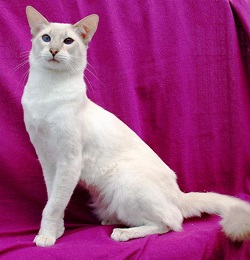 The Javanese is actually a longhaired variety of the Siamese cat dressed in colorpoint colors. All the Siamese-style cats were inspired by breeders that wanted to make a new cat breed similar to the Siamese, but with more colors and a different coat. That’s why the Siamese-style breeds – the Balinese, Oriental Shorthair, Colorpoint Shorthair, and Oriental Longhair, share similar personalities and conformations. The main differences between them lie in the length of their coat, patterns, and colors.
The Javanese breed does not come from Java. However, Java is a sister island to Bali, and the Balinese cats have a close relationship to the Javanese cats. This breed was named by Helen Smith, founder of MerryMews Cattery. Helen was inspired by the exotic appearance of the Javanese.
In the beginning, the CFA categorized this breed as distinct, but in 2008, they announced that the Javanese was a subcategory of the Balinese. The International Cat Association considers the Javanese breed a Balinese-style cat, so both breeds are both placed in the Siamese grouping.
In order to know more about the Javanese origins, one has to be familiar with the Siamese breed history. The Siamese breed is believed to have come from Asia – Thailand and then Siam. This breed is among the first recognized Oriental breeds.
Size and Physical Characteristics:
As it was already mentioned, the Javanese are similar in size, physical characteristics and personality to the Siamese, Balinese, Colorpoint Shorthair, Oriental Longhair, and Oriental Shorthair. They differ in hair length and color scheme. The Javanese have a less extreme body type because they have longer, softer hair.
| Javanese | |
| Head: | Wedge-shaped head with large ears and slightly slanted eyes |
| Coat: | Long and silky coat in different colors |
| Adult weight: | males: 7-10 pounds; females: 5-7 pounds |
| Size/shape: | Medium to long |
| Legs: | Slender, long, fine-boned legs with small paws |
| Tail: | Long tail with long fur that forms graceful, full plume |
| Voice: | Vocal |
The Javanese is a medium-sized cat with a muscular body. Their hair comes in different colors including seal, torti, red, and cream. The best thing is that the hair does not tangle, so it is easy to maintain. Their eyes are very exotic in a vivid blue color, described by most people as sapphire. Javanese have a straight nose with no break between the eyes.
The coat is probably the most distinctive feature in the Javanese breed: it lies very close to the body, is soft and silky, and develops into a rich plume on the tail. On the body, the fur is two to three inches long and it is fuller on the tail in order to create the plume. Many people who see a Javanese for the first time mistake the cat for a Siamese breed until they see the full tail.
Their body is long, tubular, and muscular, and their legs are long, slender, and fine-boned, with small paws.
Like Siamese, Javanese are pointed cats, meaning their face, tail, and legs have a darker color than the color of the rest of the body. The color in kittens tends to darken with years.
The first Javanese cats were shorter-headed, heavier cats, but in order to improve their physical appearance, breeders have decided to breed back to Colorpoint Shorthair and Siamese.
Personality and Temperament:
 The Javanese cats, just like their Balinese cousins, are friendly, playful, devoted, and always in the mood to talk to their owners. They might differ from Balinese and Siamese in color and length of their coat, but beneath the skin, they are the same. They are very fond of their owners. They simply love helping, so they follow their humans and supervise their moves.
They are vocal, but not as loud as the Siamese. Known for their great communication skills, intelligence, and curiosity, they are perfect for people who want an interactive and responsive cat that will follow them everywhere around the house. Training them is easy, and many people prefer this breed because Javanese are not demanding like some other cat breeds are. They are great jumpers and love heights, so high perches and cat trees are necessary equipment for them. If these items are not provided, then Javanese cats will make their own special perch of anything tall – the top of the fridge, a bookshelf, or even a shoulder of a family member.
As for other toys, they do not need anything fancy. The Javanese love something simple, like a ping pong ball or a feather. A bored cat might turn everything into toys, like papers, envelopes, pens, and other things.
They can sometimes be boring when they need attention, but they are great lap cats and true cuddlers.
They are athletic and agile and love to spend their time playing. This means that Javanese are not for people who hate to live with a chatty, hyperactive roommate. Their brain should be kept active with puzzle toys and find-the-hidden-toy games. They do not mind when their owners are away at work; however, they love when their human devotes their free time to them.
Nutritional and Exercise Needs:
The main concern when showing a Javanese is keeping their weight perfect. Usually, the Javanese have a fast metabolism, but there are exceptions in some cats, so they might eat more heavily and become fat. Playing and exercising, as well as a good and healthy nutrition can keep them healthy while burning off extra calories and fat. A show-ready Javanese should be neither skinny nor fat, but maintain elegant lines.
Every cat breed is unique and that is why there are different formulas to suit their needs completely. Gender, age, and health issues all play important roles in what food the cat should eat. Needless to say, the cost is an important factor as well. There are different opinions on what the proper nutrition for a Javanese is, but no single “correct way”. However, there are several commonalities: no grains, high levels of proteins, little to no meat byproducts, wet food so that the cat can get enough moisture, and so on.
Fetch, catch, and chase all sound like games for dogs. But some cat breeds, including the Javanese, really enjoy when playing this kind of games with their owner. Cats do not get all the physical activity they need when they are playing by themselves, so spending time with their owners is a crucial step toward a balanced life and good health. After all, regular physical activity and exercise improves the physical condition, prevents obesity and bad behavior, and teaches social skills.
When it comes to toys, they love catnip toys, stuffed animals, fishing poles for cats, and other toys for pouncing, fetching, and chasing.
Owners who are busy working should consider keeping two Javanese. Two cats double the fun, but they also double the work. Adding a healthy dose of playing every day is of great importance to these cats. A Javanese cat might play nonstop, while a Persian cat, for example, prefers a quiet nap over playing.
Grooming and Upkeep:
 The coat of the Javanese is silky and fine, and thus this breed does not require much grooming. They need combing with a stainless steel comb once or twice a week in order to remove dead hair, while bathing is rarely necessary.
Regularly brushing the teeth is a must because Javanese are prone to periodontal disease. Eye hygiene is also recommended in this breed, so wiping the corners of their eyes will help remove any discharge. Using the same part of the cloth for both eyes runs the risk to spread any infection from one eye to the other, so vets advise using a separate area on the cloth. Cleaning their ears is also an important part of the grooming process of this cat. They need to be cleaned with a cotton ball dipped in a mild solution.
The ideal cat needs no grooming whatsoever, but those cats are few. At the minimum, coat, eyes, and ears should be always clean, and therefore, bathing needs to be done twice a month. Normally, Javanese are not happy with the idea of water and soap, so the bathing process might take up a long time. Blow drying is the hardest part with the Javanese because they are not fans of noisy and hot blow dryers.
Words of advice: when bathing a Javanese for a show, there is a rule about never bathing the cat less than three days before the show. Their coat needs time to settle back into place because a freshly washed coat appears fluffy. Javanese need to be as elegant as possible, so fluffy is not the best look for them.
Characteristics Unique to the Breed:
| Advantages | Challenges |
| Intelligent, energetic, and playful | Potential health problems |
| Affectionate with family | Vocal |
| Friendly toward strangers | |
| Doesn’t require much grooming | |
| Great lap cats and true cuddlers |
The Javanese are more talkative than other cat breeds. They have a wide vocabulary and even different sounds for “pet me,” “I’m bored,” “feed me,” and so on.
They can also be very clingy and like to ride on their owner’s shoulders, which is adorable when the cat is 3 pounds, but more challenging when they are 10 pounds. They love heights and will find the oddest places to look down on everyone in the house. They will even get on the top of the door by crouching down at the door base, doing the popular cat butt-wiggle and springing to the top of the door in one elegant bound without touching the door on the way up.
Health and Wellness:
Both mixed-breed and pedigreed cats have incidences of health issues that are genetic. The most common health conditions in Siamese are also common for the Javanese, some of which include:
- Amyloidosis, a disease that occurs when amyloid – a type of protein – is deposited in the liver or other body organs
- Hyperesthesia syndrome is a neurological issue that causes cats to groom themselves more than usual, leading to losing hair and behaving frantically, especially when they are petted or touched
- Endocardial fibroelastosis – the cause for this disease is unknown, but stressful moments like being put under anesthesia can be risky
- Progressive retinal atrophy is a hereditary eye condition that might cause deterioration of the retina and blindness
- Asthma or bronchial disease
- Aortic stenosis and other congenital heart defects
- Gastrointenstinal conditions like megaesophagus
- Crossed eyes
- Lymphoma
- Progressive retinal atrophy
- Nystagmus, a neurological medical disorder that usually causes involuntary rapid movement of the eyes
- Protrusion of the cranial sternum
Needless to say, choosing a reputable breeder will minimize the risk of any health problem that might occur. As with any cat, regular veterinary consulting for medical advice and routine care is highly recommended.

Interesting Facts about the Javanese:
- At first, the Javanese were categorized as a distinct breed by the CFA, but in 2008 they were declared a division of Balinese.
- The Javanese have a lot more vocal sounds that other cat breeds.
- All Javanese cats have blue or green eyes.
Is the Javanese for Me?
Javanese is a cat that needs a human contact. So those who consider keeping a Javanese but don’t have a lot of time should opt for another breed. They do great in households where humans are away for hours, but they will expect some quality time in the evening. That might just mean letting the Javanese kitty sleep in your lap or something more involved like playing fetch.
For those who are looking for a fun, devoted, and funny companion with elegant looks, the Javanese is a beautiful choice.