Welcome to our Japanese Bobtail Cats page! Here you will find everything you could ever want to know about Japanese Bobtail cats and a complete list of all the Japanese Bobtail catteries we have located in the USA.
The Japanese Bobtail arrived in Japan as early as the sixth or seventh century AD. At first these short-tailed beauties could only be owned by aristocrats. Later they became popular throughout the country. In the 1960s, they traveled into the West and now have an international following. Although the breed is still rare, the popularity of these stylish and long-lived cats is soaring.
Japanese Bobtail Breeders Near You

Japanese Bobtail
- Are you a cat breeder who isn’t listed? Add your information here.
We also highly recommend reading checking out our latest news articles at our blog. Find information on cat health, nutrition, holistic healing, basic care, toys, and much more!
Japanese Bobtail Cat Breed Information
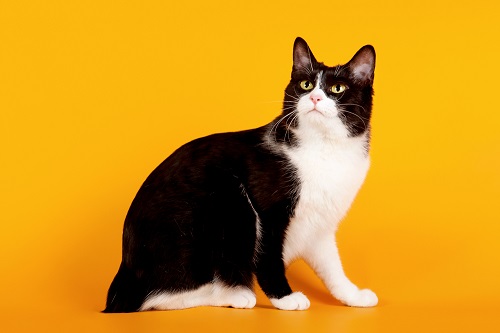
History and Origins:
The history of Japan and its bobtail kitty are entwined, but how did the cats get there in the first place?
A cat for monks and aristocrats
Buddhist monks traveling from India to Asia probably brought cats along to protect their sacred texts from rodents. From time to time, genetic mutations showed up in a few cats, including the mutation that shortens a cat’s tail. It just happened to be such bobtails that the monks carried with them to Japan many centuries ago. Since no other cats lived on the islands, and because very few long-tailed Asian domestic cats could get there, most subsequent kitty generations had bobtails, too.
Humans loved this short-tailed cat. At first, only the upper classes could own one. In 1602, there was a regime change when Tokugawa Yorinobu came to power. In his court, musicians were called “cats” and the bobtails themselves were given the official rank of “Fifth Order of the Court.” These beautiful cats have appeared frequently in Japanese artwork down through the centuries.
Into the streets and then to the show room
No one is sure how Japanese Bobtails ended up as street cats. The way it’s most often told in the West, the Tokugawa government released the cats to hunt down rats that were threatening the silk industry. A few sources in both Japan and the West suggest instead that Japan’s rulers just changed the law to allow buying and selling of cats.
In any event, after their aristocratic days were over, bobtailed cats remembered how to hunt. They became working cats and the “moggie,” or common cat, of Japan. As time passed, they also became popular as pets and good luck symbols. The traditional Beckoning Cat figure, Maneki Neko, is a Japanese bobtail.
By the late 20th century, Japanese breeders raised concerns about inbreeding. Export restrictions were eased, and breeding programs began in North America. The US-based Cat Fanciers Association recognized the Japanese Bobtail Shorthair in 1976 and the Japanese Bobtail Longhair in 1993. Today most major cat associations except in the UK give the breed full recognition.
Size and Physical Characteristics:
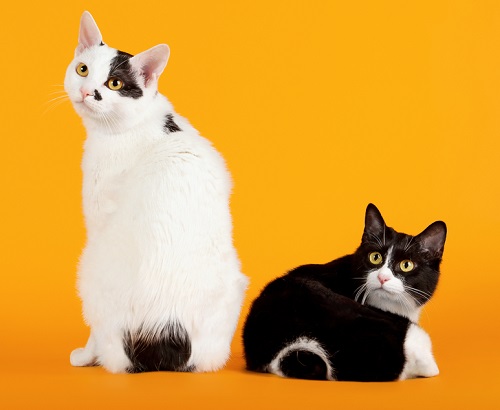
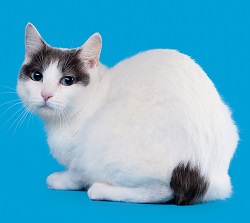 The first thing you notice about this graceful cat is its short tail. Japanese bobtails also are very athletic but never muscle-bound. They have beautiful faces and lovely patches of color on their white fur.
Head and body
The face of one of these cats is shaped like an equal-sided triangle. A Japanese Bobtail has high cheekbones and a slightly rounded muzzle. The ears are big and set wide apart, at right angles to the head. Kitty’s big oval eyes are striking against a background of white or colorful fur and give the cat an alert, watchful expression. Eye color doesn’t depend on fur color. It can be any color, including blue and some odd colors.
A Japanese bobtail’s neck curves smoothly into the animal’s lean but muscular body. Everything about this cat is symmetrical and powerful without being too extreme. The legs are long and slender, but not delicate. This cat is a good jumper because its hind legs are much longer than the forelegs. However, the hind legs are usually bent, so Kitty’s back doesn’t curve but stays level with the floor when the animal is standing still.
The stubby tail looks like a pom-pom. There are just about as many vertebrae in it as in a regular cat tail, but these tail bones are smaller and distorted. Each individual tail has a unique style of kinking, curling, or angling. If you could fully extend it, the tail would measure 4-6 inches (10-15 cm) long, but it is so distorted that it only sticks out about 1-3 inches (4-7 cm). The tail fur is just like the body fur and sticks out in all directions.
White fur and dramatic patches
Japanese bobtail fur can be short or long. Either way, everything is in moderation. Shorthairs actually have medium-length fur that is silky and soft. The longer-haired variety has semi-long fur that is shorter over the shoulders, with a moderate ruff around the neck, britches on the hind legs, and a little plumed tail.
These beautiful animals come in solid colors as well as a variety of colored patterns against a white furry background. The most popular fur coloring is “mi-ke,” which is white with dabs of two other colors, like black and red, blue and cream, silver tabby and red, and so on. The combinations are almost endless for these beautiful creatures. If you look closely at the patch hair, you’ll notice that the color is only on the outer part – down at the base, the hair is just as white as the base fur.
Personality and Temperament:
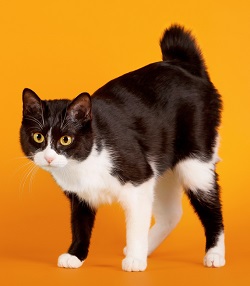 Japanese Bobtails are chatty and friendly. They like attention but can be a little headstrong. This breed has sensitive ears and startles easily. Generally, though, Bobtails are very adaptable and will fit into just about any home environment.
A chatty, loving pet for experienced cat owners
Japanese Bobtails are down to earth and affectionate. While a little too active to be called lap cats, Bobtails enjoy nothing better than snuggling down beside you for some cuddling and conversation.
This is one of the most talkative cat breeds around. Their voices are pleasant. In fact, many people compare their gentle vocalizations to songs. Japanese Bobtails usually always get their message across and will bask in the attention as you talk back to them.
Bobtails do need a lot of affection. If you are gone much of the time, they will get lonely unless there are other pets around for company. They’re fine with cat-friendly dogs, but tend to form kitty cliques with other cats, especially other Japanese Bobtails.
There’s some disagreement among cat owners about how intelligent these beautiful animals are. Bobtails certainly can be trained, but it’s usually only for something they wanted to do anyway. That could mean they aren’t the Einsteins of the cat world . . . or perhaps they have outsmarted us!
Japanese Bobtails can be a little willful and so probably aren’t the best pets for a first-time cat owner.
Sensitive but adaptable
You won’t have to tiptoe around, but don’t be surprised if your Bobtail jumps at a sudden loud noise. Those big ears are very sensitive. Don’t worry – Kitty will soon be bouncing around as usual without a care in the world.
Some individuals might be a little shy around strangers, but most Japanese Bobtails are ready to go with the flow no matter what the human and resident pet situation might be. This breed’s playfulness and tolerance also make it a good playmate for children, with adult supervision.
Bobtails may get up on your shoulder to be close to you and also to be a part of what’s going on. They also love to travel and can be brought along on vacation trips.
Japanese Bobtail Grooming and Upkeep:
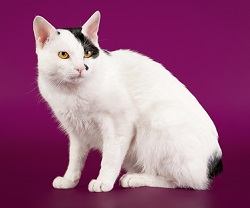 These cats don’t shed very much and are easy to care for. Japanese Bobtail longhairs need weekly brushing and that’s about it. All cats must have routine claw and dental maintenance.
Bobtail Fur
Both short- and long-haired varieties have very little undercoat, so shedding isn’t much of a problem. They will shed more in the spring and fall.
The fur on both varieties is weather resistant, so it takes quite a lot of effort to actually get a bobtail wet. Fortunately, you won’t have to bathe Kitty unless you’re going to a show.
Short-haired bobtails can groom themselves, but the longhairs will need brushing or combing, especially around the ruff and their furry britches, to remove dead hair and distribute oils. Be especially gentle around their tails. Grooming longhairs can be done once a week most of the time, and more often during shedding season.
Claws and teeth
Cats do a lot of nail grooming when they scratch, but they also need to have their claws clipped every couple of weeks. This keeps the nails at the right length and also removes the dead layers that Kitty couldn’t remove with scratching.
Ask your veterinarian about the right tools and the proper way to clip claws. The procedure can be a little intimidating at first, but with practice, especially if the cat has been trained from a young age to accept it, it can be done quickly and safely.
Don’t forget Kitty’s teeth. All cats are prone to gingivitis and gum disease. They need to have their teeth cleaned regularly. The vet can do a dental treatment, but this is always a little risky since it requires general anesthesia. If you’ve never done it before, brushing your cat’s teeth may feel a little silly, but you are actually helping your beloved pet stay healthy.
It doesn’t need to be done after every meal, but the cat’s teeth should be brushed a few times each week. The vet has special feline tooth brushes, or you could use gauze wrapped around your finger. Be sure to use cat-safe toothpaste, not the stuff designed for people.
Nutritional and Exercise Needs:
Cats have different nutritional needs than dogs do. They also tend to get dehydrated because their urge to drink isn’t very strong. Japanese Bobtails are lively and playful cats who love to get into everything.
Protein and water are important
All cats are strict carnivores – they must eat meat. Dogs are omnivores and can get enough energy to run their bodies from fats, protein, or carbohydrates, but cats get most of their energy from protein. They do need some fat and carbohydrates, but not as much.
Commercial cat foods that comply with guidelines set by the Association of American Feed Control Officials (AAFCO) have exactly the right amount of protein and the right balance of fat, carbohydrates, and other nutrients. Just look for the mark on the label.
Dry foods are less expensive, but canned foods keep longer. The major difference, though, is water. Canned foods contain as much water per serving as a cat would get from its prey. This is important because cats are descended from desert wildcats whose main source of water was their prey. They didn’t need a very strong drinking reflex, and that has come down to domestic cats, too.
A diet of dry kibbles will leave your Japanese Bobtail a little dehydrated, so make sure there is enough fresh water constantly available. Kitty may not drink all the water it needs, but it will drink enough to stay strong and healthy.
A born hunter and explorer
Japanese Bobtails are very active cats from kittenhood on. Those long hind legs of theirs power them up easily onto counters and windowsills, so it’s a good idea to have ceiling-high cat furniture around, or perhaps a window seat.
In spite of their early years of lounging around with Japan’s shoguns, bobtails are excellent hunters. They enjoy games that involve chasing, ambushing, and pouncing. They will go after laser dots or any rolling toy, feather on a string, or toy mouse that comes their way.
The Japanese Bobtail also enjoys splashing around in water. It’s a good idea to have a cat-proof cover on your aquarium and secure locks on the doors of cages that contain small, prey-like pets, in case Kitty’s hunting instinct gets triggered.
Characteristics Unique to Japanese Bobtails:
The tail – it’s the first thing you notice. Where does it come from, and how does it compare with other bobtailed breeds like the American Bobtail or the Manx?
Japanese Bobtail genes
The Japanese Bobtail has a rabbit-like tail because of a genetic mutation. This is a change in the genes that control the shape and size of the cat’s tail bones, and it is neither fatal nor painful.
It’s a recessive gene. That is, both parents must have short tails in order for the kittens to also have bobbed tails. A Japanese Bobtail is never born tailless and it is never born with a normal tail.
Japanese Bobtails compared to American Bobtail and Manx
The main difference between the Japanese Bobtail and the American Bobtail is that American Bobtails are born with tails of varying lengths and even with no tails at all. Their gene mutation is dominant – if either parent has an affected tail, then most kittens will also have affected tails. A few will also have normal tails, like one of their parents.
In Manx cats, the genetic mutation, while dominant like that in the American Bobtail, has a totally different effect. It deforms the vertebrae. Kittens will be born with normal-sized tails or short tails of varying lengths, or no tail at all, but they also can be born with Manx syndrome. This happens when the deformity affects spinal vertebrae as well as the tail. Cats with Manx syndrome will be paralyzed and have other nerve problems.
| The Japanese Bobtail | |
| Face: | Triangular. Large, oval eyes. Big ears that sit at right angles to head. |
| Fur: | Long- and short-haired varieties. |
| Adult Weight: | Males: 8-10 pounds. Females: 5-7 pounds. |
| Size/Shape: | Medium. Long and elegant, but muscular. |
| Legs: | Long, slim, powerful. Hind legs longer than forelegs. |
| Tail: | Short, like a pom-pom. Extends outwards as much as 3 inches. |
| Voice: | Soft. Very chatty, with a wide vocabulary of chirps and other sounds. |
Health and Wellness:
Japanese Bobtails are a very healthy breed, with no known associated hereditary diseases. They do need core vaccinations and boosters, and may also need other vaccinations as well.
Only routine health risks
The gene mutation that causes a short tail doesn’t harm Bobtails at all. Like all cats, they can develop ordinary health problems, especially as they get older.
The most common problems that all cats face are obesity, renal failure, thyroid problems, and diabetes. You have control over obesity, and the other problems can all be treated by the veterinarian. If kept indoors and given plenty of affectionate care, your Japanese Bobtail can live into its late teens.
Health maintenance
Regular vet visits are important both for general health checkups and for immunizations. All cats need core vaccinations against feline distemper (sometimes called feline panleukopenia) and two viruses that cause very serious upper respiratory infections. These are sometimes combined into a triple vaccine.
Kitty will need to get these vaccinations in a series delivered over several weeks. Kittens as young as six or seven weeks can get it. So can adults that haven’t been immunized yet (adult females shouldn’t be in heat). After getting this series, your Japanese Bobtail will only need boosters once a year or every three years, depending on the vaccine.
In some places, including the United States and Japan, rabies is also considered a core vaccination. The requirements and intervals vary according to local law.
There are other vaccines available, too, but not all cats need them. It depends on Kitty’s lifestyle (indoors or outdoors, what other animals it’s exposed to, and so on) and whether it will be bred. Talk with your vet about what, if any, non-core vaccinations your Bobtail might need.
Interesting Facts About Japanese Bobtails:
- Japanese Bobtail litters aren’t very large, usually no more than four kittens. However, kittens are larger at birth and develop faster than in many other cat breeds.
- Both Hello Kitty and Maneki Neko (the Beckoning Cat) are Japanese Bobtails.
- For genetic reasons, bobtails with Mi-Ke coloring are usually female. The equivalent in males is black and white, or red and white.
- So much breeding has been done in the West that purebred Japanese Bobtails today are more closely related genetically to Western than Asian cats, though they still show the Asian influence.