Welcome to our Himalayan Cats page! Here you will find everything you could ever want to know about Himalayan cats and a complete list of all the Himalayan catteries we have located in the USA.
The Himalayan is a blue-eyed, long-haired beauty that captures the heart of everyone everywhere. This breed is the most popular division of the Persians. The Himalayan, also known as Himalayan Persian or Colorpoint Persian, is actually a sub-breed with point coloration and blue eyes which are derived from crossing the Siamese and the Persian.
Himalayan Cat Breeders Near You

Himalayan
- Are you a cat breeder who isn’t listed? Add your information here.
We also highly recommend reading checking out our latest news articles at our blog. Find information on Cat health, nutrition, holistic healing, basic care, toys, and much more!
Himalayan Cat Breed Information

The Himalayan, or Himmy, as fanciers call this breed, combines the best of two beautiful, but very different cat breeds. Grown-up Himalayans are sometimes referred to as Himmy kittens because of their gentle and sweet nature. They prefer to spend their time with their favorite human as opposed to being on their own. They follow their owners around the house and are always curious. They communicate with their melodious and soft voice and expressive eyes.
The only complaint owners have about their Himalayans is the fact that this breed is high maintenance. They require special care, regular baths, and brushing several times a day.
The most recognized Himalayan cat, at least recently, has been Jinx, the toilet-flushing Himalayan in the movie trilogy “Meet the Parents.”
General Information:
Height/Length: medium to large
Weight: 7-14 pounds
Lifespan: 9 -15 years
Coloring: they are bred in different point colors, including chocolate, lilac, blue, seal, red, blue-cream, cream tortie, chocolate tortie, seal lynx, red lynx, blue lynx, lilac-cream, and more.
Area of Origin: Massachusetts
Similar Breeds: Persian, Siberian, Birman, American Bobtail
Breed History and Origins:
The first cross between a Persian and a Siamese was made by a Swedish geneticist in 1924, but it was not until 1935 that the first Himalayan was born. Two Harvard medical employees decided to cross a Persian male and a Siamese female in order to establish which characteristics would be inherited; creating a new breed was not what they had in mind. The result of this mating was a litter of black, shorthaired kittens. They later decided to breed a Persian female and a Siamese male, and the result was the same, which was not a surprise.
By crossing a male from the first litter and female from the second, the result was a Debutante – a cat with a Siamese color pattern and body type and the Persian long hair. The look of a Debutante was similar to today’s Balinese. At this point, employees who were doing the breeding had learned what they needed to know about genetics, so they ended the experiment.
Later in 1950, Marguerita Goforth, an American breeder, created a Persian-like colorpoint. In 1957, the breed was recognized by the ACFA and CFA as Himalayan. By 1961, each major cat association in the U.S. recognized this new breed.
British breeders were also interested in creating this breed, so in 1955, the Cat Fancy Governing Council recognized the Himalayan breed under the name that still remains – Colorpoint Longhair.
In 1984, the Persian and Himalayan breeds were united by the CFA. The reason behind this was their body type, which was identical. This decision was quite controversial, so not every breeder welcomed this new policy in which the Himalayan breed was a part of the Persian breed – known as Pointed Pattern Persian.
Persian breeders did not like the idea of introducing hybrid breeds into Persian bloodlines, whereas Himalayan breeders were worried that they would lose the breed they had been working on for so long to perfect.
Himalayans can be outcrossed to Exotic Shorthairs or Persians only, because the Siamese breed is no longer a part of the breeding program of Himalayans.
Size and Physical Characteristics:
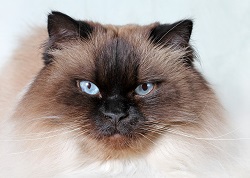 The Himalayans have unique body characteristics that distinguish them from all other members of the feline family, except for one; the Himalayan is very similar to one of the parents, the Persian, with the exception of the fur color variation and the blue eyes.
The Himalayans are medium to large in size, and have a muscular body with heavy bones, short tail and short legs, making it hard for them to jump. However, some cats are born with a Siamese-like body, so they can jump pretty high. They are deep and broad through the chest, equally massive across the shoulders, and have a sweet and innocent face.
Their head is round, with large round eyes, short nose, and small ears. One of the most striking features in Himalayans is the beautiful, vivid blue eye color.
| The Himalayan | |
| Head: | Two types of Himalayans: peke-faced (ultra-typed), and doll-face (traditional); large, round eyes and a nose break |
| Coat: | Long, thick, glossy coat in different colors |
| Adult Weight: | Females weigh 7-11 pounds; males weigh 9-14 pounds |
| Size/Shape: | Medium to large, round and muscular |
| Legs: | Short, thick legs with large paws |
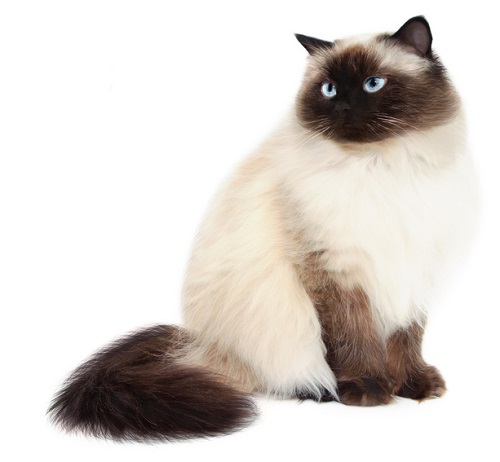
| Tail: | Short tail with long, feathery fur |
| Voice: | Quiet |
When it comes to the facial type, there are two types: traditional (doll-face) and extreme (peke-faced). Although today’s trend is toward the extreme facial type, Himalayans of this type are prone to more serious health problems. That is why TCA advises future Himalayan owners to acquire traditional Himalayan cats.
Another important and obvious physical feature is the long, fluffy coat. They have a long double coat which makes them look like cute little ewoks.
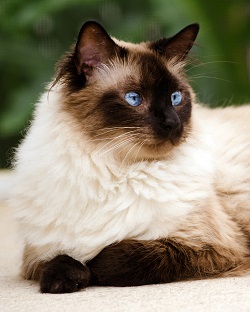
The color points are the most beautiful and distinctive physical feature of the Himalayans. On the edges of their legs they are marked in a gorgeous color palette. These cats can be chocolate, seal, blue, lilac, cream, black, red, flame, tortoiseshell, brown, golden, silver, frost, and more.
Personality and Temperament:
Like the Persians, Himalayans are quiet, sweet and docile. They are the perfect indoor companion; though peaceful and gentle, they love playing different games. Even the simplest toys can keep them amused. Although they are playful in a strange, sedate kind of way, they are more likely to be found sitting gracefully beside their owner than perching on top of the door.
They are not inactive, but they prefer sitting in their owner’s lap. They can be quite demanding of attention, but manage to do well when left alone. They will, however, tell their owner when they feel alone and neglected. They love to be groomed and petted, and thus are considered one of the most affectionate cat breeds.
They do great with children, but do not like boisterous people. Himalayans live by the motto “live and let live,” so they generally get along great with other people and pets. They are not aggressive, and it goes without saying that they must live indoors where they cannot come upon other animals.
Himalayans are easygoing and adjust great to new environments. They are calm, but that does not mean they are lazy. They enjoy playtime as much as naptime. The balance between their peaceful and playful mood is perfect, making them great family pets. They are a happy medium: not too nosy like Siamese and not too lazy like Persians.
Nutritional and Exercise Needs:
 Himalayans and Nutrition
Himalayan kittens need 35% protein levels in their food, so owners must make sure the food they are buying for their Himalayan is rich in proteins.
There are plenty of manufactured cat food brands on the market, all claiming to be healthy, when in reality, most of them are made of low quality ingredients. The pet nutrition industry has lots of similarities to the human food industry – both are full of false claims and hype, peddling poor nutrition choices.
The dry vs. wet food debate goes on and on. But when it comes to Himalayans, there are two major reasons why Himalayans should not be on dry food diet: moisture content and protein quality.
The natural diet of cats is up to 70% water. When food is cooked and dehydrated, it becomes dry. If a Himalayan is on a dry food diet, the cat’s body will have to provide sufficient moisture in order to reconstitute the food consumed. Most animals might make an effort to consume enough water, but not cats, especially not Himalayans; they are bad drinkers, even when they are thirsty. Water is crucial when it comes to protecting the Himalayans from some of the most serious cat conditions, like kidney failure, diabetes, obesity, kidney stones, bladder stones, irritable bowel disease, etc.
Overall, wet food is much better for Himalayans, be it raw or canned.
In the end, cats are carnivores and must derive their nutrients from meat and meat-based sources. Himalayans are true meat eaters and a meat diet is what they need most.
Himalayans and exercising
Exercise is very important for cats, as it has mental and physical benefits. Not only does it keep their mind active, but it also helps them get a good cardiovascular workout. Himalayans are indoor cats, so it is especially important that owners pay attention to the amount of physical activity their cat is getting every day.
As in all things, Himalayans are moderate when it comes to physical activities. They love to play games like fetch; they even like to chase string when owners pull it along, but they will not bounce off the walls or swing from the curtains. Their favorite form of physical activity is following their owner around the house and supervising their every move. They want to be with their favorite human no matter what they are doing at the moment.
There are different ways to get a lazy Himalayan moving and playing. Cheap “toys” like boxes, bags, and paper can keep them entertained for hours. Getting a scratching post and a cat tower is also recommended. Himalayans have short legs, so they are not very athletic, but towers are designed to be very fun, and more importantly, challenging for the cat to climb.
Grooming and Upkeep:
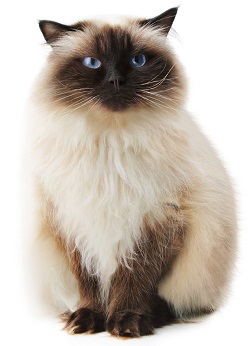 Beauty does not come easily. The Himalayan is one of the most beautiful and luxurious-looking cats, so they require daily attention when it comes to grooming.
Grooming makes a cat feel assured and calm. Himalayans need grooming more frequently than other cats, so their coat must be combed every day with a stainless steel comb in order to prevent and remove tangles and mats. Besides a comb, vets recommend a sticker brush. If owners forget to brush their Himalayan for a longer period of time, they will have to take their cat to a groomer and give them a lion trim.
Himalayans need regular baths in order to stay clean. Like most cats, they do not like water, so they should be introduced to the bathing procedure when they are still kittens. Some cat associations state that Himalayans should be bathed once a week, while others state they should be bathed more often.
Many cats experience frequent eye discharge that can result in matting and staining and can cause infection and skin irritation. That is why eye discharge must be cleaned away immediately. Ear cleaning, nail trimming and tooth brushing are also important parts of the whole grooming procedure. Getting the cat comfortable with the ear cleaner, nail clipper, and toothbrush is crucial.
Characteristic Unique to the Breed:
| Advantages | Challenges |
| Very sweet and social | Daily careful grooming |
| Gives attention and loves receiving attention | Numerous inherited health problems |
| Gets along great with everyone | |
| Quiet | |
| Calm, shy nature |
Himalayan kittens are either cream or white; they do not have colorpoints at birth. After a month, they begin developing their colorpoints located on their face, ears, legs and tails.
They have quite distinctive personalities; some inherit a placid nature from the Persian side, but others are more social and outgoing like their Siamese parent. In the end, however, the result is a wonderful companion.
Male Himalayans are larger and more outgoing than females. They need less time to bond with their owners. Females, on the other hand, are more reserved and need some time to warm up to their owners.
Health and Wellness:
This attractive cat does, however, come with a few health issues.
- Breathing challenges – their flat pug-style nose is a big medical downfall. The compression of the nasal passages and sinuses associated with their nose style makes complications in their breathing and leaves them more gentle and vulnerable to some upper respiratory infections. They also have shortened sinus cavities – a condition that further complicates their breathing.
- Polycystic kidney disease – a disorder that forms cysts inside the kidneys. It is not life-threatening disorder, but it can be very painful. Himalayans that have PKD must be on a strict diet in order to reduce the kidneys’ workload, which would lessen the painful symptoms.
- Feline cutaneous asthenia – or more known as painful and saggy skin, is actually a condition caused by a deficiency in collagen. Collagen is the protein that is responsible for providing elasticity and strength to ligaments and skin. This disorder is genetic, so the breeders are working on eliminating it.
- Hairballs – many people think that the problem of hairballs is a social issue, but hairballs can cause complications when digested. A large hairball in the tummy of a Himalayan cat could cause a serious intestinal blockage that might require emergency surgery. That is why brushing them every day is of the utmost importance.
Interesting Facts about the Himalayan:
- They have won more than 41 national awards since ’81 and more than 175 regional awards since ’92.
- Since ’57 there have been 343,000 Himalayans registered.
- They are considered the 2nd most popular cat breed in the world.
- Europeans knows this breed by the name Colorpoint Persian.
- Himalayans are featured in many movies, TV series, and anime/manga: Meet the Parents, Heathcliff, Date Movie, Homeward Bound: The Incredible Journey, Homeward Bound II: Lost in San Francisco, Prince of Tennis, etc.
- Martha Stewart is a proud owner of three Himalayans: Beethoven, Bartok, and Mozart.
- Another famous Himalayan cat is Goma, having his own blog.
Why Choose a Himalayan?
Owners are very attached to their lovable and loving Himalayan. These cats are a truly beautiful and fascinating breed that fits well in any home. They are known for their affectionate, gentle nature. Their personality and their visual appeal are perfectly combined, so it is no wonder why more and more people are interested in this breed.