Welcome to our German Rex Cats page! Here you will find everything you could ever want to know about German Rex cats and a complete list of all the German Rex catteries we have located in the USA.
The German Rex is the ideal household pet because they have tons of love for their family, as well as for other pets. They are extremely friendly and outgoing with incredible endurance skills. These medium-sized cats have a short coat that is soft to the touch.
German Rex Cat Breeders Near You

German Rex
- Are you a cat breeder who isn’t listed? Add your information here.
We also highly recommend reading checking out our latest news articles at our blog. Find information on cat health, nutrition, holistic healing, basic care, toys, and much more!
German Rex Cat Breed Information
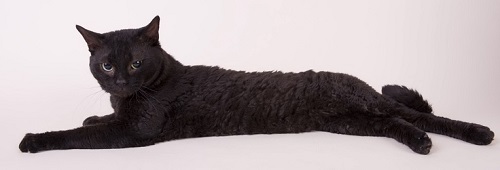
As the name suggests, the German Rex originated in Germany. The resemblance of this breed to the British Cornish Rex is striking, but the German Rex breed is not nearly as popular as the Cornish Rex.
These cats are loving and affectionate. They form a strong bond with their owner and love to spend their day playing. They do not ask for much except for a little attention and having lots of space for playing.
German Rex owners have really enjoyed the company of this breed and noted that they are very intelligent and active. Many cat owners have claimed that they have enjoyed their German Rex’s company for over 14 years! The owners of this breed were asked to describe them in five words. They reported that their cats are intelligent, active, playful, affectionate, and placid.
General Information:
Height/Length: Medium
Weight: males and females are similar in size – less than 8 pounds
Lifespan: 9 to 14 years
Coloring: white, black, blue, red, brown, cream, frost, chocolate, platinum, fawn, lavender, chestnut, cinnamon, seal, champagne
Area of Origin: Germany
Similar Breeds: Cornish Rex, Selkirk Rex, Devon Rex
Breed History and Origins:
Curly-coated cats have appeared from time to time throughout the years. Some cats vanished in no time, while others were used for creating new breeds. There are two stories when it comes to the history of this breed.
Some people believe that the first German Rex was Kater Munk, born in 1930 or 1931. Munk’s parents were Russian Blue and Angora cats. Munk spread his curly-haired genes through the cat population in his village of origin until his death in 1945. It is believed that Kater Munk was the first German Rex, but according to some German Rex researchers, Kater Munk has nothing to do with this breed.
The second story began in the 1950s. The experts claim that the first German Rex cat was a feral black female discovered after the end of the Second World War. In the summer of 1951, Rose Scheuer Karpin, a doctor in Berlin, noticed a black cat with curly coat in the hospital garden. She named the cat Lämmchen, which is German for little lamb. Lämmchen had a soft, thick, wavy coat and cute, curly whiskers. Dr. Karpin thought that the cat she found might be the result of a mutation, and she was right, so she decided to start a new breed. That means that Lämmchen was the first owned Rex-type cat – the maternal ancestor of the current German Rex.
Lämmchen had the same wavy-coated gene prevalent in the Cornish Rex. She produced several litters – all smooth-haired kittens. Later in 1957, Blackie, Lämmchen’s partner, died, so she was crossed with one of her offspring (named Fridolin) and this mating resulted in the first litter of German Rex kittens. Through the years, more and more cats of this breed made an appearance.
Two female cats named Jet and Marigold embarked on an adventure in 1960 when they were transported to the U.S. A black male cat, Christopher Columbus, also a Rex cat, was transported there. These three cats were the first of this breed to set their paws in America.
During the 1970s, people lost interest in the German Rex, which led to a reduction of the breed. Today, the German Rex is officially recognized by the SCFF and the Federation Internationale Feline.
Size and Physical Characteristics:
The German Rex is a medium-sized cat with a round face and long, slender legs. Their paws are rounded and well-developed. They appear to be large cats because they stand high on their legs. Their body is very muscular and heavier than that of the Cornish Rex. This breed is also blessed with beautiful, well-developed cheeks, alert and affectionate eyes, and large ears – wide at the base and rounded at the tips. Their tails are medium in length and well-covered with fur. The color of their eyes is almost always matched with the color of their coat.
The cutest physical features are their slightly curled whiskers and their little nose, and their most remarkable feature is their silky, short coat with short awn hairs. The awn hairs are way thicker than the undercoat hairs, making the cat look woollier.
The density of the coat varies from soft and thin to thick-upper coat. All color patterns and varieties are recognized in this breed of cat, including white.
| The German Rex | |
| Head: | Medium-sized round head with breadth between the ears, strong chin, and well-developed cheeks |
| Coat: | Wooly, curly, silky coat with short awn hairs |
| Adult Weight: | About 8 pounds for both males and females |
| Size/Shape: | Medium |
| Legs: | Long, thin legs with rounded paws |
| Tail: | Medium sized tail, well-covered with thick fur |
| Voice: | Quiet |
Although the body is muscular and their chest is strong, the German Rex is not coarse or massive. In profile, it seems like their chest is rounded and their back is straight starting from the shoulders to the rump.
Common Faults
The most common faults which can disqualify a kitten from being registered as a German Rex are:
- Bare or short tail
- Head that is too pointed or too long
- Lack of muscle tone
- Shaggy coat that is not wavy enough
Personality and Temperament:
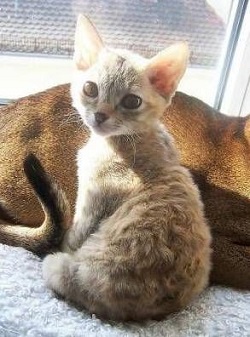 The German Rex is a friendly, lively cat that will brighten up everyone’s day. However, they do not handle new environments very well. When first brought home, they might be reluctant and reclusive, but if treated carefully, they will adapt to their new environment in no time.
Most cats do not like the concept of meeting new people, but that’s not the case with the German Rex. Owners find it funny and cute how this cat acts when there are visitors at the door; the German Rex will stop everything to greet their humans’ friends. They get along with everyone in the household, including children. However, owners with dogs have said that their German Rex had a hard time learning to get along with them.
Playful and active, the German Rex can be taught to play different games, including fetch. As a matter of fact, these energetic cats are so intelligent that they can easily be taught to do acrobatic tricks and other interesting performances. Their mischievous and adventurous nature will bring hours of fun and joy to every family. They can easily be trained and can quickly develop new routines and habits. They are also very good jumpers who love every high spot in their home.
Though active and energetic, the German Rex is also very loyal and patient. When they are not in the play mood (which is quite rare), they enjoy being petted while lying down. Whatever they do, they love being handled by their human, even though they do not require constant attention as some other cat breeds do.
It seems like two things are infinite with this cat: their love and their energy. They adore their humans and will follow them from one room to another to keep a constant eye on each of their activities.
Nutritional and Exercise Needs:
German Rex and nutrition
The German Rex has some special diet needs because their digestive system is not designed for all kinds of food. They will not eat the dinner leftovers of their humans like some other pets do.
Making sure your German Rex’s diet satisfies their needs is highly recommended because proper nutrition means a healthy cat. Vets are always there to recommend foods. It is advisable for the owners to let their cats taste test new food; if the German Rex seems to enjoy a certain food, that means the owners should probably add the food to their diet. However, if the cat does not tolerate the food, it should be eliminated from the list.
Changing foods haphazardly is out of the question because the German Rex needs to be introduced to a new food in small amounts over the course of several days.
How much food does the German Rex need?
The answer to this question depends on several things. First, it’s very important whether or not the cat has been fixed because this plays an important role in their nutritional requirements. Another key factor is whether the cat is kept as an indoor or outdoor pet. Again, only a veterinarian can help define your cat’s daily nutritional requirements.
Usually, they enjoy snacks and small meals during the day, which means the owner should leave bowls out so that the cat can eat whenever hunger strikes. Needless to say, portion control is necessary.
Exercise needs for the German Rex
The German Rex should not spend a longer period of time outside playing in variable weather because their coat is short and insufficient to protect them from extreme temperatures. That’s why they should be kept as indoor-only cats.
As it was previously mentioned, they are energetic and athletic, and in order to maintain their ideal weight, they need to be provided with lots of space for exercise. Although the favorite activities of the German Rex is not any different than that of most cats – playing, jumping, running and sleeping – they are typically more playful and more active than other breeds.
Decrease in mobility and activity must be reported to a vet because that is a sign the cat might have some sort of a health issue.
Grooming and Upkeep:
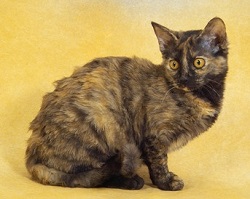 Their coat is either curly or wavy, but shorter in comparison to the Cornish Rex’s. There are no guard hairs, making them a little odd, but unique.
Usually, short-haired cat breeds do not require much grooming. However, the German Rex does not have enough hair to absorb oil secretions, so they often become greasy, and because of that, they need to be bathed often. Moreover, their skin is itchy and sensitive and it might be prone to various infections, so regular baths help with this problem as well.
The German Rex cats have bent, crimped, or hooked hairs, and the most affected parts are their whiskers. Their hair is fragile and it might be damaged with brushing, which is why owners must be very gentle with the coat of their German Rex when they are brushing them.
So, grooming the German Rex means bathing, brushing, and trimming every once in a while. They shed often, but the shedding is not that bad; owners will have to clean up their hair once a week.
German Rex cats are very hygienic, so they will not use a smelly, messy litter box. Their owners need to wash their litter box with a mild detergent and refill it at least once a week.
Checking their ears for infections is a priority; if they scratch their ears or shake their head often, they might have some health problem.
Simply put, the German Rex does not require much. The supply checklist includes several things: brush, comb, nail clipper, clean litter box, scratching post or pad, food dish, water bowl, and interactive toys.
Characteristics Unique to the Breed:
| Advantages | Challenges |
| Intelligent, smart and energetic | Not fans of other pets in the house, especially dogs |
| Playful with kids | Follow their owner from room to room |
| Affectionate eyes, cute whiskers | Sad if left alone |
| Doesn’t require much grooming |
Even though the German Rex has been bred for several decades now, they are still relatively rare.
Unlike other cat breeds, they are very active and lively. Most cats become lazy when getting older, but the German Rex cats keep their kitten-like temperament throughout their whole lives.
They are capable of surprising speed and agility. Tolerant and friendly by nature, they go along with anybody, especially their owner.
The shorthaired coat is beneficial when it comes to shedding, which makes them suited for people prone to cat allergies. However, they catch cold more easily than other cats, so they always look for warmth in the cold winter months by snoozing on household electronic equipment or cuddling with their human under blankets.
The personality of the German Rex is often considered to be a combination of a dog and cat. They are easily trainable, affectionate, and loyal like dogs, and inquisitive and curious like most cats.
Health and Wellness:
 Although these cats are generally healthy, they are susceptible to certain hereditary diseases. One common disease is hypertrophic cardiomyopathy – the most common cause of heart disease in cats. In cats who suffer from this condition, the ventricles’ walls become thick. However, the condition of thicker walls does not mean increased pumping power, but a weakened heart – simply because the affected heart wall becomes less elastic.
The early symptoms of this disease are indefinite and vague. Heart murmur and increased heart rate are common signs. Weight loss, an increased respiratory rate, and a decreased appetite might also be noted.
In order to treat this disease, the German Rex will need to have its heart relaxed through drug treatment, like ACE inhibitors, beta blockers, calcium blockers, and diuretics.
Other common health problems for the German Rex are fleas, eye problems, and diarrhea. However, in general, this breed does not have health problems very often. Needless to say, as with all pets, every German Rex owner should expect such problems to occur as the cat gets older.
4 Interesting Facts about the German Rex:
- The German Rex breed is one of the rarest cat breeds in existence.
- This cat breed has a coat with no guard hairs.
- Some people believe that Kater Munk and Lämmchen are related.
- German Rex cats with paler coat color will require sunblock on their ears.
Why Should You Adopt a German Rex?
Every cat lover needs a German Rex in their life. Cats from this breed are more than capable of entertaining themselves with boxes, drawers, toys and the like. But, what’s even better is they entertain their owners, too! They are energetic and acrobatic, so they will do anything to make their owner laugh. Furthermore, they are perfect fireside companions when reading a book.
Easy to groom, quiet, not attention-seeking, loyal to their owner, and more. What more could you ask for?