Welcome to our Exotic Shorthair Cats page! Here you will find everything you could ever want to know about Exotic Shorthair cats and a complete list of all the Exotic Shorthair catteries we have located in the USA.
The worried-looking Exotic Shorthair is actually a very happy, loving cat. As a breed, it has been around for less than half a century but it’s rooted in two of the oldest cat breeds in the world – Persians and domestic shorthairs. Breeders wanted a shorthair with a silver coat and green eyes, but instead they got a plush kitty with a pug face, a huge head, and a winning personality that combines the Persian’s gentleness with the American Shorthair’s intelligence and playfulness. Though they do have some hereditary health issues, Exotic Shorthairs are the second most popular cat breed in the world, after Persians.
Exotic Shorthair Breeders Near You

Exotic Shorthair
- Are you a cat breeder who isn’t listed? Add your information here.
We also highly recommend checking out our latest news articles at our blog. Find information on cat health, nutrition, holistic healing, basic care, toys, and much more!
Exotic Shorthair Cat Breed Information

Exotic Shorthair History and Origins:
The Exotic Shorthair is a breed that developed more or less by accident. Today the Exotic Shorthair is the one of the most popular cats in the world, second only to its cousin the Persian.
A new color for the American Shorthair
The breeders of the Exotic Shorthair didn’t set out to get a flat-faced, plush cat. What they wanted back in the 1950s was an American Shorthair (ASH) that had the Persian’s silver color and beautiful green eyes.
Persian-ASH crosses weren’t allowed by cat associations, but people did it anyway, since it produced such beautiful kittens. However, the kittens didn’t exactly look like American Shorthairs.
A new shorthaired breed
Crossing the Persian and American Shorthair became so common that by 1966 Jane Martinke, an ASH breeder and cat show judge, was concerned that the appearance of the American Shorthair breed was going to change forever. To save it, she suggested making the new shorthairs a separate breed. She called them Sterlings because of their beautiful silver fur. However, since silver is an exotic color for the shorthair breed, the Cat Fanciers Association registered the breed in 1967 as the Exotic Shorthair and accepted not only silver but also every other color and pattern that Persians come in.
Several different breeders got to work developing Exotic Shorthairs, using the Russian Blue and Burmese cat breeds as well as the American Shorthair. Once the shorthair gene was established, they then bred their Exotic Shorthairs back to Persians to keep the desired physical traits. This wasn’t easy at first, since many well-established Persian breeders resisted the idea of a shorthaired Persian. Those who bred both Persians and Exotics had the most success with the new breed.
The American Cat Fanciers Association (ACFA) and the International Cat Association began to recognize Exotic Shorthairs in the 1970s. These plush little felines soon were winning championships as well as people’s hearts all around the world. The Cat Fanciers Association (CFA) shortened the breed’s name to the Exotic in 1993, but most other major cat associations still call it the Exotic Shorthair.
Size and Physical Characteristics:
| The Exotic Shorthair | |
| Face: | Massive head. Face either round or flat. Eye color depends on coat. |
| Fur: | Not quite as short as other shorthairs. Thick, fluffy undercoat and overcoat. |
| Adult Weight: | Males: 7-14 pounds. Females: 6-10 pounds |
| Size/Body Shape: | Medium to large, muscular, round. Powerful shoulders and hips. |
| Legs: | Short, straight, thick. Big round paws with tufts of hair between toes. |
| Tail: | Short, but proportionate to the body. Bushy. |
| Voice: | Quiet. Likes to chirp and frequently purrs. |
The Exotic Shorthair resembles the Persian in everything but the length of its coat, which looks short next to a Persian’s luxurious fur but is almost medium in length compared to other shorthaired breeds. This velvety coat accentuates the Exotic Shorthair’s round body as well as its enormous head and colorful eyes.
Head and body
The first thing everybody notices about an Exotic Shorthair is its huge head and brilliant eyes. The Exotic often looks disappointed or anxious, but that’s just an effect of the cat’s shortened muzzle. Just like the Persian breed, Exotic Shorthairs come in two face shapes: the round doll-face type and the flat-faced Exotic Shorthair with the forehead, nose, and chin aligned vertically. Ideally, the top of a flat-faced cat’s nose shouldn’t be higher than its lower eyelids.
The large, round eyes are wide set and may be copper, blue, green, hazel, or even odd-eyed, depending on the coat color. They appear prominent, though not bug-eyed, when viewed from the side. Exotic Shorthairs have small ears that tilt forward and blend into the contours of the cat’s massive head.
It’s often difficult to see these cats’ short necks. Exotic Shorthairs have a “cobby” body. This cat fancy term describes a short, round shape that looks a little like a corn cob. These cats have broad chests and muscular shoulders and rumps. Their legs are short, straight, and heavily boned. They end in big, round paws with toe tufts.
Colorful, plush coat
Both the undercoat and top coat on an Exotic Shorthair are just as thick as on a Persian. The only difference is length. It is the dense undercoat that makes these lovely felines look like cuddly toys.
There are some 80 different color combinations for the Exotic Shorthair’s coat. It may be a solid color or have more than one color. The Shorthair might also have mixed colors and patterns, say, black and red tortoiseshell or a tabby pattern with bull’s-eye markings on either flank. Colorpoint Exotic Shorthair cats have the same dark fur face mask, ears, paws, and tail as a Himalayan cat.
Personality and Temperament:
 Exotic Shorthair cats are mellow but a little smarter and more playful than Persians, thanks to the American Shorthair influence. These loving, adaptable kitties make good family pets and companions.
Affectionate and loyal
Exotic Shorthairs bond closely with those who give them a lot of love, attention, and respect. This breed is famous for its devotion. The Exotic is a lap cat. It will also follow you from room to room. When you are sitting, it will quietly move closer and closer to you until it is right in your face. It just loves you that much! Exotic Shorthair cats aren’t demanding, though. They are easily satisfied and very accommodating.
Like any cat, the Exotic Shorthair needs a little time to get used to new people and situations. Once comfortable, it will quickly adapt to just about any home environment, including families with children and those with other resident pets, including dogs. This cat can be a little bossy with other pets, but it makes a very good companion and therapy animal for people.
Exotic Shorthairs aren’t too vocal, but sometimes they will chirp and meow back at you if you’re feeling chatty. More than anything, your Exotic Shorthair wants to please you, and it will miss you when you’re gone.
If your schedule keeps you away from home a lot, it might be a good idea to get two cats so they can keep each other company. This works best with two Exotic Shorthair kittens, especially if they’re litter mates, but an older cat and a kitten can learn to adjust to each other, too.
Playful but mellow
Kittens are quite lively, but once they grow up, Exotic Shorthairs tend to settle down. They will lounge around and doze for hours, but unlike their Persian cousins, these Shorthairs will go looking for some fun when they wake up. And of course they will try to involve you in the game.
When playtime is over, the Exotic Shorthair will happily settle into your lap for a cuddle session or sit nearby, ready to doze off again. This is a very fun, easy cat to live with.
Grooming and Upkeep:
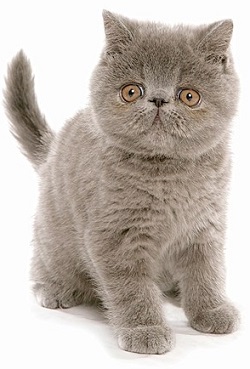 Exotic Shorthairs are easier to groom than Persians, but they do need frequent grooming as well as daily eye care. Owners must also provide regular nail trimming and dental cleaning.
Grooming tips
The Exotic Shorthair doesn’t shed heavily, except in the spring and fall. Kitty will generally do its own grooming, but it can’t get all the way down to the skin. You should comb out your cat’s double coat twice a week to get rid of dirt and distribute oil evenly along the hairs. A stainless steel comb with both fine and wide teeth on it is ideal for the job.
These cats have shortened lacrimal ducts because of their face shape, so their eyes water frequently. To prevent infections and make your Exotic Shorthair happier, just wipe off the gunk around its eyes daily with a warm, damp washcloth. There are also special cloths available that take stains out of the hair.
Even if you won’t be showing your Shorthair, give it a bath about once a month to freshen up its coat. That dense fur takes a while to air-dry, so feel free to use a blow dryer if Kitty will tolerate the noise. If you do use a blow dryer, though, be sure to always keep the setting on low to avoid burns.
Claws and teeth
The Exotic Shorthair grooms its own claws by scratching, but it must have some help in removing all the dead layers of nail. The Exotic has 18 nails, five on each forefoot and four on each hind foot. That can be a little intimidating if you have never trimmed a cat’s claws before, but clipping goes quickly and easily with the right tools and a little practice. Your veterinarian can show you how to do this safely.
Cats are prone gum disease, so your Shorthair will need to have its teeth cleaned regularly. The vet can do this, but it involves general anesthesia, which is always a little risky. If you are comfortable with using a gauze-covered finger or a special toothbrush and cat-safe toothpaste once a week or so, you’ll be protecting your Exotic Shorthair’s health as well as saving money.
Nutritional and Exercise Needs:
Exotic Shorthairs, like other domestic cats, need plenty of protein and a well-balanced diet. They should be encouraged to drink water, too. This cat doesn’t require a lot of room to exercise, but you should play with your laid-back Exotic Shorthair frequently enough for it to burn off calories and avoid obesity.
Proper nutrition and plenty of water
Your Exotic Shorthair is an adorable, big-eyed ball of fluff, but it is also a carnivore, descended from a long line of hunting cats that trace their roots to desert wildcats. Its body is designed to live off prey, which is mostly protein, with a little fat and a few carbohydrates. Any cat food that meets Association of American Feed Control Officials (AAFCO) guidelines provides everything a Shorthair needs to stay healthy and happy. There are two diet profiles, one for kittens and one for adults.
A cat can live quite well on either canned or dry food, but the Exotic Shorthair’s pressed-in face means that your cat may have difficulty eating dry food. Kibbles designed for Exotic Shorthairs (and for flat-faced Persians) are available in some specialty stores or from the veterinarian.
Water is the other consideration when choosing what to feed your Shorthair. Canned food contains enough, but when serving dry food, be sure to leave lots of fresh water out so your Exotic doesn’t get too dehydrated.
Exercise and obesity
Exotic Shorthairs are livelier than Persians. They will chase feathers, balls, and other toys until they’re exhausted and still be disappointed when you put up the toys. However, it remains important to watch the calories with this breed.
The Exotic Shorthair needs exercise to keep its bones and muscles healthy, its mind alert, and its weight down. Unfortunately, it enjoys lying around and snoozing a lot. Its short legs also limit exercise options. Most Exotic Shorthairs would rather snuggle down on the couch than romp around.
It’s up to you to keep your Shorthair fit and…well, “trim” doesn’t seem like the right word for this round fur ball. Let’s say “firm” instead. That roundness underneath all the velvety hair should be muscle, not flab.
If Kitty is packing on the pounds, add in a few more play sessions each day. The Shorthair isn’t the Einstein of the cat world, but it needs mental challenges to stay interested in things. Just interacting with you may be enough of a challenge, and it will also enjoy puzzle toys that dispense a treat when Kitty figures them out.
A plump Exotic Shorthair won’t resist the extra exercise when it’s getting all that extra attention from its favorite person – you. In addition, you can watch serving size and limit treats and table scraps to no more than 10 percent of what the cat eats each day.
Characteristics Unique to the Exotic Shorthair:
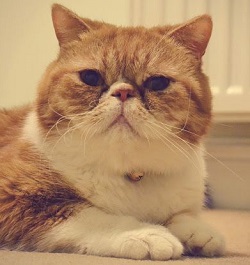 An Exotic is built like a Persian, but it has shorter hair. Breeders have had much more difficulty achieving that look than you might think.
A longhaired, shorthaired Persian?
Persian cats have long hair, and breeders used the American Shorthair, Russian Blue, and Burmese breeds to get the dominant shorthair gene established in the Exotic. That’s all well and good, but the recessive longhair gene is still there. It has to be, because breeders keep outcrossing to Persians to get the right physical characteristics. For this reason, nobody knows when a long-haired kitten may be born, even with two Exotic Shorthair parents.
The trouble getting short hair and the right physical traits gave breeders a headache back in the early days of the breed. A long-haired Exotic Shorthair looked just like a Persian cat, but it couldn’t compete in cat shows back then because it had Persian-ASH hybrids in its family tree. Yes, that wasn’t fair not fair to the longhair, but it wouldn’t have been fair to Persians to make them compete with hybrids.
The cat fancy to the rescue
The major cat associations settled things by adjusting their categories. Some, like the CFA, created a longhair Exotic division but allowed those fluffy kitties to compete in Persian color classes. Others, like the ACFA, decided that the longhair hybrid is a separate breed, the Longhair Exotic or Exotic Longhair.
The International Cat Association got creative and established a Persian breed group that includes the Exotic Shorthair but also allows long-haired Exotics into championship competition. That’s a win-win situation for everybody.
Health and Wellness:
Along with velvety fur and a rugged but cute body build, the Exotic Shorthair has inherited the tendency to get some diseases from its Persian ancestors. The Exotic’s flattened face also makes it prone to breathing problems. Like all cats, Exotic Shorthairs need regular vaccinations.
Hereditary health issues
The Exotic Shorthair is overall a healthy cat, but it does have an increased risk for polycystic kidney disease (PKD), blindness, and heart disease.
Studies have found polycystic kidney disease in some 40% to 50% of Exotic Shorthairs. Like Persian cats, Shorthairs with this problem develop tiny fluid-filled sacs on their kidneys that eventually cause kidney failure. It develops so slowly that most cats aren’t diagnosed with it until around age 7 to 10. Responsible breeders screen for PKD before they let a cat breed. Be sure to purchase your Exotic cat from a reputable breeder and ask if either of the cat’s parents has PKD.
Two other genetic issues have been associated with Exotic Shorthairs. One is a gene mutation that causes retinal degeneration and eventual blindness. The risk for this disease isn’t quite as high as it is in some other breeds, but you should still be aware that it can happen. It’s not the end of the world. A blind cat can live a full and happy life but should always be kept indoors.
The other issue is a heart disorder called hypertrophic cardiomyopathy. This is the most common form of heart disease in all domestic cats. It does sometimes cause sudden death, but milder forms can be treated with medicine and a special diet.
Breeders screen for retinal and cardiac problems. After you have purchased your Exotic Shorthair, the vet will also perform office screening for both these conditions.
That flat face and square skull cause breathing problems in Exotic Shorthairs, too. It usually just means Kitty will snore in its sleep and snort more often than other cats, as well as get out of breath a little more quickly when playing.
Head colds are harder on the Exotic, too. The doll-faced Exotic Shorthair can still use its nose if it develops a cold, but a flat-faced Exotic with the same cold must breathe through its mouth and might also develop a sinus infection.
Routine health maintenance
All domestic cats need to be immunized against feline leukemia (sometimes called panleukopenia or parvovirus), as well as FHV-1 and FCV – two very severe upper respiratory infections. These are sometimes combined into a triple vaccine. Core vaccinations are given as a series over ten weeks. Exotic Shorthair kittens can get them at 6 to 8 weeks of age. Adults that haven’t been vaccinated can receive core vaccinations at any time, although females shouldn’t be vaccinated while they’re in heat.
Rabies is considered a core vaccine in some places, including the United States. The schedule varies according to local law. Veterinarians can tell you what is needed where you live and where you might travel with your Exotic Shorthair.
Shorthairs might need other vaccinations, too, depending on such things as whether they go outside, are exposed to other cats, or will be bred. Again, check with your vet to see if your kitty might need any of these non-core vaccines.
Interesting Facts About Exotic Shorthairs:
- Famous Internet Exotic Shorthairs include Snoopy the Cat from China, Pudge the Cat from the US, and Bronte, the singing cat in a UK mobile phone commercial.
- Some say that the cartoon cat Garfield is an Exotic Shorthair, but that hasn’t been established yet.
- On average, Exotic Shorthairs can live into their mid-teens.
- Other names for the Exotic Shorthair’s two different faces are traditional (doll-face) and extreme (flat-face).