Welcome to our Dwelf Cats page! Here you will find everything you could ever want to know about Dwelf cats and a complete list of all the Dwelf catteries we have located in the USA.
The hairless Dwelf cat is descended from three cuties: the Munchkin, the Sphynx, and the American Curl. It may look strange to you at first, but those expressive eyes and elfin ears will quickly win your heart. Dwelf cats, a new breed, are registered with The Dwarf Cat Association. These sociable and very affectionate kitties require a lot of care, but they enjoy being handled and make great family pets. Dwelves overall are very healthy, though they are prone to a few skin, orthopedic, and cardiac problems.
Dwelf Cat Breeders Near You

Dwelf
- Are you a cat breeder who isn’t listed? Add your information here.
We also highly recommend reading checking out our latest news articles at our blog. Find information on cat health, nutrition, holistic healing, basic care, toys, and much more!
Dwelf Cat Breed Information
Dwelf History and Origins:
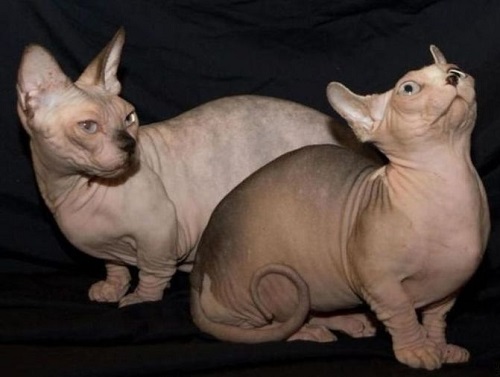
In 2008, a new type of cat appeared. It had the hairless body and face of a Sphynx, the short legs of a munchkin, and curled ears that resembled those of an American Curl cat. Cat breeder Stephanie Osborne in Arkansas named it the Dwelf – a combination of “dwarf” and “elf.”
The unusual look of Dwelves caught on with some breeders. Today, there are about 30 Dwelves living happily in the United States. The breed is fully recognized by the Dwarf Cat Association, and the International Cat Association has it listed as experimental.
Breeders are still developing the Dwelf. Besides outcrossing with its Sphynx, Munchkin, and American Curl forebears, the breeding program include genes from two other hairless breeds – the Minskin and the Bambino. To widen the Dwelf gene pool, outcrossing with domestic shorthairs and longhairs is also allowed.
Size and Physical Characteristics:
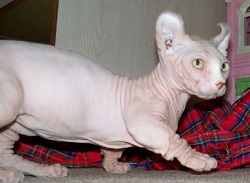
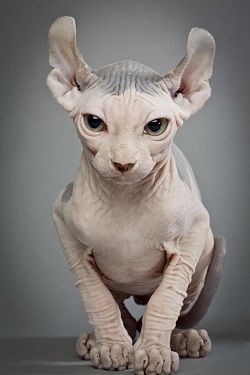 At first glance, Dwelf cats remind you of their Sphynx ancestors. They have wedge-shaped heads with high cheekbones and large, lemon-shaped eyes that angle up slightly. Their muzzles are short, with obvious whisker pads and a whisker break, though Dwelves often don’t have any whiskers or eyebrows. They have a strong chin that is perpendicular to the nose.
A Dwelf’s ears are unique. This cat breed got its curly ears from the American Curl, but in Dwelves the ear tips are crimped vertically, not horizontally like the Curl’s. Ears on a Dwelf cat are very broad in the base and always stand upright and alert. When seen from the front, the ears start at the level of the eyes and taper into curled tips that curve gracefully inward toward each other over the top of Kitty’s head.
A hairless body
Dwelf cats are heavier than they look, with plenty of hard muscle. Their compact bodies are usually covered with Sphynx-like downy fuzz that feels like suede when you pet them. Some Dwelves may have no hair at all except on the nose, ears, and tail. The chest is broad. The cat’s tummy is round and always looks full.
These odd-looking but lovable cats have short, heavily muscled legs. Their big, oval feet have obvious knuckles and a paw pad that makes Kitty appear to be walking on tip-toe. Unlike the Munchkin breed, Dwelf cats sometimes show bowing in the forelegs.
The hind legs are slightly longer than the forelegs. This makes the Dwelf’s back slope upward, starting at the shoulders, but it doesn’t curve. That’s because the Dwelf keeps its hind legs in a flexed position (except when this active little cat is jumping up onto something).
Dwelf tails aren’t quite as long as the body. They are whip-like and taper to a fine point.
Dwelves show patterning and color on their skin as well as their fur (if they have any). These cats come in all color combinations, though the colors are lighter than they would be in fur.
You can also see Kitty’s wrinkles, especially on the forehead, cheeks, and shoulders. We humans try to hide our wrinkles, but Dwelf cats earn extra points from the show judge for them!
| The Dwelf Cat: Adorable and Weird-Looking | |
| Head: | Rounded wedge. High cheekbones. Large eyes. Crimped ear tips point upward. |
| Fur: | Downy, suede. All colors/patterns. Some individuals may be almost hairless. |
| Adult Weight: | Males: 6-9 pounds. Females: 4-7 pounds |
| Size/Shape: | Small. Very muscular. Skin wrinkles on forehead, legs, and shoulders. |
| Legs: | Short, muscular. Forelegs may be bowed. All four paws have big knuckles. |
| Tail: | As long as body. Whip-like. |
| Voice: | Fairly vocal |
Dwelf Cat Personality and Temperament:
It takes a little while for the Dwelf to get used to a new environment. Once it feels comfortable, Kitty will get right into the middle of whatever is going on with its human companions. It loves to nestle close to you not just to keep warm but also to give and receive lots of affection. These intelligent and friendly kitties are also active and curious.
Cautious but big-hearted
The world can seem a little overwhelming to a little hairless cat with big ears. Its body has no furry insulation and those big ears pick up every little noise. It’s not surprising, then, that a Dwelf cat tends to hold back until it has an idea of what to expect from its new home and the humans and other pets that live there. Once it knows things are all right, your Dwelf will confidently set out to make friends and explore its new home.
These cats are very focused on people. They bond with the whole family, not just one or two individuals. Dwelves also get along with other resident pets, including dogs. Because they enjoy handling, Dwelf cats make good playmates for children, as long as there is adult supervision.
Dwelves like warm places. It doesn’t take them long to realize that the best place in the room is on your lap or snuggled beside you in bed. They love to be held and will purr happily and chatter with you for hours. This human-centered cat needs a lot of affection. Dwelf cats do get lonely if they are left alone very long, even just during a work day.
Curious, active, and playful
Despite those short legs, Dwelf cats are natural racers. They hop along in leaps and bounds like a ferret. Their lower center of gravity also lets them take corners at high speed. These little kitties can jump up onto beds and counters, too, thanks to their powerful hind legs.
Dwelves keep themselves busy, but they are happiest when you’re involved. These intelligent animals can be trained, though they are also strong-minded and it’s anybody’s guess if they will accept it (unless it’s something they already want to do).
Grooming and Upkeep:
 Most people think a hairless Dwelf cat would be easy to groom, but it actually requires a lot of care. This is because there is nothing to soak up skin oils and keep microbes in check. These cats get dirty quickly and are prone to yeast infections in their skin wrinkles and between their toes. Like all cats, the Dwelf also needs its claws groomed and its teeth cared for regularly.
A high-maintenance pet
Skin secretes oil to stay healthy and hold in moisture. Cats then distribute this oil all over their fur when they groom. Dwelves can’t do this, so it doesn’t take long for them to get grungy.
You will have to be your Dwelf’s groom. Wipe Kitty down frequently and give it a bath every ten days or so, with special attention to its face and toes as well as the spaces in between wrinkles. Dry it off thoroughly, but don’t use a hairdryer, which can easily burn the Dwelf’s tender skin, even on the lowest setting. Kitty’s bedding and any furniture it uses will also need regular cleaning.
Microbes collect in wrinkles and in between the toes. They will cause infection if those areas aren’t washed or wiped down almost every day.
The ears are important, too. Dwelves don’t have fur inside their ears, so wax builds up there. Washing the ear with water can cause infection, and cotton-tipped swabs will injure the delicate ear canals. Instead, groom the ears gently by wiping them out with a cotton ball that has been soaked in a cat-safe cleaner.
Dwelf cats are also very sensitive to sunburn. They shouldn’t be allowed outside much, but if they do go out, give them jackets and cat-safe sunscreen (available at the veterinarian’s office). Indoors or outside, jackets keep Kitty warm during cold weather, though it is certainly true that Dwelves are very good at finding the warmest spots in the house.
Claws and teeth
All the running around these alien-looking little kitties do slows down the growth rate of their claws, but you will still need to do some trimming every couple of weeks. It’s not at all hard to do with the right tools and a little practice. The veterinarian can get you started.
Dental care is important, too. Domestic cats are prone to gingivitis and need routine dental care. To do this, veterinarians have to put them under general anesthesia, which always has some risks associated with it. It is safer, as well as easier and cheaper, to clean your Dwelf’s teeth yourself. This isn’t difficult, especially if the cat has been trained to be used to it from a young age. Just use a gauze-wrapped finger or a kitty toothbrush and toothpaste from your vet once or twice a week.
Nutritional and Exercise Needs:
Dwelf cats eat more than most other breeds because they are very active. It also takes more calories to keep them warm. All cats require a high-protein diet as well as lots of water and the right portions of other nutrients. Your Dwelf cat should have plenty of room to exercise, too.
A complete diet and lots of water
It’s difficult to remember that cute little Dwelf cats are carnivores, just like their enormous cousins, the lion and the tiger. They must have more protein and other meat components than dogs, as well as different amounts of fat and carbohydrates.
Each serving of any commercial cat food that meets guidelines set by the Association of American Feed Control Officials (AAFCO) has the right amount of protein and other diet requirements for your Dwelf. Look for the sign on the label.
As for serving size, just use trial and error. Put out as much as Kitty will eat. If any is left over, then make the next serving smaller. Too many table scraps will throw off the diet balance, so try to limit those to no more than 10 percent of the total amount of food Kitty eats each day.
The only other thing you should think about is water. Domestic cats are descended from desert wildcats that got most of their hydration from prey. Felines don’t have a very developed drink reflex and will need to be offered more water if their diet consists solely of dry food. This isn’t quite as important with canned food, as each serving also contains the right amount of water to keep your Dwelf happy and healthy.
Exercise needs
Dwelves go from sound asleep to Warp 5 in an instant. Because they are fairly small, they do well in apartments as well as houses, but they will need some room to run around in.
Your Dwelf cat keeps itself occupied with sleeping, playing, cuddling, and jumping up onto things to survey its territory. It will also be delighted with the extra personal attention that comes when you personally exercise Kitty at playtime.
Dwelves are intelligent and can be taught how to play fetch. Puzzle toys also keep them busy, particularly those that dispense treats. These lively pets also like hunting games like laser pointers, whirling feathers, bell toys, and catnip mice.
These little kitties can also get some exercise just by leaping onto a securely fastened window seat to relax in the warm sun. Pet furniture gives them something besides your curtains and bedspreads to climb. Yes, they’ll climb up anything. Dwelves are agile and energetic enough to go where they want to, even if they have to take the scenic route to get there.
Unique Dwelf Characteristics:
 A Dwelf cat resembles nothing else in the feline world except the Bambino or the Minskin. What makes Dwelves different from these two breeds?
Dwelf cat compared with Bambino
The Bambino cat was bred in 2005 by the same people who developed the Dwelf cat in 2008. It is descended from the Sphynx and the Munchkin, too.
Here’s how you can tell the two apart: Dwelves have curly ears, while the Bambino’s ears taper to a smooth tip. The Bambino is also a little smaller than a Dwelf and sometimes has a tuft of fur on the tip of its long, whippy tail.
If it’s a purebred, you can check the papers. Both cat breeds are listed with the Dwarf Cat Association, and the International Cat Association lists them as experimental breeds. However, the Bambino, a slightly older breed, is also recognized by the Rare and Exotic Feline Registry.
Dwelf cat compared with Minskin
Like Dwelf cats, Minskins are descended from the Munchkin and the Sphynx. It’s easy to tell at a quick glance whether you’re looking at a Dwelf cat or a Minskin. Dwelves have curly ears and Minskins don’t. Minskins are also smaller than Dwelves, standing just 7-8 inches at the shoulder and weighing no more than 6 pounds on average.
Dwelf cats have a full, muscular build, while Minskins have short and stocky bodies. The Dwelf is either hairless or covered with down that feels like peach fuzz. Minskins show a bit of fur on their face, ears, legs, and tail, and it may even extend up over their shoulders and hips.
Again, the papers also help. Both breeds are registered with the Dwarf Cat Association, but the International Cat Association, which recognizes the Minskin, considers the Dwelf cat an experimental breed.
Dwelf Cat Health and Wellness:
Three genetic mutations give the Dwelf cat its special look. Fortunately, that doesn’t mean that Dwelves are less healthy than other breeds. It does mean that there is some controversy over breeding them. In addition, Dwelf cats may be prone to heart disease.
There was some concern that the mutation causing their curly ears might also make them prone to the sort of bone and cartilage changes that Scottish Folds sometimes suffer. Fortunately, it turns out that a different gene is responsible and Dwelves are just fine in this respect.
The fuss over dwarf cats
If you get a Dwelf, you will soon learn that many people have strong feelings about breeding dwarf cats.
Everyone is concerned that unethical breeders sometimes pass off runts or sick cats as dwarf cats. All you need to know is that not every small cat is a dwarf cat. True feline dwarfism happens because of pseudoachondroplasia – a genetic disorder that shortens the long bones of the leg. Dwelves inherited it from their Munchkin ancestors, and reputable breeders will have the right paperwork to show that your Dwelf cat is a truly a dwarf.
The most intense controversy is over that technical-sounding medical term, achondroplasia. Some people argue that it is a medical illness and also leads to other health complications. They believe it is cruel to breed cats that have achondroplasia.
Others disagree, stating that short legs don’t hinder the cats at all or lessen their chances for survival in the wild. Short-legged cats, according to this side of the argument, also have more flexible spines and won’t develop the spine and hip issues that afflict short-legged dog breeds. These supporters also point out that any breed, not just dwarfs, can get potentially serious orthopedic problems like lordosis and pectus excavatum.
Dwelves are such a new breed that the jury is still out on which side is right. The best thing to do is to purchase your Dwelf from a reputable breeder. With less than 50 in existence, Dwelves are hard to find, but don’t be discouraged. Your veterinarian or the Dwarf Cat Association can give you reliable guidance on how to find a healthy, purebred Dwelf.
The controversy aside, a couple of other health issues have been raised.
Heart problems and curly ears
One of the Dwelf’s ancestors, the Sphynx, is prone to congenital heart problems that cause thickening of the heart muscle or deformities of the cardiac valves. Your vet can screen your Dwelf cat for these diseases. Cats with cardiac issues are often treated with drugs and special diets.
Another Dwelf founding breed, the American Curl, has unusually shaped ears thanks to a genetic mutation called cu. A genetic mutation also makes the ears droop in a Scottish Fold, and it may cause bone and cartilage deformities, too. Roy Robinson, a feline geneticist, proved that this gene in Scottish Folds is Fd, a totally different one from the cu gene that gives American Curls and Dwelves their curled ears.
Interesting Facts about the Dwelf:
- These cats are not hypoallergenic. Contrary to popular belief, cat fur doesn’t cause allergies; the animal’s skin dander does. Dwelves, like any other kitty, do have dander. However, these cats may not trigger allergies as much, because they are bathed frequently and don’t have to groom a full coat of fur.
- Male Dwelf cats are often 25 percent bigger than females.
- This breed is a work in progress, with ongoing outcrosses to several other breeds. This means there will probably be slight changes in the Dwelf appearance in the future, but these far-out hairless felines will always have those soulful big eyes and enchanting curly ears.