Welcome to our Chausie Cats page! Here you will find everything you could ever want to know about Chausie cats and a complete list of all the Chausie catteries we have located in the USA.
The Chausie is a hybrid status with origins in wild Jungle Cats. The ancestors of this breed date back thousands of years and were revered as gods among the ancient Egyptians. While today’s Chausies are domesticated, they have retained a regal look and nature, making them a stunning and exciting option for cat enthusiasts.
Chausie Cat Breeders Near You

Chausie
- Are you a cat breeder who isn’t listed? Add your information here.
We also highly recommend checking out our latest news articles at our blog. Find information on cat health, nutrition, holistic healing, basic care, toys, and much more!
Chausie Cat Breed Information

Breed History and Origins:
The Chausie was developed into a domestic breed of cat originating from a nondomestic species of cat called the Jungle Cat. Jungle Cats were bred with domestic cats and the offspring were interbred with one another and by the fourth generation of offspring, the Jungle Cat-domestic cat hybrids had become a unique and district breed, the Chausie. The Chausie is recognized by the International Cat Association (TICA) as a nondomestic hybrid source breed. It shares this distinction with other breeds including the Bengal and the Savannah.
Definitive dates describing the origins of the first hybrids of Jungle Cats and domestic cats is not exact, but sources indicate that they originated in Egypt several thousand years ago. The Jungle cat has a large native range, and have been found roaming in regions containing rivers and lakes throughout Southeast Asia, India and the Middle East. Within the North African region, the Jungle cat is found only in one location: the Nile Delta.
These Jungle cats were highly regarded by ancient Egyptians, and efforts were made to domesticate individuals due to their beauty, good natured temperaments, and adept hunting ability. Several Jungle cats have been discovered as mummified remains in tombs throughout Egypt, often found beside their owners in the hopes they would accompany them to the afterlife. These cats are even thought to have been the objects of worship, and many believe the Egyptian Goddess Bastet was modeled after these prized Jungle Cats. The first Jungle Cat-domestic hybrids are thought to have arisen from the unintentional mixing of the two species, when Jungle and domestic species mingled and the first hybrids were born.
The modern-day development of the Chausie breed began as an experiment breeding these wild Jungle cats with domestic breeds during the 1960’s and 1970’s. These first cats were bred with the intention to provide a tamer and more domesticated alterative for those keeping true wild species of cats as pets. These first attempts at creating a new breed were only mildly successful and it was not until the 1990s that a group of dedicated and thoughtful breeders developed an organized breeding program with definitive goals. These breeders agreed that the new breed of cat would be called the “Chausie”, named after the scientific name of the wild Jungle Cat, Felis chaus. By 1995, the breeding program had been so successful in the development of the new Chausie breed that it was awarded registration status from TICA. So successful was this dedicated group of breeders and advocates for the Chausie that the breed has become TICA’s newest Championship breed as of May 1, 2013.
Today’s authentic Chausies are at least four generations removed from the original Jungle cat stock. These cats are far enough removed from the original wild Jungle cat such that they are fully domesticated and have generally more docile and gentle temperaments. Because the breed is still in development there occasionally breeders will incorporate other domestic species such as the Abyssinian to be used as outcrosses to maintain genetic diversity and keep the breed healthy.
Size and Physical Characteristics:
Body Type
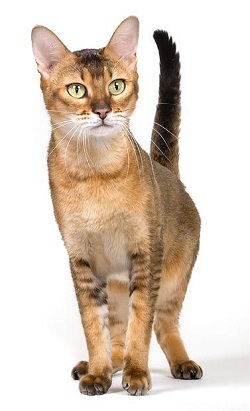
Chausies are bred to be a fairly large, medium boned breed with males typically weighing 15-25 pounds and females weighing 12-18 pounds. The Chausie is an expert at running and jumping and therefore has a sleek, athletic, elongated body and long legs. The body of the Chausie has is rectangular in shape, with a deep chest and fairly flat sides. The legs are moderately long with good musculature, and the hind legs are slightly longer than the front legs to facilitate jumping. The tail is long and strong, used for balance. Chausies have small, round feet in proportion to their body size, giving them a somewhat delicate appearance. The face is long, with angled, high-set cheekbones that serve to balance out their long muzzle. The ears are large and tall, set relatively close together on top of the head with a wide base. The ears have a slightly outward angle and have rounded tips, usually without hair tufts.
Coat and Coloration
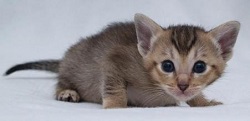 The Chausie has a medium to short double coat. The top coat is coarse while the undercoat is softer with a fine texture. The breed standard of the Chausie set by TICA allows for three coat colors: solid black, black grizzled tabby, and brown ticked tabby. The eyes also have three color possibilities: gold, hazel, or light green.
Solid black Chausies are often born with faint tabby markings as kittens, called ghost markings. As the cat matures, the coat develops a solid, dense, jet black appearance. However, if a solid black Chausie is exposed to strong sunlight, the black coat may fade and take on brownish hues.
Chausies that have a black grizzled tabby coloration are truly unique among domestic cat breeds. This coat pattern and coloration was acquired from the original Jungle Cats and is never seen on any other breed of domestic cat. Kittens that are black grizzled are born completely black, however, as they age a tabby coloration appears. This coloration evolves into a striking pattern of black on black tabby striping. The background color is a very dark brown nearly indistinguishable from black in some light while the stripes are pure black. To make these cats even more striking, often off-white, alternating bands of color appear on the background hairs. Unlike a typical ticked pattern, these bands of color appear only on the middle of each hair; the root being dark gray, white center and the tip being black. These unique patterns first appear on the belly, neck, chin and on the inside of the ears. As the cat ages, the pattern extends to the sides of the body to the spine. By three years of age, the ticking pattern may even extend over the back of the neck, down the legs and tail and even on the face.
The brown ticked tabby color varies in shading. The top coat can range from reddish-gold to sandy and even gray. Background color may be reddish gold, it may be a light golden brown, warm beige, cold beige, and even a very cool light gray with just a hint of brown in it. The soft, fine undercoat has three bands that make up a dark ticking pattern. The front legs have barring patterns along the upper and inner portions while the back legs have only faint or no barring pattern. The tabby markings are visible on the face and legs. The tail often shows black rings with a black tip. These Chausies may have coloring on the neck that make it look like they are wearing a necklace. Like the black grizzled coloration pattern, Chausies that are brown ticked do not develop their full coloration until they mature.
Although there are three color patterns that are accepted by TICA, many Chausies are still born with showing a variety of colors and patterns. In large part, this is due to the fact that the breed is relatively new and although these color patterns may not be accepted for competition, these Chausies still make wonderful pets.
| Advantages | Challenges |
| Curious, love exploring | May be illegal to own in some places |
| Social, develop strong bonds with owner | Require a great deal of exercise |
| Very intelligent | Nutritional needs are difficult to meet |
| Do well with dogs | |
| Few health concerns | |
| Requires little grooming |
Personality and Temperament:
Chausies are known to be intelligent, active, fun-loving, gregarious, and athletic cats. They are curious and fearless, but not aggressive, and they constantly seek to explore new environments. They are very active as kittens, constantly on the move and exploring their environment. Even the most active owners find that the addition of a Chausie kitten to a home significant increases a home’s activity level as these kittens appear to have ceaseless energy and enthusiasm. When they reach adulthood, many Chausies slow down, albeit relative to their level of activity as kittens, but they always retain their playful and inquisitive nature. Chausie owners often describe these cats as being intuitive, emotional, and steadfastly loyal. These qualities make the Chausie a wonderful addition to a home dedicated to their needs although caution should be mentioned as families that acquire a Chausie should be intent on keeping the cat for life as it is often difficult for Chausies to adapt to new environments if they are re-homed as adults.
Chausies love to play and are among the most athletic of the domestic cat breeds, perpetually on the move and insisting on intense interaction with their owners of caretakers. They must be given ample space to run and play in order to maintain optimal physical and mental health. Being very social by nature, Chausies develop very strong bonds with their owners, following them room to room and never straying far. The Chausie has a dog-like quality and readily learns to walk on a leash and play “fetch” with a favorite toy. These cats are fast runners and often will sprint from room to room with great exuberance. Beyond their natural athleticism, Chausies have a rare talent for jumping, and often becomes a favorite game between cat and owner. They are able to effortlessly leap to spectacular heights, and seem to enjoy this game more than any other cat breed.
The activity level of the Chausie is second only to its high level of intellect. This is not a breed satisfied by batting a toy endlessly, and often repetitive and predictable actives will bore any Chausie to tears. Chausies require both physical and mental stimulation to be happy, and owners must find games and activities that challenge their cat’s body and mind. Games that require problem solving and puzzles are a must for any Chausie and owners should endeavor to vary the games and activities provided. Due to their social needs and intelligence Chausies are not happy to be left alone for long periods of time. They will quickly become bored if left alone and may become destructive or depressed. A Chausie will do best with families that are home most of the time or have other, equally active, feline companions. Chausies do quite well with dogs too, if raised from kitten hood with the family dog.
Grooming and Upkeep:
The Chausie has an uncomplicated grooming requirement. Due to its short coat, the Chausie requires only to be brushed with a grooming comb once a week. However, many Chausies enjoy more frequent grooming as bonding time with their families. Bathing is recommended only once or twice per year. Nails should be trimmed every two weeks to prevent catching on furniture or cat trees and a scratching post should be provided.
Oral hygiene is important for the prevention of periodontal disease. While daily brushing of the teeth is ideal, brushing at least once per week will go a long way and benefit the Chausie by preventing tooth decay and gum disease. Owners should consider professional teeth cleaning at least once per year.
Exercise and Nutritional Needs:
Exercise Requirements
The Chausie’s exercise needs are considerable, but not impossible to meet if owners are dedicated and educated about the nature of this breed. The Chausie requires a minimum of 30 minutes of exercise on a daily basis. Keeping the Chausie’s exercise needs met entails a variety of interactive games, toys, and ideally some time spent outdoors. Owners should consider meeting these requirements a fun challenge, and always be on the lookout for new and exciting games to play with their Chausie. The addition of several cat trees of varying heights and cat walks placed strategically throughout the house are excellent ways to engage this active breed and fulfill their natural climbing and jumping tendencies.
Unlike many breeds that are best suited to indoor-only living, the Chausie is happiest when allowed to spend a significant amount of time outdoors. While Chausies should not be allowed free range, as along with their curious nature comes a strong tendency to wander, suitable outdoor accommodations can fairly easily be provided. A cat garden, which includes a large, completely fenced in area will allow the Chausie to play outside and stay safe. These areas should include climbing structures, elevated walkways, and the addition of cat-safe herbs, like catnip, all of which greatly increase the Chausie’s quality of life. Because the Chausie readily accepts a leash and harness, many owners find going for daily walks an effective way to spend time with their cats, fulfilling the Chausie’s need to move and explore their world.
Optimal Nutrition
The nutritional needs of a Chausie are slightly more complex than those of most domestic cats. Like all nondomestic hybrid source breeds, Chausies are often born with intestinal tracts that are shorter than most traditional domestic cats. The consequence of shorter intestinal tracts is that the ability to process plant-based foods, including cereals, vegetables, herbs and spices, is diminished. This inability can result in digestive difficulties and food allergies for Chausies that are given commercial pet foods including these ingredients. Therefore, care must be taken when considering appropriate foods to ensure the Chausie maintains optimal health and prevent illness.
Most Chausie owners and breeders find that their cats accept superior-quality commercial foods that contain no or minimal plant-derived ingredients. Very few commercial pet foods are able to provide dry cat food without plant-derived ingredients; however, there are some commercially available canned foods that meet this standard. “EVO – 95% meat canned cat food” is one such example.
Some Chausie owners and breeders elect to feed homemade raw or cooked meat diets and add vitamin and mineral supplements. It is not recommended that owners attempt to create these homemade diets unless they have been educated thoroughly about portion size, supplementation, prevention of contamination and the nutritional needs of felines. Meat alone does not contain all of the required nutrients a Chausie requires and adding vitamin and mineral supplementation without full understanding of the effects may result in unintended health problems. Feeding the Chausie any number of commercially available raw diets is likely the best way to meet the nutritional needs of this breed while minimizing the chances of health risk. Typically, raw diets are commercially available in either frozen or freeze dried forms, although there are some local pet stores that may offer fresh raw diets.
Health and Wellness:
 Overall, the Chausie is a healthy and robust breed with few noted health concerns. With relatively few inherited health issues and an active lifestyle, these cats live an average of 14 years. However, as mentioned above, the Chausie does have issues regarding digestion of many plant-based foods and therefore prevention of these issues associated with nutrition should be taken into consideration when choosing a Chausie. If digestive problems develop, the cause is likely an intolerance to gluten. The consequence of these digestive problems includes the development of diseases such as irritable bowel syndrome which is a chronic disorder. The symptoms of irritable bowel syndrome in cats include diarrhea, frequent passage of small amounts of feces and mucus, constipation, abdominal pain, vomiting, and abdominal bloating. Another issue that the Chausie may encounter involving food intolerance are associated with food allergies. Symptoms of food allergies are variable but often include persistent scratching, hair loss, dermatitis, discharge from eyes, diarrhea and vomiting.
Chausies should be taken for exams and vaccinations regularly and ideally to a veterinarian who is familiar with the breed and can answer specific questions regarding the unique needs of the Chausie. Regular vaccinations and de-worming treatments every 3-4 months is especially important for Chausies that spend time outdoors and is highly recommended.
Characteristics Unique to the Breed:
The Chausie’s athletic ability sets it apart in the cat world. Able to jump to incredible heights and play tirelessly for hours, this breed has a stamina and athletic prowess unmatched in the cat world. The intellect of the Chausie also aids in setting this cat breed apart and Chausies never seem to exhaust their curiosity and love for exploring their world, often surprising owners by demonstrating problem-solving skills and creativity.
Interesting Facts about the Chausie:
- Proper pronunciation of this breed is “chow-see”, taken from the original Jungle cat Latin name, chaus.
- The breeding of the Chausie means it is still considered a wildcat in some places and therefore it may be illegal to own this breed in some areas. Check with local and state laws before buying!
- Chausies can be highly opinionated, often demonstrating preferential treatment, whether toward toys or humans.
- Their new status and rarity as a breed makes them expensive! Prepare to spend from $1200-2500 for the highest quality breeding and color varieties.
- The Chausie has a shortened digestive tract, a testament to its wild origins, and must be fed specific foods to stay healthy.
- The Chausie is the only breed of domestic cat that has a grizzled black tabby coat pattern.