Welcome to our Bambino Cats page! Here you will find everything you could ever want to know about Bambino cats and a complete list of all the Bambino catteries we have located in the USA.
The Bambino is one of the newest and rarest cat breeds. The look and personality of the Bambino was deliberately created by breeding select Sphynx and Munchkin cats. This crossing resulted in a short, hairless cat.
Bambino Cat Breeders Near You

Bambino
- Are you a cat breeder who isn’t listed? Add your information here.
We also highly recommend checking out our latest news articles at our blog. Find information on cat health, nutrition, holistic healing, basic care, toys, and much more!
Bambino Cat Breed Information

Breed History and Origins:
The Sphynx cat is a hairless breed. Although considered hairless, this breed actually has a very fine, chamois-like coat. Hairless cats have been around for centuries; the Sphynx breed was officially developed as a collaborative effort during the 1960’s in both Europe and Canada. A random mutation in the genetic makeup of this breed is responsible for their hairlessness. They are a medium size, athletic, outgoing, curious, intelligent, and very affectionate.
The Munchkin cat is a breed characterized by their very short legs, caused by a random, naturally occurring genetic mutation. This breed has been documented since the 1940’s, although the breed seemed to disappear following World War II, re-emerging only again in the 1980’s. The Munchkin is far from hairless, and is known for their medium to long coat which is silky and very soft. This is a small breed, the largest males weighing up to 9 pounds, with smaller females weighing in at only 4 pounds.
The Bambino, an almost perfect mix representing the most unique characteristics of the Sphynx and Munchkin, owes its origin to Pat and Stephanie Osborne, who obtained a Munchkin/Sphynx crossbreed and fell in love with the personality and look of the cat. This cat became the inspiration for the couple to begin establishment of a new breed, and inspired them to the start a breeding program which ended with the foundation of the Bambino. Following extensive research on the health and viability of litters, the Bambino breed was officially recognized by The International Cat Association (TICA) in 2006.
The naming of the breed was chosen by Pat Osborne, who descended from Italy, and felt the look and personality of the cat deserved the name “Bambino” meaning “baby”. Pat’s naming proved quite accurate, as this breed maintains its kitten-like appearance and behavior throughout life.
Since the establishment of the breed and recognition by TICA, the Bambino has gained ground in terms of popularity. Although the breed is still in its infancy, there are several dedicated, knowledgeable breeders that can be found throughout the United States and Canada.
Size and Physical Characteristics:
Body Type
Although fairly diminutive in size, the Bambino’s is a medium-boned cat with a strong, muscular body. Bambinos typically weigh between 5-9 pounds, with males being slightly larger than females. They have a medium to long body, with a broad chest and round abdomen. The legs are strong and short, and the back legs tend to be slightly longer than the front legs. The Bambino has a strong, whip-like tail, and the length is well-proportioned to the body. Although normally devoid of hair, some Bambinos have what is referred to as a “lion tail,” which has a small tuft of hair on the tip.
The Bambino has large eyes that are almond-shaped, widely set and slightly slanted. They have a short muzzle that gives the head a square appearance. Like the Sphynx cat, the Bambino has high cheekbones and prominent whisker pads, although whiskers tend to be short and sparse. They have very large ears that stand upright, giving this breed an inquisitive appearance. The ears of kittens appear huge, and these cats grow into them as they age.
| Advantages | Challenges |
| Very adaptable | Must have sunscreen outside |
| People-friendly and sociable | Must be bathed relatively often |
| Very affectionate | Still sheds despite bare skin |
| Gets along well with other pets | |
| Gets along well with children of all ages |
Coat and coloration
The Bambino’s most recognizable attribute is its wrinkled, hairless coat. While from a distance they appear completely bald, many Bambinos have a fine, down-like covering. This can have the texture which has been described to feel like peach fuzz, suede, or velvet, although some Bambino’s are truly hairless in which case the skin has almost sticky or putty-like feel. Although no substantial amount of hair is present coat is present, the skin color of the Bambino determines the “color” of the cat. The Bambino comes in any and all color varieties. Common colors included patches of dark against a lighter background, pointed versions similar to the Siamese with color points on the nose, ears, feet, and tail, and dark-bodied with a white muzzle and paws. The eye color is also quite varied and any color is acceptable, although normally Bambinos have light-colored eyes, with blue being the most common.
Personality and Temperament:
 Along with their distinct physical appearance, great care has been taken in the development of this breed to emphasize and maintain their gentle and affectionate nature. These cats are very friendly, active, intelligent, and adaptable, making them great family companions and easygoing by nature. Bambino cats are described as being highly affectionate, and love to be cuddled, often found on laps of family members. Their friendly and gentle nature makes them easy to handle, a wonderful addition to a home that has children. Their loving and affectionate nature extends to all household members and this breed gets along well with dogs, cats, and small animals including hamsters, ferrets and even birds. Their high level of adaptability allows them to easily adjust to new environments and makes them good travel companions that are usually happy to accompany their family on vacation. Many owners appreciate that the Bambino is not an overly talkative breed, and do not meow excessively.
Despite their short legs, the Bambino is an athletic breed and can be quick and agile. They enjoy time spent with their families and happily engage their owners or caretakers in games. While the Bambino can be quite social, they are overly demanding or energetic and do not require intense physical playtime. Their easgoing nature makes the Bambino a breed that is always happy to play with family members, but they do not often initiate these games on their own.
Grooming and Upkeep:
The Bambino requires a very dedicated and knowledgeable family in order to maintain health when it comes to grooming and upkeep. Because the Bambino is hairless, this breed’s skin must be maintained or it becomes greasy and irritated. The Bambino should be given a bath every other week to avoid skin irritation and keep the natural oils secreted by the cats’ skin under control. If the Bambino is not properly bathed on a regular basis, he will become overly oily and leave stains where he rests. Over-bathing the Bambino can also lead to problems of dry skin and discomfort, therefore using non-irritating, fragrance-free, gentle soaps is a must for this breed. Finding the right frequency of bathing is essential to maintaining a happy, healthy Bambino. Using cat wipes in between bathings can help soothe skin and remove oils without drying. It is important to make sure Bambinos are introduced to water when they are young in a gentle, supportive fashion. While most Bambinos tolerate water and are quite content to be bathed, it is important to make the process pleasant and reduce stress as much as possible.
The ears and nail beds of the Bambino may be prone to oil buildup, therefore it is important to pay extra attention to these areas and ensure they are clean and do not become irritated. Trimming the nails on a regular basis will help keep nail beds healthy and should be done every other week. The inside of the ears can be wiped with a soft cloth to prevent wax buildup, but never use cotton swabs deep in the ears as this may lead to damage or hearing loss.
Like all hairless breeds, the Bambino is prone to sunburn and if outside, must be protected with gentle sunscreen. They are also somewhat intolerant of cold temperatures, lacking long hair to retain heat, and should be provided a cat sweater when weather is cold or rainy.
The Bambino’s bare skin may be deceiving when considering shedding and allergies. Bambinos do in fact shed quite heavily, and owners should be prepared to clean often as they tend to leave fuzz about the house. Despite being hairless, Bambinos are not hypoallergenic and individuals that are allergic to any cat breed with hair will likely be allergic to the Bambino as well. Allergies do not originate from the hair of cats, rather from the proteins shed by skin, dander, and saliva. While some people find they are less allergic to the Bambino than other breeds, this is likely due to the intense grooming and bathing schedule this breed requires, rather than an innate hypoallergenic nature.
Exercise and Nutritional Needs:
 Exercise Requirements
The Bambino does not require intense exercise. They are playful in nature, and maintain their kitten-like curiosity throughout life but are not demanding. While they do enjoy playing interactive games with their owners, this breed’s “laid back” personality means few play sessions a week will keep the Bambino happy. They are adept at climbing and enjoy cat trees and scratching posts. The Bambino is not very good at keeping warm, so having warm, covered cat beds around the house will keep this breed content.
Optimal Nutrition
Bambinos tend to require more calories and eat more frequently than cats of a similar size and activity level. This is because this breed has a higher metabolism because it requires extra work to maintain warmth compared to traditional cat breeds. Diets developed for high-energy cats are ideal for the Bambino. Ideal food for the Bambino should be high-quality and contain higher levels of fat and protein, while minimizing grains and fillers. When searching for a commercially available food that will be well-suited for the Bambino, owners should seek foods formulated for high-energy or active cats. Some of these foods include “Diamond Naturals – Active Cat,” “Blue Wilderness – Adult Red Meat,” and “Wellness – Complete Health Adult”. It is recommended that Bambinos be given dry food as opposed to canned, wet foods to prevent excessive tartar buildup which can lead to dental problems and gingivitis. However, the Bambino will greatly benefit from high-quality treats such as freeze-dried liver or beef which will contribute to keeping him healthy and happy. As with all cats, access to clean drinking water should be available at all times and water bowls should be made of stainless steel and cleaned on a daily basis.
Health and Wellness:
The Bambino is a new breed and still in development and thus there is limited information on long term health issues. However, overall, the Bambino is a healthy, hardy breed living an average of 12 years. It is recommended that the Bambino be kept as an “indoor cat”, as the inability to control temperature well put this breed at risk of becoming too cold in winter and getting burnt by the sun in warmer weather. While the Bambino enjoys time outside, this should be limited to excursions in which the Bambino can be supervised.
Health issues associated with dwarfism may become an issue for this breed, although they have not yet had time to surface. These may include joint problems like arthritis. These issues are best dealt with by prevention, and Bambinos should be kept at a healthy weight to minimize joint stress. Some Bambinos are born with legs that are bowed, and it is imperative that these cats maintain a healthy weight and are encouraged to exercise to maintain good muscle tone to support their joints. It is important that all Bambinos are regularly taken to a trusted veterinarian, ideally that is familiar with the breed, and that all vaccinations and health checks are kept up to date. This will ensure the cat maintains optimal health and wellness, and is protected from life-threatening diseases which are easily prevented by vaccination.
The best way to make sure you bring a healthy Bambino home is to find a reputable and knowledgeable breeder that is aware of the history of the Bambino and strives to improve this new, unique breed.
Characteristics Unique to the Breed:
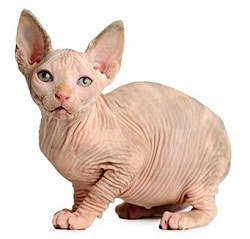 The Bambino is quite unique! A cross breed of Sphynx and Munchkin gave this breed a hairless, short-legged, wrinkled skin appearance. The word “bambino” is Italian for “baby,” and describes this breed perfectly, as Bambinos have a small size and kitten-like curiosity and sweetness throughout their lives. They are experts at cuddling and one may find it hard to find a more gentle and affectionate cat. Bambinos are one of the best breeds for families with children of all ages, and known to get along superbly with even the most active children. Their bare skin requires that they be given extra warmth in winter and lends an opportunity for owners to provide a creative assortment of sweaters and coats to help keep this cat warm year-round. They are extremely adaptable and welcome new environments readily, and they are docile and eager to please.
Interesting Facts about the Bambino:
- “Bambino” means “baby” in Italian, and is the name given by Pat Osborne, the founder of the breed.
- The Bambino was recognized as an official breed by TICA in 2006.
- The Bambino often has kittens with long legs and kittens with short legs.
- They can easily burn in the sun and require sunscreen when outside.
- The Bambino is one of the most gentle and affectionate cat breeds.
- This is a tiny cat. Some Bambinos tip the scale at a mere 4 pounds!
- Bambinos are expensive; expect to pay $2000 – 2500 for a kitten from a reputable breeder.