Welcome to our Asian Cats page! Here you will find everything you could ever want to know about Asian cats and a complete list of all the Asian catteries we have located in the USA.
Asian cats (sometimes called Malayans) are rare short-haired beauties. They were developed by British breeders through mixing of the Burmilla and the Burmese cats. They are athletic but elegant, and very friendly. They should be screened for dental and renal problems, but these cats are generally robust. Asian cats have no special nutrition requirements and should get plenty of exercise. They make great family pets for experienced cat owners.
Asian Cat Breeders Near You

Asian
- Are you a cat breeder who isn’t listed? Add your information here.
We also highly recommend reading checking out our latest news articles at our blog. Find information on cat health, nutrition, holistic healing, basic care, toys, and much more!
Asian Cat Breed Information
History and Origins:
The Asian group of pedigreed cats started in Britain accidentally in 1981 when a Chinchilla cat belonging to Baroness Miranda von Kirchberg escaped one day and bred with the neighbor’s lilac-colored Burmese.
The resulting litter of kittens had such beautiful silvery coats that the baroness developed a new cat based on them, calling it the Burmilla. She also bred some Burmillas back to Burmese cats in order to get the Malayan cat breed, with a variety of rich coat colors. Some of the new cats had the traditional Burmese colors. Others were darker or came with fur patterns that had never before been seen in the Burmese.
Since the breed name can be confused with that of a totally different cat – the Himalayan – Malayans are officially recognized by the UK’s Governing Council of the Cat Fancy (GCCF) as Asian cats. The Southern Africa Cat Council recognizes them as the Asian Shorthair, and that is also the name under which they are registered by the International Cat Association.
Size and Physical Characteristics:
| The Asian Cat | |
| Head: | Rounded wedge. Wide at cheekbones, tapers to firm chin. Large, wide-set eyes. |
| Fur: | Short, silky, dense. Comes in variety of self, smoke, or tabby colors/patterns. |
| Adult Weight: | Males: 7-10 pounds. Females: 6-8 pounds |
| Size/Shape: | Medium. Compact, muscular. Body like a Siamese, but sturdier. |
| Legs: | Slender, but well boned. Hind legs a little longer than forelegs. |
| Tail: | About two-thirds as long as body, thick, with a slight taper. |
| Voice: | Loud voice. Very vocal. |
Whether you call it an Asian cat or a Malayan, this is a plush-looking feline with a lithe, muscular build.
Head and body
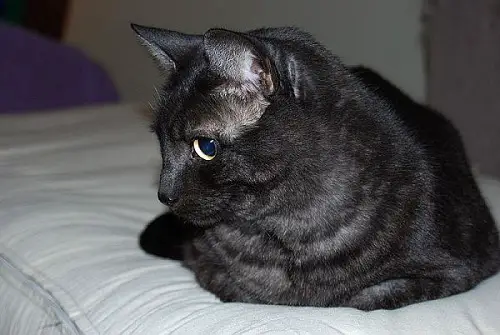
The Asian cat has a slightly longer, more rounded body than a Burmese. Its legs are sturdy and graceful. You can see the muscles ripple during exercise. Although the hind legs are a little longer than the forelegs, the back is straight. The Asian cat’s paws are oval and fairly large.
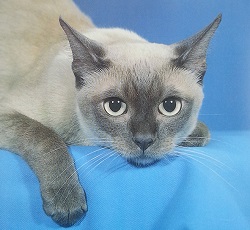
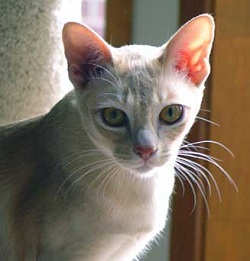
Asian cats have rounded heads that are widest around the eyes and taper down to a blunt muzzle with a sharp little chin. Their green to greenish-yellow eyes are large an set wide apart. An Asian kitten’s ears may seem too big for its body, but it will grow into them. On an adult, the ears are medium to large, fitting nicely into the lines of the cat’s head.
Velvety, colorful, short fur
Their layered fur gives Asian cats a velvety appearance. The top coat is glossy and very dense, but it lies close to the body. The undercoat isn’t thick, but it does lift up the top coat. Asian cat fur is just as silky as in the Burmese, but it can be a little longer, depending on the color.
The coat is what sets Asians apart from their Burmese cousins. Asian cats usually come in darker solid colors. Sometimes their fur is ticked, too. That is, it has bands of alternate colors on each hair. Asians can also have tabby stripes and spots. Purebred Burmese cats never have ticking or tabby marks.
Asian cats always have short hair. Long-haired Asian breeds have a variety of names, most commonly the Tiffany or the Chantilly.
Personality and Temperament:
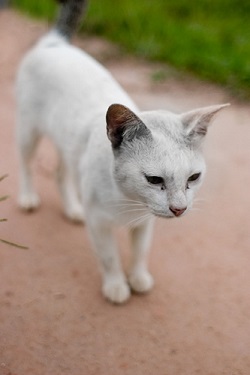 These beautiful cats are very affectionate and would rather be around people than on their own. They bond with entire families rather than just one or two people. Asian cats adapt quickly and socialize well with resident pets and strangers. However, they can be clingy as well as a little headstrong, so they probably aren’t the ideal pet for a first-time cat owner.
Loving, active companions
The Asian cat is very sociable. It also has inherited its Burmese ancestor’s “Velcro” nature. It follows you everywhere, even riding on your shoulder for a better view of the action! This interactive breed likes to exercise with you, and it also enjoys lots of cuddling and handling. It will sound off in a loud voice when it feels ignored.
Playfulness makes the friendly Asian cat a very good pet for children, with adult supervision, though Kitty will let everyone know when playtime is over by disengaging and walking away.
These cats will happily greet strangers at the door and then bask in all the attention as visitors praise their beauty and athletic good looks. They also get along well with dogs and other pets. However, they are smart enough to figure out how to open doors and also can to turn knobs and remove lids. If you keep fish or have other prey-sized pets that might trigger a cat’s hunting instinct, you should be sure to keep them protected with child-proof door locks. Aquarium tops should also be secure and child-proof.
Asian cats are curious and energetic. Their antics can be very entertaining, but they’re not hyper. After its workout, your cat will like nothing better than to settle down in your lap or next to you on the couch for a petting session and then a long snooze.
Clingy and a little stubborn
The Asian breed is never aloof and distant! Everyone enjoys the affection they get from these cats. However, even the most loving owners may sometimes want to get a break.
Kitty will get very lonely if left alone for very long. It will miss you during the work day and will expect lots of love and attention as soon as you walk in the door. Having other animals around helps, but this is one very people-centered breed. Fortunately, it’s very adaptable and loves to travel. Rather than staying at home with a sitter, your Asian cat might make a very good vacation companion.
It is important to train your Asian cat. Each of these cats has a mind of its own and will try to dominate the relationship. It isn’t hard to establish control with such an affectionate feline. It wants to please you and will appreciate the opportunity to spend extra time with you.
Still, the Asian breed of cats can be a handful for people who have never owned a cat before.
Grooming and Upkeep:
The coat of an Asian cat is incredibly beautiful. It’s also very easy to care for. Other than weekly brushing, your pet only needs routine care of its claws and teeth.
Grooming tips
Asian cats have very dense fur, but it is short and there isn’t much of an undercoat. All you need to do is brush the coat once a week to reduce shedding and prevent matting. Some owners use a chamois to keep the fur nice and glossy. If you do this, use pure chamois, not something that contains chemicals.
This cat’s ears are big enough to easily pick up dirt and irritants. Check them during the grooming session. If they are dirty or appear irritated, just wipe them out gently with a cotton ball that has been soaked in a cleaner that is safe for cats.
As short-hairs, Asian cats can handle bathing themselves. Unless you plan to show your cat, it isn’t necessary to wash it regularly. If it does get extra dirty, choose a bath time when the animal is feeling especially mellow. Brush the fur out first and then use lukewarm water and a cat-safe shampoo. Make sure there is a mat so the cat won’t slip and slide around. Warm towels are nice, and a hairdryer on a low setting is okay to use if your pet tolerates the noise.
It’s a good idea to trim the claws before you proceed with bathing, and this is something you will have to do routinely anyway.
Claws and teeth
Cats groom their own claws by scratching, but this doesn’t remove the entire dead nail. The claws also grow at a steady rate and can get ingrown. Your Asian cat’s nails should be trimmed every couple of weeks. This goes quickly when you’ve got the right tools and have had a little practice. Your veterinarian can show you how to do this safely and easily.
Don’t forget the teeth. Asian cats are among the purebreds that are most likely to get gingivitis. They need regular dental care. This can be done by a veterinarian, but it requires general anesthesia, which is always risky. If possible, try to clean the teeth at least once a week with a gauze-covered finger or with a pet toothbrush and cat toothpaste (never use toothpaste designed for humans). This shouldn’t be too difficult with an Asian cat, especially if it has been trained to accept your handling its mouth while it is young.
Nutritional and Exercise Needs:
 Dogs can eat just about anything, but cats are strict carnivores – they must have meat. Your Asian cat requires about twice as much protein in its diet as a dog would, along with the right balance of fats, carbohydrates and other nutrients. Watch Kitty’s serving size, though. That lovely muscle will turn to fat if your cat doesn’t get enough exercise.
A complete, balanced diet
Domestic cats have inherited from desert wildcats a metabolism that gets most of its energy from prey rather than from carbohydrates. This dependence on prey also builds in a need for taurine and certain fatty acids.
A serving of any commercial cat food that meets guidelines set by the Association of American Feed Officials will have just the right amount of protein and other nutrients to keep your Asian cat strong and healthy. Pet food manufacturers in the UK and the European Union also follow AAFCO standards. Just look for the statement on the package label.
This food can be either dry or canned. Most owners do some trial and error to see what works best for their Asian cat. If Kitty prefers a dry diet, then be sure to make plenty of fresh water available all the time.
Some Asian cats may need extra potassium in their diet. Since too much potassium is just as bad as too little, this is something you should talk about with your vet rather than trying to supply it yourself with supplements.
Exercise and health
The distant ancestors of Asian cats were working cats in the temples of Southeast Asia, but nowadays these rare pets are kept indoors for health and safety reasons and may not get enough exercise. Kitty can keep itself busy, but it also likes to lounge around and snuggle. This inactivity can lead to one of the most common health problems in modern domestic cats – obesity.
The Asian cat breed is surprisingly heavy for its size, but that weight should come from muscle and bone. If you can’t see muscles moving under the fur anymore, or if Kitty’s weight is more than 15 percent above average, then it’s time to take action. Just get out the toys a few more times and cut down the serving size each day, or simply lay off the treats. If all else fails, your vet can recommend a weight-reducing diet.
It is easy to exercise Asian cats, as they are naturally active and will enjoy spending time with you. Trigger their hunting instincts with whirling feathers, bell toys, catnip mice, and red laser dots. These intelligent animals also like puzzle toys, though if you’re trying to help Kitty lose weight, you may want to avoid the ones that dispense a treat.
Your chubby Asian cat might even enjoy the extra attention and social opportunities that come with organized cat agility tournaments. At these events, cats are sent through an obstacle course. Is it really possible to herd cats? Check it out and see!
Characteristics Unique to Asian Cats:
The colors and patterns of an Asian cat’s coat are the defining qualities of the breed. Cat fanciers really get into detail about it, but it’s not too hard to understand. Basically there are two genetic colorings – Burmese restriction and full expression – and three types of coat color and pattern.
Burmese restriction and full expression
Genetically speaking, a cat’s coat comes in four basic (or “self”) colors: black, red, chocolate, and cinnamon. The rainbow of coat colors we actually see around us comes from various modifications of those self colors.
Asian cats can have either the Burmese gene color restriction or full gene color expression. Sable brown, for instance, is a Burmese fur color, so an Asian cat with that color would be said to have the Burmese color restriction. Black, on the other hand, is the gene’s full expression. One of those gorgeous black Asian cats, therefore, is described by cat fanciers as having full expression.
Any purebred Asian cat will have either the Burmese restriction or full expression. However, its coat will also match one of three color pattern groups.
Asian Self, Asian Smoke, and Asian Tabby
Asian Selfs come in solid colors, though the Governing Council of the Cat Fancy also includes tortoiseshell (torties have two colors, neither of which is white). The basic requirement is that the color must go all the way down each shaft of hair. This group always shows full expression and comes in any of 17 colors.
Asian Smokes also come in self colors, but only on the tips of each hair. The lower half of each hair shaft is silver to white, giving these gorgeous kitties a shimmering appearance. Smokes may show either the Burmese color restriction or full expression.
Asian Tabbies can be any of the 17 self colors and either the Burmese restriction or full color expression. However, these beautiful felines also have an “M”-shaped dark fur pattern on the forehead and show one of the usual tabby patterns on their coats: spotted, classic, mackerel, or ticked tabby.
Health and Wellness:
 The Asian cat is a very healthy breed, but it needs a little health screening. As far as vaccinations go, Asians need the core shots and boosters that all domestic cats should have. Whether they need non-core vaccines depends on the individual cat’s circumstances.
The need for screening
The Burmese cat breed has some health issues associated with it, including:
- GM2 degenerative nerve disease (Tay-Sachs disease)
- Hypokalemia
- Kidney problems
- Congenital craniofacial defects (especially in contemporary US lines)
That’s a scary list, but none of these problems is very common in Burmese cats or the breeds, like Asians, that have been derived from the Burmese. It’s just something to be aware of when you purchase an Asian cat, especially if you plan to register it. Britain’s Governing Council of the Cat Fancy requires hypokalemia certificates of health for registration.
There are tests for all these diseases. Reputable breeders will screen each pair before letting them breed and provide a health certificate for an Asian kitten. Later in the animal’s life, your veterinarian may want to do an ultrasound and other lab tests on Kitty during one of its routine health visits.
Immunizations
Kittens are protected from most communicable diseases by antibodies in their mother’s milk during the first few weeks of life. After that, they need to be vaccinated.
This involves an initial series of core vaccinations against feline distemper (also called enteritis or parvovirus) and two types of severe upper respiratory infection (FHV-1 and FCV). After the series is given, Kitty just needs boosters once a year or once every three years, depending on the vaccine.
The United Kingdom is currently free of rabies, so this vaccine is not required there. However, it is considered a core requirement in places where rabies exists, including the United States. If you will be traveling with Kitty, be sure to check the rules before you go.
Other cat vaccines are optional, depending on your cat’s lifestyle or whether it will be bred. For example, if Kitty goes outdoors or is exposed to other cats, then it should get the feline leukemia vaccine. Check with your vet to see if your cat needs any of these non-core immunizations.
Interesting Facts About Asian Cats:
- Besides the Asian breed, the Asian cat group includes Burmillas, Tiffanies, and Bombays.
- Asian cats were the first UK purebreds to have good temperament included as a judging standard.
- Most Asian tabbies have the ticked pattern, simply because all Burmese cats in the UK, where the Asian breed developed, have the gene for this pattern. Breeders have had success bringing the spotted tabby and classic tabby patterns into the Asian cat breed, but they are still working to get more kitties with the mackerel tabby pattern.