Welcome to our American Curl Cats page! Here you will find everything you could ever want to know about American Curl cats and a complete list of all the American Curl catteries we have located in the USA.
The inception of the American Curl was only recently, in the early 1980’s, but the breed has found widespread popularity. Their signature curled ears and their affectionate nature have won the hearts of cat lovers everywhere.
American Curl Breeders Near You

American Curl
- Are you a cat breeder who isn’t listed? Add your information here.
We also highly recommend reading checking out our latest news articles at our blog. Find information on Cat health, nutrition, holistic healing, basic care, toys, and much more!
American Curl Cat Breed Information
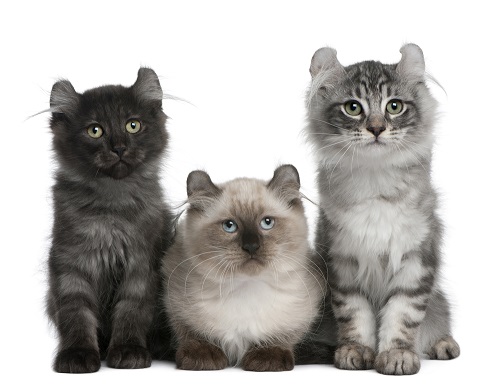
General Information:
Height/Length: 18-20 in.
Weight: 5-8 lbs. (female), 7-10 lbs. (male)
Life Span: 15+ years
Coloring: Any
Area of Origin: Lakewood, California, United States
Similar Breeds: American Shorthair, Scottish Fold, Oriental
Breed History and Origins:
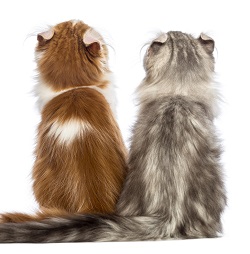 On a hot June day in 1981, Joe and Grace Ruga saw a pair of stray kittens outside of their home in Lakewood, California. These kittens had a unique characteristic—their ears curled back towards their heads! These strange ears were not the result of interbreeding with Scottish Folds, since the Folds’ ears are constructed completely differently.
The Rugas began feeding the kittens and named them Panda and Shulamith. Unfortunately, Panda was killed shortly afterward in an accident, but the black-furred Shulamith moved in with the Rugas. Interested in reproducing the cat’s interestingly curled ears, the Rugas bred her to random-bred cats. Many of her kittens also had her curled ears, and so they became the foundations of the American Curl breed. Grace Ruga gave one of the kittens, named Mercedes, to her sister, and Mercedes’ curl-eared litter caught the attention of local cat fancier Nancy Kiester.
The American Curl was created largely from domestic shorthairs and longhairs that were bred with the curl-eared descendants of Shulamith. Scientists have since confirmed that the American Curl’s unique ears are the result of an autosomal dominant mutation, which means that any cat that carries the gene will have the curled ears.
The curious breed grew in popularity with cat fanciers after Grace Ruga and Nancy Kiester teamed up to exhibit the first American Curl in 1983. Only four years later, The International Cat Association granted the breed championship status, followed by the Cat Fancier’s Association in 1993. According to the Cat Fancier’s Association’s standard, American Curls can only be outcrossed to domestic breeds born before January 1, 2015. This restriction will allow the breed to further stabilize.
Size and Physical Characteristics:
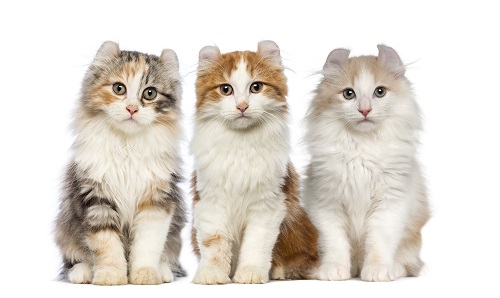
The American Curl has a generally sophisticated and swept-back appearance, with its curled ears and prominent “furnishings,” or large tufts of fur at the base of the ears. They are small-to-medium sized cats that with a build that is well-proportioned. The American Curl has a “semi-foreign” body type, meaning that it is slightly more thickset than a breed such as the Siamese or Oriental. They have long bodies—their length should be about one and a half times their height—and have moderate musculature. Flexibility is more important in this breed than strength. The Curl’s tail is long—about the same length as its body—and it begins with a wide base that tapers to a rounded tip.
The curled ears should bend smoothly back anywhere between 90 and 180 degrees from the head. They are set evenly apart on the head and, when alert, the tips of the ears should point to the center of the base of the skull. Unlike the Scottish Fold’s ears, which are the result of a cartilage deficiency, the American Curl’s ears are made of very firm cartilage, often making them stiffer than most cats’ ears. Kittens are born with straight ears, but they begin curling within a week of their birth. As the kittens grow, the ear changes, settling into its final curl by about five months of age.
As a result of their domestic breed background, American Curls come in two varieties: longhaired and shorthaired. Both varieties can come in a wide range of colors and patterns. Longhaired cats have fine, silky fur. The light undercoat means that the longhaired Curl’s fur lies flat against its body, but their plumed tails are reminiscent of luxurious boas waving behind their bodies. Shorthaired Curls have a similarly sleek coat, but, of course, much shorter and lacking the dense pile that some other shorthaired breeds might have.
Personality and Temperament:
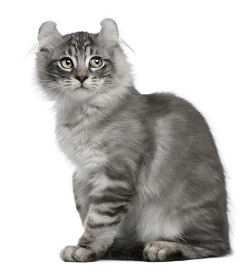 American Curls are definitely people cats. They are eager to insert themselves into every aspect of their humans’ lives, whether that be a quiet night watching TV or a busy day in the kitchen. Although Curls love to jump on shoulders and pat at their human’s faces, they are not as insistent as other breeds in their need for attention. Rather, these are demonstrations of their affectionate natures. These cats are not usually very vocal, but they will express their desires for food, affection, or attention through gentle trilling noises.
These are fairly active cats, and are great companions for children—as long as they know how to handle a cat gently. The American Curl is, in fact, a wonderful addition to any family, including first-time cat owners and families that already include a pet or two. They enjoy a variety of games, including fetch, and will remain playful well into old age. They are known as the “Peter-Pan” cat for their tendency to continue acting like kittens even into adulthood. When they are not enjoying a boisterous game, you can usually find an American Curl perched on a high place or somebody’s lap.
Nutritional and Exercise Needs:
This breed is not a terribly picky eater, and is not particularly prone to overeating. Still it is important to avoid obesity by only giving your cat food at mealtimes and keeping its body moving. The American Curl is an easy cat to keep exercised. Indeed, with their kitten-like demeanor, owners may find that they do not have to put any effort into keeping their “Peter Pan” active. Mouse toys, cat trees, games of “fetch,” and puzzle toys will keep a Curl engaged, happy, and active.
| Advantages | Challenges |
| Great with children | Will follow you from room to room |
| Active into old age | Require special care for cleaning ears |
| Love being with people | Can be more vocal than other breeds |
| Overall very healthy breed | |
| Not prone to overeating | |
| Grooming for shorthaired variety is simple |
Grooming and Upkeep:
Grooming for a shorthaired American Curl is very simple. These cats rarely require more than usual maintenance—that is, a weekly brushing to make sure that its undercoat remains in good shape. The longhaired variety, however, should have more frequent brushings to prevent matting or tangles in its longer fur.
Cat owners should make sure to keep their cats’ ears cleaned out, teeth cleaned at least once a week, and their claws trimmed every two weeks. To put a cat at ease with all of these procedures, it is best to start the process when it is young. Cleaning an American Curl’s ears requires special care—to prevent breaking the hard cartilage, do not force the ear to bend or fold. Although most breeds require regular ear cleaning, you should wait until the Curl’s ears are dirty before cleaning them.
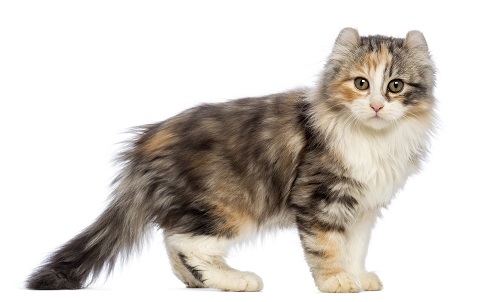 Characteristics unique to the breed:
The most clearly unique characteristic of this breed is its ears. These ears are not a defect, and do not affect the cat’s health in any way. These ears are already being passed into new breeds like the Kinkalow and Highlander.
Although several other breeds, like the Ragdoll or the Scottish Fold, can also trace their ancestry back to random-bred cats, few breeds have had such a meteoric rise as the American Curl. There were only six years between the discovery of the first cat with curled ears and the breed’s international recognition.
 Health and Wellness:
Due to its frequent outcrossings to hardy domestic breeds, the American Curl is an incredibly healthy cat. A yearly wellness checkup at the vet should suffice to make sure that your Curl is still in tip-top shape. Of course, since this is a long-lived breed (living for 15 years or more), an older cat ought to have more frequent trips to the vet.
American Curl kittens do not yet have their ears set. It is important to avoid bending or playing with a kitten’s ears before it reaches five months of age, or you risk damaging the Curl’s ears. Some lines are born with narrow ear canals, which leads to rapid wax buildup and infections. With frequent cleaning, these problems can be mitigated. Despite this, the American Curl’s unique ear structure is not an indicator of skeletal problems, as it is in the Scottish Fold.
3 Interesting Facts about the American Curl:
- The progenitor of all American Curls, Shulamith, was named a Hebrew name that means “peace.” When she chose the name, however, Grace Ruga thought that the name meant “black and comely,” much like the new addition to her household. Indeed, Shulamith is also the name of the beautiful black woman written of in the Song of Solomon.
- Not all American Curls are born with curled ears! The cats born without the curl-eared gene still make excellent pets. They keep the same body and boisterous personality as other American Curls, but only lack the characteristic ears. Many breeders will sell these at a discounted price, but may place breeding restrictions on their pedigrees.
- The American Curl was the first breed with two acceptable coat lengths granted Championship status by the CFA.
Sources:
http://www.cfainc.org/Breeds/BreedsKthruR/Ragdoll.aspx
http://cattime.com/cat-breeds/american-curl-cats#care
https://www.petfinder.com/cat-breeds/American-Curl
http://www.petmd.com/cat/breeds/c_ct_american_curl
http://www.vetstreet.com/cats/american-curl
http://www.iams.com/pet-health/cat-breeds/american-curl
http://www.catster.com/cat-breeds/American_Curl
http://cats.animal-world.com/Cat-Mutations/AmericanCurlCat.php