Welcome to our Abyssinian Cats page! Here you will find everything you could ever want to know about Abyssinian cats and a complete list of all the Abyssinian catteries we have located in the USA.
Abyssinians are highly active and playful cats, and they require owners that can satisfy their activity needs. The cats belonging to this breed are known for their intelligence, affection towards their owners and curiousity.
Find Abyssinian breeders near you!

Abyssinian
- Are you a cat breeder who isn’t listed? Add your information here.
We also highly recommend reading checking out our latest news articles at our blog. Find information on Cat health, nutrition, holistic healing, basic care, toys, and much more!
Abyssinian Cat Breed Information
General Information:
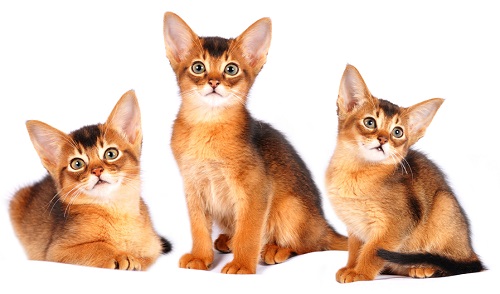
Height/Length: The Abyssinians are medium sized cats, their adult height usually being situated somewhere between 8 and 10 inches. The cats from this breed will reach most of their adult height by 6 months, and they will reach their full size at approximately one year old.
Weight: Cats belonging to this breed can weigh between 6 and 10 pounds, being considered medium sized cats.
Lifespan: The regular life span of the Abyssinians is between 9 and 15 years; however, as long as they are kept in proper conditions and fed properly, they can exceed the maximum age of 15 years.
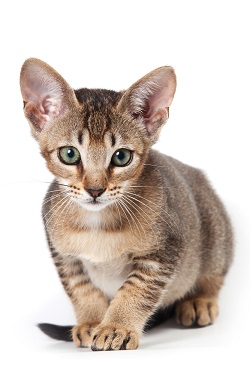 Coloring: Abyssinians have some of the most diverse colorings out of all cat breeds. The main reason for all this diversity when it comes to coat coloring is due to the various crosses that were made between the Abyssinian and other cats back when the breed was first established. There are various colors accepted by the breed’s standards based on the following criteria: overall appearance, ticking color, paw pads, base hair, and nose leather.
- Usual: The first and most common of colors is the usual color, which has the overall appearance of a rich golden brown ticked with black; the ticking color and the paw pads are always black while the base hair can be apricot or ruddy orange. The nose leather must be brick red.
- Sorrel: This coloring has the overall appearance of shiny copper with some chocolate markings. The nose leather and paw pads must be pink, while the base hair is always bright apricot. The ticking color is, just like the markings, chocolate.
- Blue: The overall appearance of the blue coloring is light blue ticked with darker blue-gray. The paw pads have maintain the same blue coloring, being mauve-blue, and the ticking color must be blue-gray. The nose leather is a dark pink, different from the overall coloring of this cat.
- Fawn: The fawn coloring in Abyssinian cats has the overall appearance of light fawn ticked with darker fawn. While the ticking color is also fawn, the base hair of these cats is cream that has small tendencies towards fawn. The paw pads and the nose leather are always pink.
- Usual Silver: base hair of this coloring is silvery white, while the overall appearance is rich silver with black ticking. The paw pads must be black for the cats with this coloring, while the nose leather needs to be brick red.
- Sorrel Silver: The overall appearance of the sorrel silver coloring is silvery peach with chocolate markings. The base hair is silvery white, and the ticking color must always be chocolate. The only acceptable color for the nose leather and paw pads is pink.
- Blue Silver: This coloring has a distinctive pigment on the paw pads, all of them being a mauve-blue color. The overall appearance is blue-gray silver, and the ticking color is a dark blue-gray. The base hair must be silvery white, while the nose leather is a very intense pink.
- Fawn Silver: With silvery white base hair and a fawn ticking color, the overall appearance of this coloration is a silvery fawn that also has some fawn markings. Both the nose leather and the paw pads must be pink.
- Chocolate: This is one of the most distinctive colorings of the Abyssinian, the fur appearing as dark copper with dark chocolate markings. The base hair is apricot, the ticking color is dark chocolate. While the paw pads are a simple, chocolate color, the nose leather is a more pinkish chocolate.
- Lilac: This coloring gives the appearance of a pinkish gray that has deeper, darker gray influences. While the base hair is of a pinkish cream color, the ticking color is of a darker gray, giving the overall appearance mentioned above. Both the nose leather and the paw pads are the same, a very dark pink, almost mauve.
Area of Origin: The Abyssinian or Aby (as they are called by fans throughout the world), is a cat breed that has generated lots of myths and theories regarding its origin. During the Victorian age in England, showing cats became one of the most interesting and popular activities for the aristocracy. During the 1871 Crystal Palace Cat Show, an Abyssinian took the third place in the competition. The cat from this cat show was presented as being “captured in the late Abyssinian War”. On the 27th of January, 1872, Harper’s Weekly wrote a report on the 1871 Crystal Palace Cat Show, in which the Abyssinian is mentioned and which has become the first known reference of this breed in any publication. There are no clear records regarding the breed’s origins; however, plenty of myths and theories have risen through the years. One of the most popular stories is that this breed was the cat of the pharaohs. Another theory about the Abyssinian’s origin is that this breed was created by crossing brown and silver tabbies with different types of cats that had only “ticked” coats. Recent evidence based on genetic testing has proven that this breed originates from the coastal regions of the Indian Ocean, as well as parts of Southeast Asia. This means that the breed was brought to Europe by British and Dutch traders, which used to frequent the ports in the areas mentioned above. The name of the breed probably came from Zula, the Abyssinian that was exhibited at the 1871 Crystal Palace Cat Show, which is said to have been imported from Abyssinia, current day Ethiopia. This breed was first brought to the United States of America in 1900; however, Abyssinian breeding was only taken seriously during the 1930s, after more cats were brought from Great Britain. The Second World War was devastating to the Abyssinian breed in England, with only a few cats surviving the war. However, after the war ended, the breed recovered due to imports from the United States, and it has become one of the most popular breeds in Britain.
Similar Breeds: There are two cat breeds which are most similar to the Abyssinian: the Nebelung and the Javanese.
Breed History and Origins:
The history of this breed includes certain controversies, since some people believe that Abyssinians are the cats found in Egyptian paintings and sculptures, due to the physical resemblance between them. However, there is no evidence to suggest that the cats from Ancient Egypt are the same as the Abyssinian breed. Even if the first recorded Abyssinian cat, the one from the 1871 cat show, came to Britain from Abyssinia (current day Ethiopia), it was proven that the breed did not originate there. Based on recent genetic evidence, the Abyssinian cat most likely originates from the coastal regions of the Indian Ocean, as well as parts of Southeast Asia.
Size and Physical Characteristics:
The adult height of an Abyssinian cat is usually 8-10 inches, and they are considered medium-sized cats. Their adult height is reached at approximately 6 months of age, while their adult length and full size is reached a little after the cat reaches one year old. The adult weight of the Abyssinian is somewhere between 6 and 10 pounds.
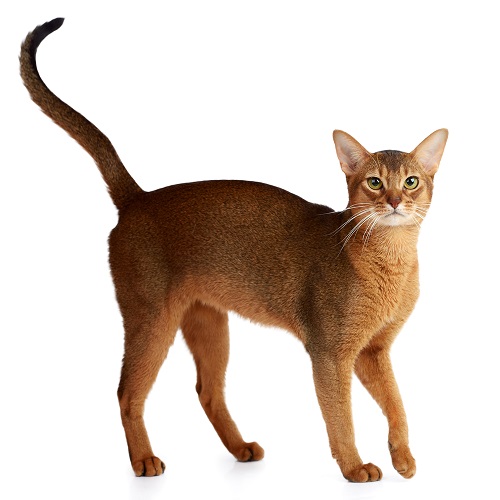
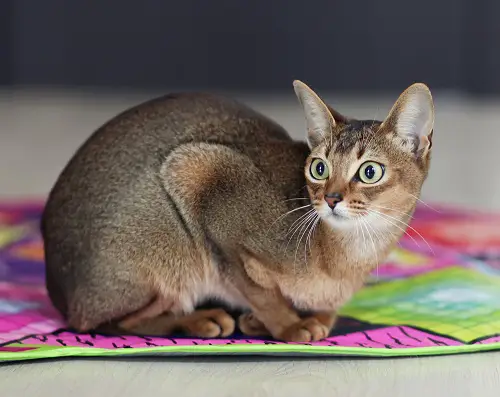
The size of Abyssinian appears to be enhanced by their tall ears which are held up high. They always seem to be on alert, with an inquisitive appearance. Their appearance is given by the color of their eyes, which includes different shades of green, gold, and copper. The fur of Abyssinian cats is of a medium length, but quite dense and of a silky texture, which has a great effect over the overall aspect of the cat, improving the Aby’s sleekness. Cats of this breed are very well proportioned, with small paws, long, slim legs, and plenty of muscle.
Personality and Temperament:
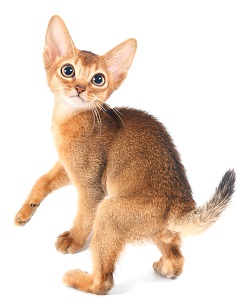 The Abyssinian is a highly energetic breed, which is perfect for families that have children. They are proud, but as long as they are treated with respect, they can get along with any member of your family, and even with other pets. Abyssinians can easily befriend dogs, as long as the dog behaves politely with the cat, and doesn’t try to push things further then they should be pushed. Cats belonging to this breed will get along great with school-age children, since they are the only ones that can match the cat’s enthusiasm and playfulness.
Nutritional and Exercise Needs:
This breed is known for being extremely intelligent and playful, and these two characteristics have made the breed very popular. Their playful personality should not be taken lightly by owners, because there are studies which theorize that the cats of this breed will become depressed if they are not exercised properly and if they don’t receive the required attention from their owners. Even if the Abyssinians are widely known for being very playful, they are quiet cats and shy when surrounded by strangers.
The Aby has no special nutritional needs; all you need to provide is a balanced diet that includes all the regular vitamins and nutrients needed by a cat of this size. Of course you can also choose premium dry food, which already includes a balanced diet for your cat.
Grooming and Upkeep:
The coat of the Aby requires no special care; a simple weekly combing is enough to keep the fur fresh. During the shedding period, a bath is recommended in order to make sure that you are removing all the dead hairs properly.
Other tips about an Aby’s hygiene are daily teeth brushing in order to make sure that the cat does not get any periodontal diseases (however, if you are unable to brush the cat’s teeth daily, at least once a week should do the trick); the nails need to be trimmed once every few weeks; the eyes of the Aby must be kept constantly clean with a soft, clean piece of cloth in order to remove any type of discharge from the cat’s eyes (use different parts of the cloth on each eye, in order to prevent the spreading of any possible eye infections); the ears must be checked weekly and if they are found to be dirty, they must be cleaned with a piece of cloth moistened in a mixture created from vinegar and warm water, these two ingredients in equal parts.
The litter box must be kept constantly clean because any type of residue found in the box can make the cat find other places in the house to resolve their bathroom needs.
The Abyssinian is a cat that can stay outside the house, since they are not extremely sensitive to changes in temperature. However, it is recommended to keep the cats inside the house because outside they run the risk of contracting diseases spread by some other already sick cats, they can be attacked by dogs or even coyotes, or they can even be stolen by people who recognize the breed and wish to sell the cat.
Characteristics Unique to the Breed:
| Advantages | Challenges |
| Highly intelligent | Highly energetic |
| Good with children | Prone to periodontal diseases |
| Very playful | May become depressed if not exercised enough |
| Good with dogs | |
| Not much grooming required | |
| Very playful |
This breed has a reputation of looking as if it came from the wild. This reputation has risen because the fur of this cat has a ticked pattern, which makes the Abyssinian look like a wild cat, or even a cougar. The ticked coat means that the fur has both light and dark shades of the same color on each of the hair shafts on the Abyssinian’s body. All the Aby does suggests that this is an active, gracious cat. The body of this cat is quite graceful and it is covered with muscles. It is not as stocky as the Persian, and it is also not as svelte as the Siamese. The Abyssinian is a cat that simply said, looks good. Most Aby owners say that these cats appear to be walking silently, constantly on the lookout and scouring for prey.
Health and Wellness:
This breed is susceptible to gingivitis, and that aspect can easily lead to periodontitis, which means that the Abyssinian’s dental hygiene is extremely important. Also, Abyssinians have been known to have renal amyloidosis, also called AA amyloidosis, which is a kidney disease that is caused by a mutation of the protein gene called AA amyloid.
One of the most common health problems of this breed, which was encountered in over 45% of all cats belonging to this breed, was blindness caused by a hereditary mutation found in the rdAc gene. This health problem has been overcome, the prevalence of the disease being currently at less than 4%. Since there is a very simple detection test that can be performed on all cats of this breed in order to see if they have the rdAc mutation, it is quite easy to presume that this hereditary mutation should be entirely extinct in all future specimens of this breed.
6 Interesting Facts about the Abyssinian:
- Jake from the 1978 movie “The Cat from Outer Space” is an Abyssinian.
- The 7th episode of the 4th season of CSI includes Isis, a beautiful blue Abyssinian, as one of the most significant clues required to solve the case.
- One of the most famous BBC Broadcasters, Desmond Carrington, is known to own an Abyssinian cat which he named Sam, and which he always mentions in his radio broadcasts.
- The familiar Abby, a character from Michele Hauf’s book “The Highwayman”, can transform into a rust-colored Abyssinian cat.